Not much prepping coverage today; it’s all bees, but a good article for anyone who is a new beekeeper or might become one. Oh, I did things this past week like mow the lawn, but I also built 60 frames for my beehives and constructed a new hive stand. Most of what I did was work in the beehives.
This is peak season for beehive growth around here, and how well the hives do now will impact how much honey they produce later this year. So I worked the bees Saturday the 19th, again on Thursday, and will be back in them mid-week. I also helped a new beekeeper on Sunday. He did not know how to inspect his hives, so I did one inspection while he watched and then let him do the next. It was a good thing, as he had several uncapped queen cells that would have led to a swarm if we had not found and removed them.
I am working with two new beekeepers this year, and it’s a reminder of what you have to learn as a new beekeeper. If you are thinking of becoming a beekeeper (which I encourage), here’s what you have to do once you place an order for bees.
Overcoming the Fear
Since childhood, we’ve been taught to fear bees, yellow jackets, wasps, hornets, and other stinging or biting insects, like horseflies. And then, one day, you find yourself seeking them out, pulling the roof off their homes, and having dozens fly out at you and buzz around your head. It can be intimidating. They can also be loud; I have met people who fear the buzzing. Better to learn to differentiate a happy buzz from an angry one.
Besides repeat exposure, the easiest way to overcome your fear is to trust your equipment. If you are wearing a bee suit with a veil and a good pair of gloves, the odds of getting stung go way down. While you can get stung through your equipment—especially your gloves—the stinger barely scratches your skin and the sting is mild. About once a year, a bee or two crawls up my pant leg and stings me behind the knee. This year one got me on my shinbone, just above my sock. If that’s a fear, tuck your pants inside your boots or tie rubber bands around your ankles to keep the bees out. I no longer worry about stings. They are brief annoyances, but I remember being a new-bee (that’s what we call new beekeepers) and I hated getting stung.
With time and experience, not only do beekeepers build up resistance to their venom, we learn to understand the bees, recognize their behavior, and determine the level of personal protection to wear based on that assessment. I know beekeepers who don’t wear gloves, but I have also seen them put them on when the bees are in a bad mood.
Reading a Frame
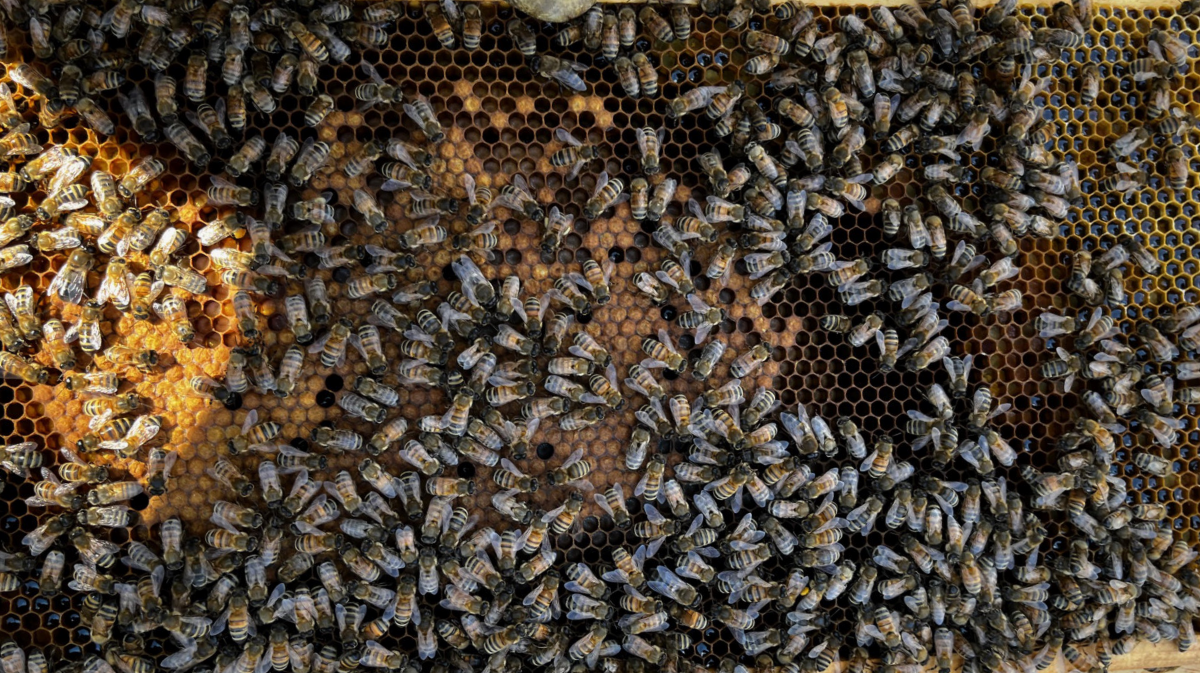
One of the most important things a new beekeeper needs to learn is to understand what they are looking at when they pull a frame of bees out of their hive. It’s critical because only after you know what you are seeing can you make an assessment of what it means and what, if anything, you need to do. That’s the difference between a beekeeper and a bee-haver.
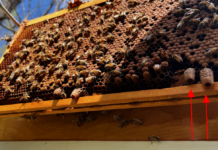
Beehives tend to have brood frames in the center of the hive, with food frames (pollen and honey) next to them and frames of capped honey near the hive walls. An experienced beekeeper can usually tell what frame is what as soon as they look at the open hive, without even pulling out the frame. This time of year, however, it is important to examine your brood frames to look for queen cups or queen cells because spotting these and knowing what to do will help keep your hives from swarming.
A novice beekeeper must learn to safely remove and handle a frame of bees. They should be able to identify the eggs, larva, and capped brood, recognizing the approximate age of the larva and capped brood. (Watching YouTube can help.) If they know the lifecycle of a bee, they can use this knowledge to predict when the hive will get crowded and when the population of foragers will peak. If they are an experienced beekeeper, they can manipulate this to ensure the forager population peaks at the same time as the honey flow.
This is why I remove resources from strong hives and give them to small ones. I am trying to keep the big hives from peaking too soon and prevent the weak hive from peaking too late, or not at all.
When does the Honey Flow Start?
A new beekeeper has to know when the honey flow starts. Every geographic area has that at different times of year. (We have two.) During a honey flow, bees make the bulk of their honey, and the crop they visit also varies based on what is growing there. For example, the Appalachians are known for producing sourwood honey (honey made from the nectar of the blossoms on a sourwood tree), but I live at too high an elevation to make sourwood honey.
If I rely on what a beekeeper 1,500 feet below me does, I’ll be wrong. My honey harvest is likely to be later and based on different plants. But if I pay attention to what is happening 500 feet below me, I can get a couple of days’ notice before the tulip poplar, for example, starts to bloom up here on the mountain.
Knowing which trees create a good crop of honey and when is like knowing when to plant your garden; you can get a general idea by reading books, but it pays to experience it yourself, and the more years, the better. And since this is our sixth summer here, I can tell what is happening in the beeyard by looking out my window at what is blooming on the mountain. Is it wild cherry? Locust? Chinese Knotweed?
Bees are funny. You can see a tree full of blooms and they will ignore it. Why? Possibly because the blossom is shaped wrong and they can’t access the pollen or nectar. Or, maybe they are working on another plant that has more nectar, and they’ll swing by the other tree in a week when what they are working on dries up. An experienced beekeeper can make predictions, but they can also be wrong.
More Hives
After visiting my bee yard at the lower elevation, I made two tiny nucs (a kind of starter hive) using fresh eggs and very young larva in hopes the hives will raise a new queen. That gives me 14 hives and two nucs that may become hives.
Hence the reason for building a new hive stand—I am running out of room.
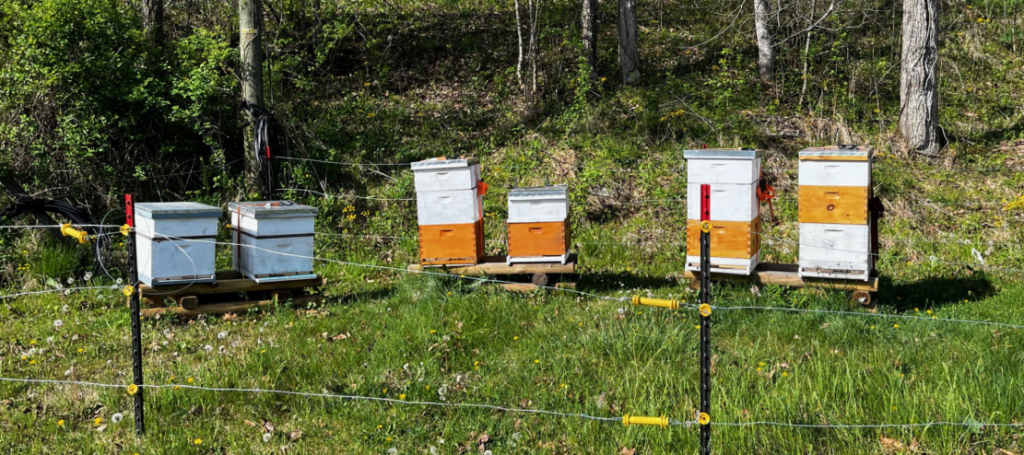
I mentioned above that I am building new frames. This is because with more hives, I will need more supers. (I already built 10 new supers. Now I need 90 new frames.) I take an existing super with nine frames of drawn comb and replace three of them with new frames. This gives the bees a place to store honey during the flow and encourages them to draw out the new frames. I take the three frames I pulled out of old supers, add three new ones, and then I have enough for a new super. So I am sharing frames from two old supers with new frames to produce three supers full of a two-to-one mix of old and new frames. It’s a process I have developed over the years, and it works well for me.
In another week or two, the bees will be loading the supers with honey. I expect we’ll harvest in the first half of June, and then things will slow down on the beekeeping front and I’ll write more prepping articles.