
I lost $200 worth of honeybees on Thursday. At least that’s how I look at it. A swarm of bees got away, and since a nucleus hive costs $200, that’s like losing $200 worth of bees.
At the same time, I gained $400 worth of bees by splitting two hives, or producing $400 worth of bees. Again, that’s how I look at it. You could argue that I didn’t pay anything for these bees, so nothing was gained or lost. I look at the opportunity cost. Since I can sell a nuc for $200, it’s a potential loss.
Let me explain and give you more details.
Swarm Alert
After 8 p.m. on Wednesday, the property owner where I have my off-site bee yard called to tell me there was a swarm of bees in the trees behind my beehives. That’s never a good sign because, in my opinion, if a beekeeper is careful and attentive, their hives should not swarm. In my six years of beekeeping up on the mountain, I’ve only had one hive swarm, until now.
On Thursday morning, I loaded my truck with equipment. A ladder to reach the bees. An extendable branch cutter in case I need to cut them out of the tree. A bucket to catch the bees if I can shake them out of the tree. And my normal gear, like a smoker, hive tools, bee suit, gloves, a gallon of syrup to feed a new hive, and enough wooden ware to make two more hives. Just in case. And since the hives were growing, I grabbed two medium supers. I didn’t think I’d need them this early in the season, but “be prepared” is kind of my mantra.
I get there, and the swarm of bees is gone. Bummer. $200 worth of honeybees flew away and are literally “holed up” in a hollow tree or someone’s outbuilding.
Why do Bees Swarm?
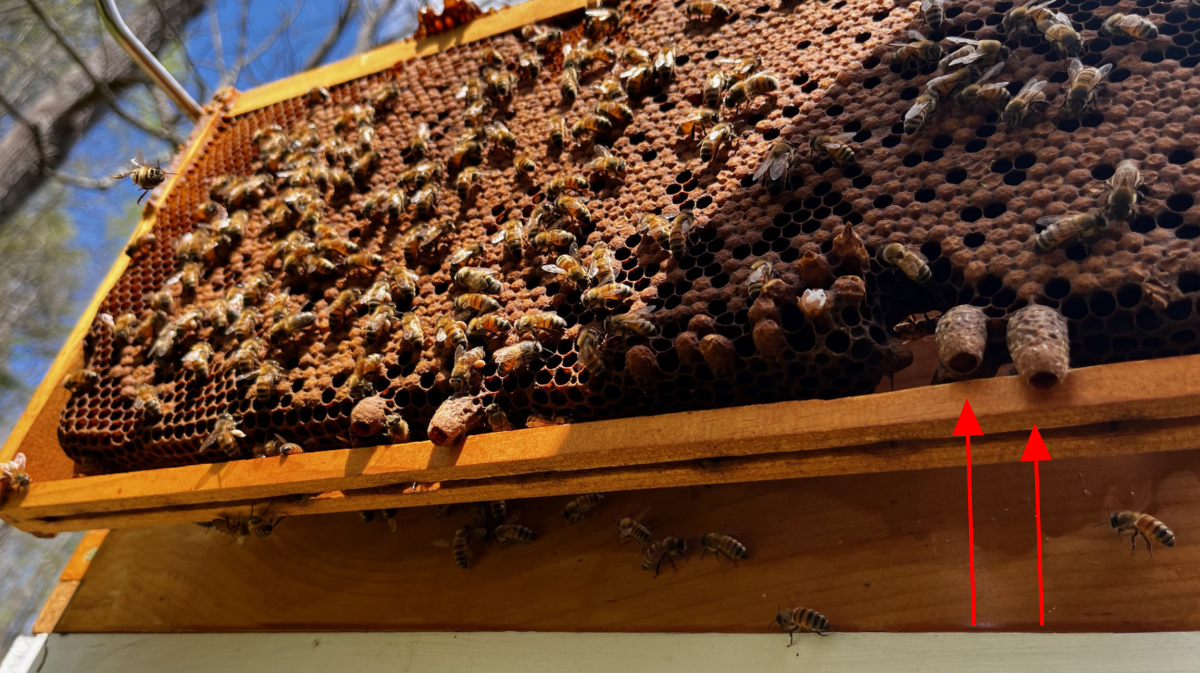
When a hive is over-crowded, the queen takes between 30 and 70 percent of the bees and flies off to find a new home. She leaves behind her new queen cells, special cells that hold future queen bees instead of drones or workers. These new queens fight it out, and the one that wins reigns supreme, becoming the new queen of the old hive.
This is how a new colony of bees is formed. It’s how the bees breed. You might think every egg is an example of bees breeding, but I equate that to you or I growing new skin cells. Our skin replaces itself every 28 to 30 days. Worker bees live 40 to 42 days and then have to be replaced, so you see why I like this analogy. When a hive swarms, it would be like your skin splitting in two and forming another version of you. (OK, maybe that’s where the analogy fails, but you get the idea.)
For a hive to get overcrowded, a few things have to happen: First, the queen has to be healthy enough to lay eggs, lots of eggs. Second, there have to be enough pollen and nectar available for the hive to produce 15,000 to 30,000 new bees. Third, it has to be warm enough that the swarm can sustain itself while it looks for a new home.
This has been such a strong spring that we reached that point—the ideal swarming time—earlier than ever in my experience. Of course, this bee yard is 1,000 or 1,200 feet lower than my home apiary, so they are ahead of the bees I got used to.
Preventing More Swarms
I opened the strongest hive, and it still looked pretty strong, but there were no fresh eggs. That told me the queen had left the hive a few days ago. Then I found two damaged queen cells, evidence a new queen had been born and killed her future competition before they were born. Then I found one queen cell that had been opened and was empty. That was clear evidence that this hive had a new queen. One or two frames later, I found a second uncapped queen cell, meaning two queens were born. When this happens, they usually fight it out, and one survives to be the queen bee.
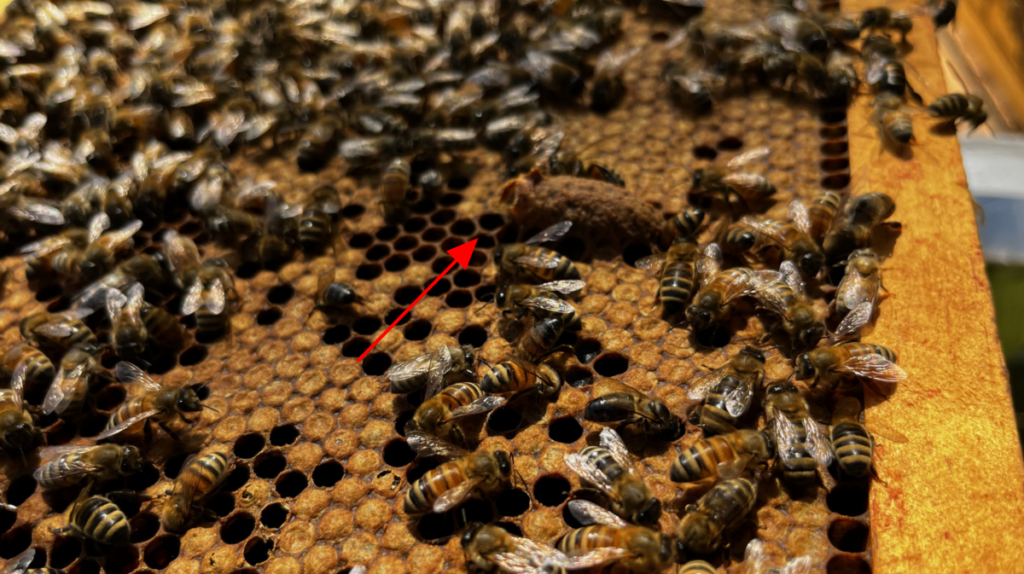
I reassembled the hive and moved on to the next one. This had been a strong hive, but rather than split it, I had given it a third hive body, hoping this would relieve the pressure on the queen to swarm. It had not. I looked at all 30 frames, and I found quite a few empty queen cups and two charged queen cells. These are cells in which an egg had turned into a queen larva but they had not finished capping the cell. Chances were excellent that the hive had not swarmed, but would when those cells were capped. So I removed the queen cells and put them in a new hive. Then I added most of the resources from the third box into that new hive, giving the soon-to-be emerging queen bee food and brood.
Making Splits
This hive was so strong that I pulled another frame or two and added it to the first split I made (its queen was laying, but she is a young queen and had not yet hit her stride), replacing them with empty frames. By redistributing the strong hive’s resources, I gave the queen room to lay and made the hive feel less crowded. Hopefully, this will reduce its urge to swarm.
Then I looked at the hive that had been doing OK. It hadn’t been a bad hive, just not a great hive. Darned if I didn’t find a frame with four charged and uncapped queen cells. So I split that hive as well, removing the queen cells, several frames of bees and resources, all in the hopes it reduces the swarming pressure.
Then, I added a honey super to each of the three big hives. I didn’t have quite enough frames to fill all three, so I left some holes, but I will go back on Friday or Saturday to weed whack and fill up the supers with frames.
In another week, I’ll have to go back and make sure there aren’t any more charged queen cells. Hopefully my actions will have tricked the queen into thinking she swarmed and the hive will concentrate on making a big load of honey instead of producing more swarm cells.
Three New Hives
I ended last year with three hives in this bee yard, and I started the spring with those same three. I split one, and now I have split the other two. Assuming all three splits live (the early one has already proven itself viable), I will have six hives. Had I caught that swarm, or prevented the hive from swarming, I’d have seven. Pretty good considering that a year ago, there were only two hives in this apiary.
I’d love to take all the credit and say that this is my great beekeeping skill at work, taking two hives and turning them into six or seven, but it’s not. Sure, I fed and treated the hives to make the conditions ripe for breeding, but they did all the work.
I know plenty of beekeepers who don’t like using queens from swarm cells. They prefer to make their own queens under tightly controlled conditions, but I have always had good luck with swarm cell queens. That should be no surprise; that’s how queens have been made in the wild, well before humans domesticated bees and tried to rule their lives. The bees know what they are doing. Part of my job as a beekeeper is to get out of their way and let them do it.
I own grafting equipment and if I needed ten queens in three weeks, I’d graft 20 cells (to be safe) and raise my own queens. While I recognize the utility of forcing queen production using grafted cells, I don’t need it right now. And after the SHTF, natural beekeeping is going to be more important than ever.
The Benefits of Livestock
I know many people don’t think of honeybees as livestock, but they are. Beekeepers need to give them shelter, feed them, protect them, treat them for disease, and prevent mites. In return, we get honey and other hive products, like beeswax. That’s what I have to do with my chickens, or what a rancher does for their cattle.
For a prepper with little property, you can have four to six beehives in far less space than you can have chickens, and the bees make less noise. I’m in favor of having both, and maybe rabbits, too. That kind of combination will give you food every day (eggs), meat once a week (rabbits), and sweets twice a year (honey), which can be saved for use as needed. By all means, store food, preferably lots of it. Have a garden. But redundancy is important, so don’t neglect livestock. They will feed you when your stores run low and give you valuable goods for barter or sale. For example, in a month, before I have harvested the first drop of honey, I will have two new beehives I can sell for $200 each.