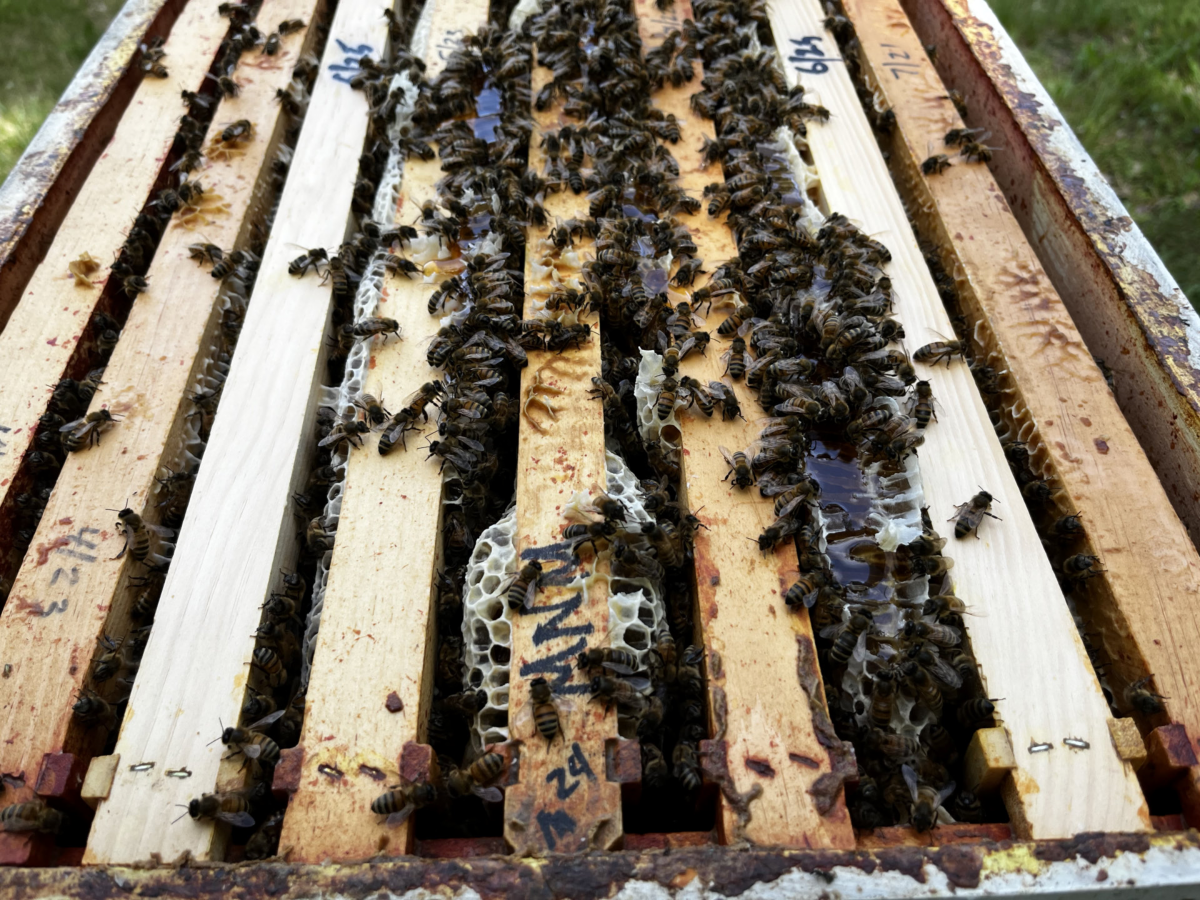
It may be hard to see in the main image (above), but when I lifted the top super off this hive, it was so packed with wax that some of the comb broke, leaving a layer of dark, golden-brown honey open to the air. Rather than attack me in anger, the bees got to work salvaging it. Meanwhile, I added two more supers to give them room to make more honey.
This apiary now has four hives with a total of 11 supers on them, and five of them are full or close to it. We are expecting a bigger harvest this spring than last year, and we have weeks to go before harvest. Of course, we also have more beehives this time around. Still, given the drought, we are getting more honey than I expected.
Even the hive with only one large hive body is making honey. I just added a second super to it. That experiment is paying off.
The other hives are at my home apiary at a higher elevation where the weather is colder and the flowers and trees blossom and bloom later. It is not producing as much honey, but they are still producing some. I expect more as the season progresses. Last year, the higher-elevation hives had a smaller spring crop and a larger late-summer crop. We’ll see if that repeats this year.
Drawing Comb
I have mentioned before that I mix six drawn combs with three undrawn frames in each super. This allows me to take 10 fully drawn-out supers and create fifteen that are two-thirds drawn out. That gives the bees plenty of comb to fill with honey while the younger bees build comb on the empty frames. (A bee’s wax glands are activated during the second or third week of its life.) As a beekeeper, every frame of new comb means more honey in the next harvest. A colony must consume seven pounds of honey to produce a single pound of wax. So every pound of wax I can reuse is seven pounds of honey I can harvest!
I am also drawing out comb in the larger boxes, which is where the brood (eggs and larva) live. Because I have expanded my bee yard from 10 to 15 hives this year, I need all the new comb I can get so the hives can build their strength and focus on producing a large honey crop. I can barely cover growing from 10 to 15 hives. I would have a serious comb shortage if I grew from 10 to 20 in a single year.
So far, this looks like it is shaping up to be a good beekeeping year. I am more in tune with the seasons, the bees, and the new bee yard. That is helping, but I don’t know if I am lucky or good because so much depends on the weather.
Checking the Spring
My neighbor asked if I could give him a ride up the mountain in my side-by-side so he could check his spring, water storage tank, and its overflow. He was worried because of the drought. He’s lived there for 20 years and the spring has never stopped before, and there have been previous droughts, but I didn’t blame him for checking. If the hundreds of feet of black polyethylene pipe between his spring and the cistern had sprung a leak, he might get only a fraction of the spring’s output and the rest could be leaking out.
Not only was I happy to help, but I was delighted to have the excuse to go up his road because that part of the mountain is closed off with a gate, and I rarely have an excuse to go up there.
His spring was fine. There was no sign that the drought or any leaks were impacting his water supply. In fact, he has three or four times as much water coming out of his overflow pipe as I do.
His cistern is so high above his house that he has 91 pounds of water pressure. He has to use a regulator to reduce the water pressure before it reaches the house. Our cistern is at the perfect elevation to give us 65 pounds of water pressure in the basement, a few pounds less upstairs.
Our Water Situation
The streams and creeks—sometimes called branches around here—are low, but there is still water flowing in all of them. Our spring is not 20 years old, so we don’t have a lengthy history to prove its drought resistance. We’ve had dry spells since it was put in, but only for a month or six weeks. We’re keeping our fingers crossed.
My wife watered the garden and some areas we had just planted using the hose and a sprinkler. We didn’t run out of water. I consider that a good test.
I had previously written that we could pump water from a stream into our cistern, but my neighbor’s spring is an even better option. First, his cistern is higher than mine. Second, he has a significantly higher flow rate and a larger diameter pipe. That means I could pipe his overflow into my cistern and it would have no impact on the water going into his house because I would use the water that flows out of his cistern when it is full. When he uses 20 gallons, the level in his cistern drops, and the overflow stops flowing. No big deal, because it will refill in five minutes. In the meantime, my cistern is full, so I don’t even notice.
I have seen this kind of stair-step cistern where the overflow from one cistern feeds someone else’s on down the line, repeated three or even four times. The family that developed the spring and has the first (and highest elevation) cistern never runs out of water. Folks living the furthest down the line have the least reliable supply, but if designed correctly, everyone should have plenty of water.
The Water and the Weather
My biggest challenge in using my neighbor’s cistern is distance; it is 1,200 to 1,500 feet away, but it is also 250 feet higher than ours, so if I can come up with that much pipe, gravity will do the work. When we buried our existing spring pipe, it was 800 feet, so I know where to buy the pipe, but I bet it’s more expensive now.
With any luck, the El Niño will save us and we’ll get rain this summer, if not before.
Some of the storms hitting the Midwest are supposed to bring us much-needed rain as soon as Wednesday evening. I’ll believe it when the drops hit the ground. Too many times this year the forecast has predicted scattered showers or possible thunderstorms, and we’ve stayed dry. I know it’s a holiday weekend, but I’d be happy to welcome a round of summer thunderstorms every afternoon.