It’s been a busy weekend, and a bit of a strange one. The kind of strange that never happened when I lived in the city.
Moving to the country is well worth it, but my decades of city and suburban experience—sprinkled with bits of camping, lots of prepping, gardening, and some retreat living—didn’t prepare me for everything. I’ve been building up country experience for seven years now, but weekends like this are a reminder that I still have a way to go.
Let me recap for all of those who think we have it easy out on our prepper property in the middle of nowhere.
Weird Water Woes
We’ve had our water tested twice since Hurricane Helene because of the concern that flood water could have contaminated wells and springs. The first test came back with coliform bacteria and very low levels of lead. We were not worried about the bacteria. Not only was there when we moved in, but coliform bacteria are common in spring and even well water (and lots of other things). Also, our water tested negative for E. coli—which is the dangerous form of bacteria. But having lead in the water was new. The house is built with PEX, not copper with solder, so where could the lead have come from?
I installed a new kitchen faucet after we bought the house, so maybe it came from there. I figured it was a Chinese-made faucet that wasn’t meeting U.S. specifications!
A year later, the non-profit that was going to provide us with a free ultraviolet light to kill the bacteria sent another guy out to test the water. He took the sample from the bathtub, which amused us because of all the faucets in the house, it is the least used. It took months for the results, but they had improved: no bacteria, but still trace amounts of lead, about half of the EPA minimum. I’m not too worried, but I am curious—where is it coming from?
After conducting some research, it turns out lead in water can come from brass. I think back to when we buried the water pipe from the spring a few years ago. We may have used brass valves. On Friday, I drove up to the spring to take a look. I dug up the junction box, and yes, there is a brass valve. Bummer, but mystery solved.
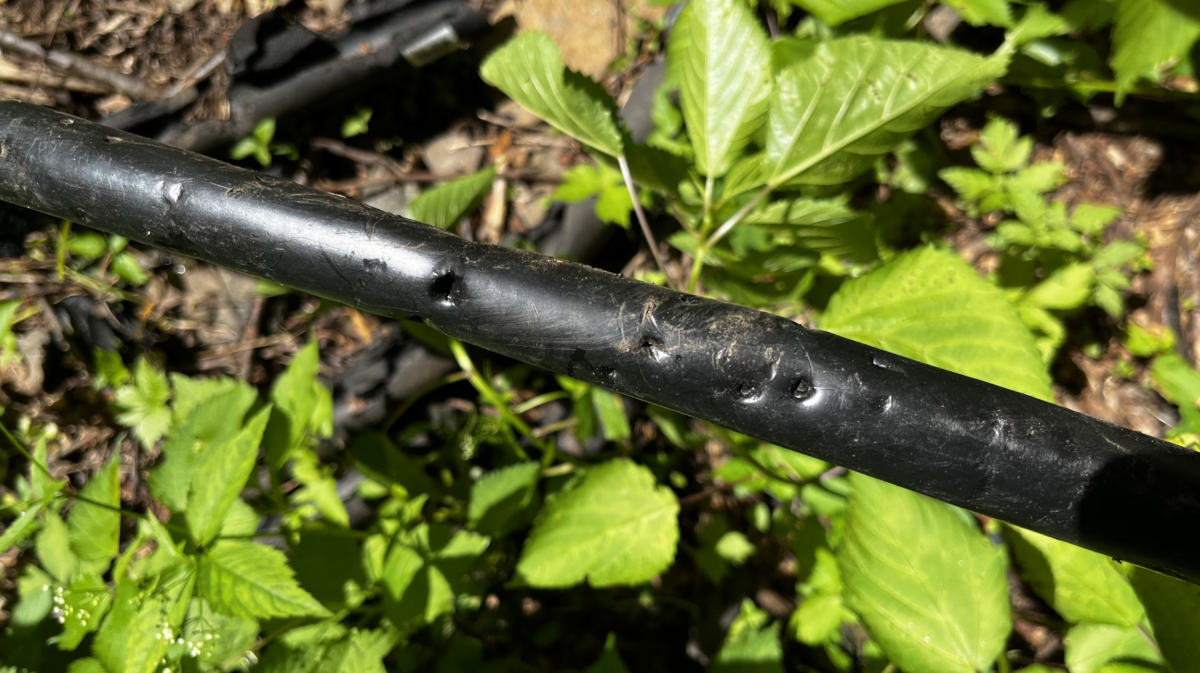
But worse, the insulation we carefully installed on about 50 feet of pipe has been torn off by some animal that then bit the pipe. There are teeth marks covering 40 feet of pipe. I don’t know when this happened, but I’m a bit surprised it wasn’t causing our coliform bacteria numbers to be higher!
Mystery Animal
This is the second time we’ve had an animal bite the pipe in six winters. Locals say the critters want the water inside the pipe, but where this pipe was chewed on was never more than ten feet away from flowing, clean water. They will also tell us it is a bear, but I find that hard to believe. Their teeth marks are too small.
My thinking is coyote, of which we have many. Maybe a fox, although I think their teeth are too small. Someone suggested a bobcat, but that would surprise me unless the cat thought this was some bobcat game, like a giant string of yarn for your kitten. The bobcats I have run into don’t seem playful; they seem cautious and aloof.
In any case, I have since made arrangements to replace the pipe and have it buried. We measured, and it’s about 69 feet of pipe that needs to go. I had 100 feet of “spare” pipe on hand, so we are covered. Now I just need to buy two plastic valves to replace the brass fittings. Apparently, micro-plastics in our brains and balls is preferable to lead in our bloodstream.
Another Mystery Animal
While walking the dog at 12:30 a.m. on what was by then early Sunday morning, we heard a bleating noise. I thought of baby goats, but the nearest goat is more than a mile away. The dog is immediately excited and barks. In the light of my headlamp, I see shiny eyes, but a couple of feet above the ground. Just when I wonder if a raccoon is in a low tree, the eyes turn into a doe that runs up out of the stream and into the woods.
The bleating continues.
We approach, and down there in the stream, trapped in a pool by rocks bigger than it is, I see a tiny fawn. How tiny? The smallest I’ve ever seen. It weighed less than our cat. What stupid mother leads her baby down there when a perfectly good road crosses the creek 10 feet to the south?
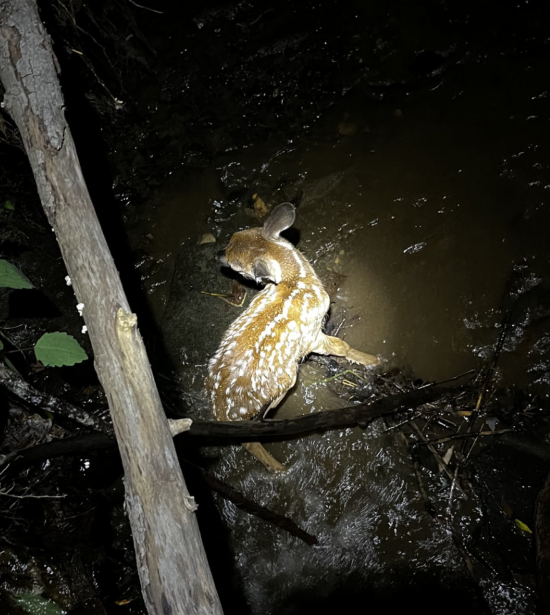
The dog, as you can imagine, is quite excited. The fawn is quite panicked.
A Midnight Rescue
I dragged the dog back and clicked her onto her outdoor leash and headed back to rescue the fawn. It was way down there, a good 15 feet down a steep bank. I couldn’t climb down there, so I accessed the water 30 feet upstream and started walking down the stream. I slipped and my pants got wet. Water ran into my boot. Then I leaned on a branch that snapped; I fell, but caught myself. Finally, I reached the fawn. It was wet and shivering when I picked it up. It wasn’t thrilled, but this was a house-cat-sized animal with no claws and spindly little legs; it couldn’t do anything about it. I walked back upstream, climbed out, and set it on the ground where things leveled out. It collapsed, worn out. I gave it a wipe-down with the tail of my flannel shirt to dry it off. Maybe its mother will come back and nurse it back to health. Maybe not.
The dog was pissed she didn’t get to “help.” For the next 40 minutes, the dog paced by the door, whining, hoping I would change my mind and let her out.
Instead, I washed up, poured peroxide on a scrape I got on the back of my hand when I caught myself, and blobbed on some three-in-one antibiotic ointment and slapped on a bandage. I swear, you can never have enough Band-Aids as a prepper or a homesteader. But who thinks of wearing work gloves when walking the dog?
The Next Morning…
The next morning, the fawn was gone. I felt good. The dog and I walked up the mountain past where I left it, and then back down the other side. On the way home, the dog stumbled across the fawn; I’m not sure who was more surprised. I saved the fawn’s life a second time by not letting the dog eat it. The stupid animal had crossed back across the stream, but it seemed dry. Maybe it used the bridge.
I told the story to my wife before we went out Sunday morning, and she insisted we stop to find the fawn. I’m not sure why, as neither of us is prepared to bottle-feed a small woodland animal, but I know better than to argue. She couldn’t find it, and then she gave a little shriek as she almost stepped on it. It was hiding under a leaf next to a rock. She decided to call the wildlife rescue people, but they are only open on weekdays.
We got home four hours later, and the fawn was gone. Hopefully, reunited with its mother. If not, it will be coyote food by the time you read this. But coyotes have babies to feed, too, and I’ve never seen one of them abandoned in the stream.
Bee Trouble
On Saturday afternoon, after processing more firewood, I was sitting in the basement and I heard this high-pitched sound, like someone had left the vacuum cleaner on in the other room. Maybe we were being buzzed by a drone, I thought. I looked out the window and several thousand bees were looking in. We were experiencing a swarm.
This is the second honeybee swarm we’ve had at my home apiary. The first one got away. These guys settled into some empty bee equipment I had piled on pallets under my deck. I brought out a nice, new hive for them, but they wanted nothing to do with it. They’d rather plop into these empty hive boxes.
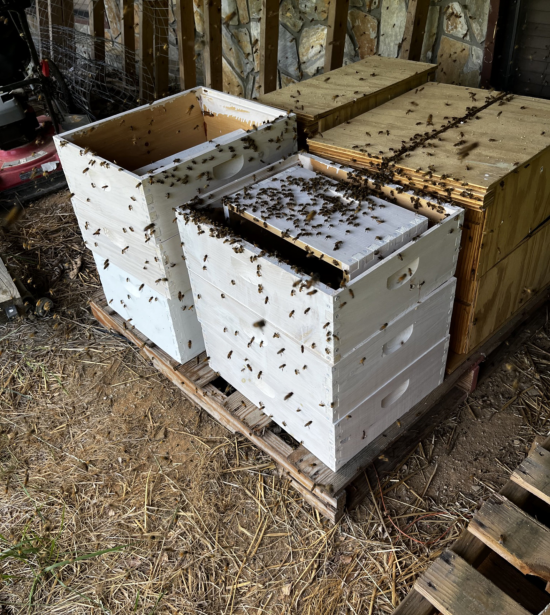
When I checked that night, they were packed into two double-stacked nuke boxes, meaning I had about 12 frames of bees. (These are the six-frame nuc boxes I built myself.)
On Sunday afternoon, I added frames to the empty boxes. I want to wait for them to make some comb before I transfer them to a full-size hive and take them to my out yard, and get them set up. They can’t live under my deck forever; it would piss my wife off. I fed them some sugar water to help them make more wax.
Admittedly, the swarm was my fault. I generally pride myself on having very few swarms, but I had not been checking for swarm cells these last few weeks because the hives have honey supers on them. Not only is it a giant hassle to check hives with honey supers on them, but most bees that are making honey won’t swarm. I guess no one told these girls.
Crazy bees.
More Firewood
The pile of firewood rounds I posted a couple days ago is now smaller, but more work lies ahead. More sawing, more splitting, and more stacking. This is two 20-foot (five pallets long, double-stacked) rows of wood averaging 4.5 feet high, and more than half of it was stacked and split this week. If each chunk of firewood averages 16 inches long (1.33 feet) that gives me 240 cubic feet of firewood, or just under two cords.
With this stack, we now have almost four cords ready for the coming winter. We’ll need five and like to have six, but we are making good progress. The first two cords have already been seasoning for six months and four months, respectively, so we will burn them first. This new stuff will start seasoning today as the sun and wind dry out the wood all summer. With any luck, we won’t be burning this new wood until late January.
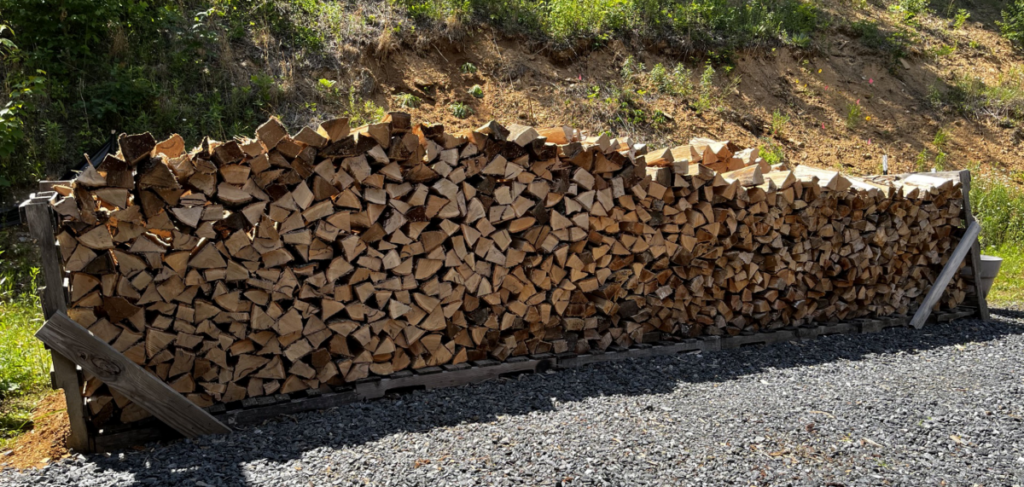
Like I always say, having firewood drying and ready to burn is like having money in the bank!
Markets Plunge on Friday
Here’s another weird thing that happened, although it has nothing to do with animals or living on the homestead.
On Friday, the U.S. announced 170,000 jobs were created, meaning that from March through May, more jobs were created than in any three-month period over the past two years. Sounds like good news, doesn’t it? But the markets plunged, led by the tech-heavy Nasdaq. Bitcoin was down, oil was down, and gold and silver dropped, with silver giving up about 8 percent.
Why the glum reaction? Not because of the war in Iran. Not because Trump made some announcement. No, everything dropped because the market doesn’t want rates to rise, and good employment news means the Fed might think they have room to raise rates.
We have reached that weird place where good news is now bad, and bad news causes markets to go up. This is what I refer to as “bass-ackwards.” Is that a warning sign? Maybe; it’s definitely a sign things are unpredictable.
Kitco showed silver closed Friday at 67.71, down $6.03, or 8.18 percent. I saw silver eagles on sale this weekend for $71.96 each when you buy a roll of 20, which is the lowest I have seen for some time. Maybe you consider this a buying opportunity. I don’t—I’m waiting for it to drop under $50—but I consider it good for people who dollar-cost average.
Dollar-Cost Averaging
If you like the idea of dollar-cost averaging, let me mention a company I do business with: OneGold. While I like holding physical gold and silver, I can put in my gun safe or bury in the back 40, I have a standing buy order at OneGold.com to buy a few ounces of silver every month. This allows me to dollar-cost average. The value of your holdings fluctuates as the price of whatever metal you buy goes up and down.
The gold and silver are held in an account for you, and you can pick your vault location. If you prefer physical metal, you can ask them to send it to you. You can pick the coins or bars you want off their website, or you can go to the Apmex website, pick your metals, and select your OneGold account as a payment method. That’s what I did when I made a physical withdrawal because Apmex had more options on their website than OneGold did. If you prefer, you can also liquidate your holdings and they will send the cash to your bank account. That’s often easier than taking coins to a dealer or pawn shop.
Some rules and limitations apply, and there may be a small storage fee, so check their website for details. One I remember is that you can only liquidate holdings that are at least 60 days old.
Also, if you sign up using this link and spend $1,000 or more, they will add $20 to your account and also add $20 to my account. Thank you in advance, because firewood isn’t the only thing that is as good as money in the bank!