
If you are paying attention, you have probably heard most of the following:
- Russian missiles are landing in Poland. Russia is also threatening the Baltics.
- An estimated 50,000 Moroccan men “invaded” Spain, pouring over the border unopposed. This is similar to the hordes of Mexicans, Guatemalans, and others that poured into the U.S. during the Biden administration, but Spain has a population about a seventh of ours and far less landmass. Plus, once they are in the EU, it’s easy to travel from country to country. Italy has already closed its border with Spain to prevent this.
- The stock market is jittery. Lots of volatility over the course of a week. AI is dead, sell, sell! The next day, AI is back! Buy, buy, leading to an AI short squeeze. Makes me glad I am not a stock trader.
- Oil prices are rising. Then they pause, flip-flop a bit, and rise again. We seem to be on an upward trajectory as the war in Iran gets worse and the strategic oil reserve dwindles. The markets seem to hang on Trump’s every word, oil declines and stocks rise whenever he says “peace,” yet there is no lasting peace.
- One day, China is sending MANPADs to Iran, the next day they are not. Then maybe they are?
- Ukraine blows up an Iranian ship in the Caspian Sea thought to be carrying weapons from Russia to Iran, spurring fears that the Ukraine/Russia war and the U.S/Iran war are blending together. Then they say it wasn’t intentional. What?
- The economy grew 1.5 percent in the last quarter, less than expected. That’s not good.
- The Democrats are going to win 30 seats in the House during the Midterms. No, the Democrats are going to lose seats because they have too many communists and socialists. The truth is, we don’t know, but most of us agree the Democratic Socialists of America’s platform is un-American (and terrible).
- The Europeans hate Trump. The next week they love him and woo him. Then they back off. They need him, but they don’t like him. Their feelings change; he doesn’t seem to care.
- Zelensky and Ukraine are winning the war! But wait, Russia isn’t down and out yet. The deep attacks are working. Russia is losing too many men. But maybe they have reserves they are holding back in case they have to fight NATO. Does anyone really know what is happening? Of course not; we are only told what one side or the other wants us to hear. Missiles and drones might as well equal smoke and mirrors.
- We’re running out of missiles and interceptors. Or are we? We are producing new cruise missiles at a record pace. We’re making tens of thousands of drones a month. The country is gearing up to fight a war. Defense stocks are up. Even Ford has military contracts.
- The Houthis have joined Iran and are blocking the Red Sea. But Saudi Arabia is joining the U.S. in attacking Iran and the Houthis. But now the Saudi’s encouraged Trump to accept a peace deal. Or not.
This dirty dozen is a mishmash of news: some good, some bad, some you can’t be sure. What are we to believe? It boils down to this: You should be preparing because no one knows what the future holds, only that it may not be all sunshine and flowers.
What Should Preppers Do?
If I wanted to sound like a broken record, I would say buy and store gasoline, ammo and food, and consider buying hard assets. But you have heard that message many times, so I will provide details on what else you might do to prepare in case we see high inflation, stagflation, a recession or depression, hyperinflation, terrorism, more cyberattacks, global war, civil war, a massive natural disaster, a governmental collapse, or the U.S. defaulting on its loans. Consider these suggestions that go above and beyond the Big Three of food, water, and shelter.
Get Hand Tools
When the post-SHTF situation reaches the point where you cannot find fuel to power your gasoline engines, the electricity is shut down and you cannot power your electronics, all you will have is people power. At that point, you are going to need hand tools. Among these, consider:
- Tools to plant, maintain, and harvest a garden: Basics are shovels, trowels, hoes, rakes, and cutting tools. Beyond basics might include a rock bar to leverage large rocks out of the field, a tool to break up hard soil, different kinds and shapes of shovels, a way to stake and tie up plants to keep them from falling. And don’t forget seeds, peat pots or seed starter medium, trays, and possibly some fertilizer. And advanced plan might include fencing and fence posts, but these are better installed before the SHTF.
Keep in mind that people farmed and almost every family had a garden well before tractors and rototillers were invented. Farmers may have had a horse, but many gardeners did not. It was all done by hand. If you have to do this, better to have the right tool for the job instead of a sharp stick.
Beyond gardening, you might need a shovel to dig a latrine or fighting positions. - Tools and hardware for building: Tools to build and make repairs, like hammers, manual screwdrivers, and hand-crank drills. If your window gets smashed, you will want to nail or screw plywood or boards over it. When a tree limb falls and punctures your roof, if you can’t call a roofer you will have to make that repair yourself. (Do you have an extension ladder?)
You might want to build an outhouse when you get tired of squatting over the latrine. That will require lumber and screws or nails. Might be worth buying ten pounds of a few different sizes of nails and several large boxes of screws while you still can. Having a nail gun won’t matter if you can’t power your air compressor. - Tools to harvest and use firewood for heat: Without chainsaws, we’re going to be down to pulling a manual saw back and forth or using an axe to cut logs into rounds and split them. It may be better to just focus on smaller trees until you build your skills. Of course, you also need a way to convert that wood into fire for cooking or heat for your house. Wood stoves, fireplaces, a volcano stove, even a fire pit can be used to cook with wood.
Household Gear
I’ve talked previously about how a grid-down emergency will mean we will be living like it’s the 1880s. For example, my wife can bake bread, but she often uses her big mixer with a dough hook. She’ll need to knead the dough manually if there is no power.
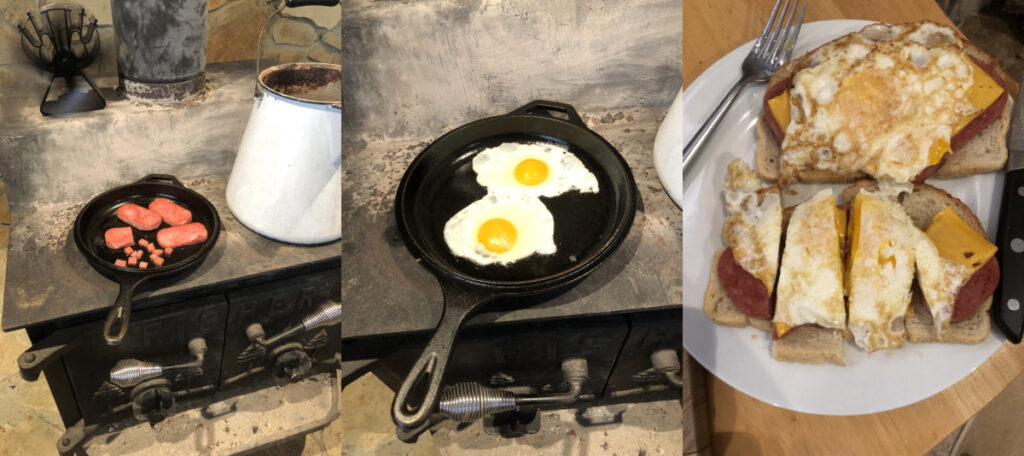
- Old-world baking and cooking equipment: We use cast iron cookware, and this will be useful for cooking on our wood stove or over an outside fire in the warmer weather when we don’t want a fire indoors. Grates and a flat griddle are also useful, as are multiple Dutch Ovens. You will also find you need extra hot pads, lid lifters, and spatulas with longer handles than cooking on your range requires. Knives and knife sharpeners are a must as are manual tools to replace your blender, mixer, Keurig, food processor, and other appliances.
- Laundry equipment: If you don’t have the basics to do laundry by hand, you could find yourself in the nearest stream or river banging your clothes on a rock to get them clean. A washboard in your bathtub or a five-gallon pail is a better option. Failing that, consider a plunger and a five-gallon bucket; you need some way to slosh clothing around and help the dirt wash free. Key to all of this is a way to transport water to the new laundry site, not to mention some laundry soap.
- Cleaning and bathing: Without power, even basic things like running the vacuum cleaner become impossible. This means you need brooms. Wall-to-wall carpet becomes dirty without vacuuming, which is why so many historic homes had wood floors and rugs. You can pick up a rug and shake it out, beat it, or even wash it, which you can’t do with wall-to-wall carpeting.
Even cleaning dishes, the kitchen itself, and people (bathing) will need to change if there are no utilities. Think about how you are going to manage that and plan accordingly.
So much of a prepper’s planning related to water is about drinking water, but running water has many more uses, from carrying away waste to keeping the garden growing. Be sure to have a plan for that. A few buckets of water from a local above-ground source can help, but how will you transport it? - Sewing and Mending: If there are no new clothes on the shelves, you may need to darn that sock rather than tossing it, or repair that ripped seam in your work pants. Do you have the tools necessary for mending, sewing, and knitting? Can you turn animal pelts into wearable garments?
Check back for the next post with more suggestions when you are ready to graduate from the prepping basics and look for more than guns, first aid, and communications.