While people are worried about the cost of gas and food, electricity prices are climbing an average of three times faster than food prices—and it has little or nothing to do with the Iran War. Check this article, which includes a map, to see how your state performed.
On a state-by-state basis, the price increases ranged from a 23 percent annual increase to a seven percent decrease, with only six states showing a drop in electricity prices over the past year.
By my calculations, 39 states (more than three quarters) saw an increase in electrical rates above the rate of inflation. Eighteen states showed a double-digit increase, while another 18 saw increases of five to 10 percent. Only nine showed smaller increases, ranging from 0.1 to 3.6 percent.
Virginia, which is known for its data centers, saw an average increase of 15 percent. So if your bill a year ago was $260 a month, in Virginia it is now $300. That assumes you aren’t using more electricity, of course.
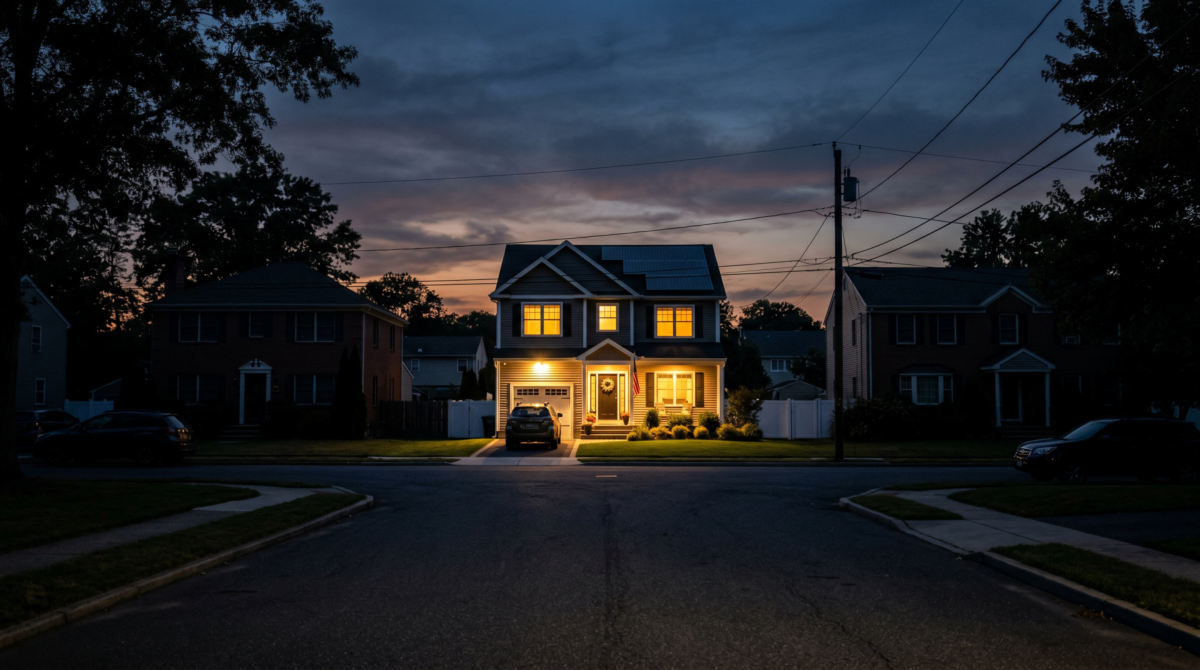
Happily for us, our solar system absorbed our local price increase. The rising cost of electricity means I will reach the breakeven point and recoup my investment even sooner than I originally calculated.
The increase in the cost of power where I live exceeded the rate of return on my retirement investments, so I am getting a bigger return on my solar power investment than I would if those funds were still in an IRA.
Our May Numbers
According to our app, we consumed 800 kilowatt-hours (kWh) in May. That’s a nice low number because we used little or no heat or air conditioning thanks to the mild spring weather.
Because it was sunny for most of the month, we produced 1,225 kWh, a surplus of 50 percent. That extra 425 kWh means our May bill will be below zero, and we will start building up a “bank” of energy with the power company. In fact, the electric company now owes us more than $50.
When November rolls around and we use more electricity than we produce, the utility will tap into our “bank” and our bill will remain below zero until we consume all the excess energy we’ve “saved up.” Meanwhile, when the power goes out, we have backup batteries, and if the sun is shining, we can produce enough power to run the house—or at least most of it.
Speaking of power outages, we had two in the past month, each of which lasted more than six hours. They had nothing to do with data centers and everything to do with falling trees and what the utility calls “equipment failures.”
Consumption Patterns
Of the 800 kWh we consumed, 285 came from our battery, which I let run down to 40 percent on nights when we are not expecting rain or heavy winds. Unless we run the dishwasher after dinner, we don’t consume much power at night. Just a few lights, a TV or two, and a computer. All low-power devices, especially in the age of LEDs. The refrigerator consumes about 1.5 kWh a day and the freezer even less (once it is cold), because we rarely open it.
It’s during the daytime when we use the most power. This starts off with brewing coffee, running a hot shower, cooking breakfast, etc. The water heater shoots our consumption up to 5 kW when it is running. In comparison, the air conditioner uses less than 3.5. Of course, you run the AC far more hours of the day during warm weather.
Then there are chores—like doing the laundry. The last time I checked, the washer used less than 200 watts per cycle, but the dryer uses far more because it generates heat. The stovetop isn’t bad if you use one burner, but the oven consumes large amounts of power, especially when pre-heating. We use the toaster oven whenever we can. No need to power up the big 240-volt oven to bake a few biscuits when the pan fits in our 120-volt toaster oven.
Solar Power Glitch
Our solar power system is not perfect, and this is a bit of a concern when it comes to long-term viability in a post-SHTF collapse. Let me give you two recent examples:
About two weeks ago, everything electric in the house flashed and clicked. I assumed it was just another power fluctuation from the grid. Then, a couple of hours later, I noticed our solar power system was using battery power, but was not charging the batteries or feeding the grid, despite the bright sun and the inverter producing 5.8 kWh of electricity.
I called the Franklin WH tech support line and after wrestling through their AI helper, spoke to a very helpful technical support rep who diagnosed and repaired the system remotely. He also upgraded our firmware to the latest version. The system started importing electricity, our battery levels rose, and when our state of charge reached 100 percent, we started exporting power to the grid. It all looked good. At least until a few days later, when my wife turned on the AC to get the humidity out of the air one afternoon, and the temperature inside the house increased. Turns out the AC compressor was not working.
I called our trusty HVAC repair shop on a Friday; they sent a technician out Monday, but it was a quick visit. “Youre compressor isn’t getting any power,” he told me. “You don’t need an HVAC tech, you need an electrician!”
After some thought, I realized I needed to make another call to Franklin.
Tech Support, Take Two
This time, their AI was ugly. It hung up on me twice. I had to call back and insist on speaking to a human. Repeatedly. Eventually, I got a human, and once again they (a different rep) were helpful.
I had diagnosed the problem as a failed relay. You see, when the battery state of charge drops below 80 percent, the system has a “smart switch” that uses a relay to stop sending power to the HVAC. This is to save our battery power for more important things, like refrigeration and food preparation. He talked me through how to use the app to turn on the smart switch. “But it’s already on!” I said. It said so, right there on the app.
“Then turn it off, wait ten seconds, and turn it back on.” I had already manually flipped the breaker on and off. He wanted me to use the software to do that to the relays. I didn’t even know that was possible. I did, and within moments, the HVAC compressor was working. I got out the point-and-shoot thermometer and pointed it at the ceiling register. The air coming out was 59.3°F. Yep, the AC was back on.
Lessons Learned
The obvious lesson here is that the “brains” of my solar power system are not only a bunch of cables, wires, electronic components, and circuit breakers, but a computer. Like my desktop, when something goes wrong, the first thing I should do is reboot it. In fairness, I have only had to do this twice over about two years, but it’s something to remember the next time I get an odd error.
My second lesson is that I should have checked the voltage at my compressor before calling my HVAC repair guys. I looked in the breaker box to be sure the circuit breakers were on—they were—and I checked outside to see if any of those big red fuses had blown—they hadn’t—but I didn’t take that extra step. I expect that will be a $100 mistake after I pay for the service call. But it will be one I don’t repeat.
Live and learn.