
This is the conclusion of the series that started last week. For perspective, you should read the first and second parts before you read this one.
Getting a New Address
Lisa already made a standard move by going to the UPS store and getting a mailbox. This gives her (and the imaginary Tony) a street address. Most companies will know this isn’t a residential address because there is a database of mailbox companies, but it works fine for ordering things online.
Another way to use an alternate address is to ask a friend if you can have things sent to their place because packages in your neighborhood keep getting stolen off the porch. If they work at home, this makes sense. Don’t abuse the privilege, but use it from time to time so no one is surprised if a package with your name on it shows up there.
Lisa can’t get a package for Tony delivered to her friend’s house without facing a slew of questions about who Tony is, but it is a perfect opportunity to roll out the misspelled last name, like the Matson vs Madsen I mentioned in Part One. It’s unlikely that someone will realize Elizabeth Matson who lives at 2715 Churchill St is the same person as Lisa Madsen who got a package in a different zip code, maybe even in a different town. And if she leaves her phone at home or in a Faraday bag when she goes to pick up her package, it will be even harder to connect the dots.
So what on earth is Lisa or someone like her buying that she wants to hide? It doesn’t matter. You might be thinking sex toy or something naughty, but it could just as easily be something she considers embarrassing, like incontinence pads or medication for a fungal infection. In the case of preppers, it might be an FRT. It doesn’t matter why someone prefers privacy; they are entitled to it.
The Dead Drop
One thing I have done is so use the address of an empty home, but this may only work in the country where there are no close (and nosey) neighbors. A man died, and it took his estate eighteen months to get settled and put the house on the market. For more than a year, I had packages delivered there. UPS didn’t care. They left them in the carport, and I picked them up when I got the delivery notification. Only after I met the real estate agent on one trip did I stop. I told her I had been doing it for years and the former resident had let me. That is the location where someone later tried to serve me, and the new owners did not know who I was.
The ATF may know who I am because I own guns and suppressors purchased under my name with proper paperwork. Neither they nor anyone else knows all the items I may have purchased under business names, other names, and address. That’s the way I like it.
Hiding Behind a Business
Speaking of business names, if you want to buy large quantities without attracting attention and/or at wholesale cost, form a business to buy it. This is also a great avenue to convert cash to assets less likely to depreciate. You could also consider setting up a church or a nonprofit—but just be careful that it really is acting as a church or a nonprofit.
Doing so isn’t difficult. Churches can be small—just a few families… like a prepper group. A 501(c)(7) nonprofit is a recreational club—you could form a shooting club, camping or hiking club. The IRS paperwork to form a nonprofit is simple—I’ve formed one—and the tax return is a postcard if it generates less than $50,000 in revenue, although 501(c)(7) requires a Form 1024.
This takes more work than renting a PO box—although your entity should have a PO box, maybe in a different town or zip code. The key: you need your organization to be able to withstand scrutiny and not be fraudulent.
However, if you are a terrible marketer and your new entity fails after three years—and many new businesses fail within five—the paper trail fades, especially if taxes are paid and you don’t owe anyone any money. File a final tax return, tell the state your business is inactive, close the bank accounts, and wipe your hands of it. As long as you don’t declare bankruptcy, no one will care what happened to all the freeze-dried food and solar generators the company had in stock. And if they end up in your basement, well, how about that? I still own some useful things purchased by a Delaware company that I folded up in 2014.
Using a Hotel
If you travel for business or pleasure, you can have an item shipped to your hotel. This is done all the time by people who go to conventions and trade shows, and large hotels in major cities have full receiving departments. When you check in, the desk clerk will tell you there is a package waiting for you. Just ask them to deliver it to the room. You should tip the bellman or whoever delivers it, but it is a seamless process that no one will think twice about. Note: This only works if you have a reservation.
Is it possible to tie your shipping address to your reservation and back to your method of payment and home address? Yes, but they would have to go through the effort. And then, your “home” or billing address might be a Post Office Box or a UPS store.
Speaking of P.O. Boxes, they are an easy, quasi-official address no one will question, except the bank or other financial company, which will want your street address. P.O. boxes are tied to your physical address by the post office. The way around that is to open your box before you move or change residences. Then you conveniently “forget” to update your records. This works great. When I check my credit reports, two of the three still list the address I moved out of six years ago as my “home” address.
In fact, I encourage you to open bank accounts, sign up for PayPal, Venmo, and make similar transactions in the months before you plan to move. That creates an explainable gap in the records, as many companies won’t have your new address after you relocate. With the prevalence of data being accessed online or sent via email, there isn’t much reason for them to mail something to your physical address and then complain with the item is returned as undeliverable.
Alternate Vehicles
It’s easier to use an alternate address than it is to drive a car that is not connected to you. Cars need insurance, plates, and registration. That means there will be a paperwork trail.
Driving without a current registration or with a plate that belongs to another car is asking to be pulled over by an alert cop or one whose squad car features a license plate reader camera. (Some municipal cops sit at a busy intersection and do this their entire shift.) At the least, they write a ticket. Occasionally, they catch drug dealers/users or someone with outstanding warrants.
The best ways I’ve found to obscure car ownership are to:
- Drive one owned by a company, church, or nonprofit you control, but be advised this can get complicated and costly;
- Rent a car when you need one—I like to do this for road trips;
- Borrow a car from a relative or friend, but don’t do anything while driving it that could get them in trouble.
Keep in mind that any Uber, Lyft, Waymo, taxi, or similar conveyance will have cameras, often multiple cameras. Use them only for benign things, even if they record over the data in a week or a month.
License Plate Readers
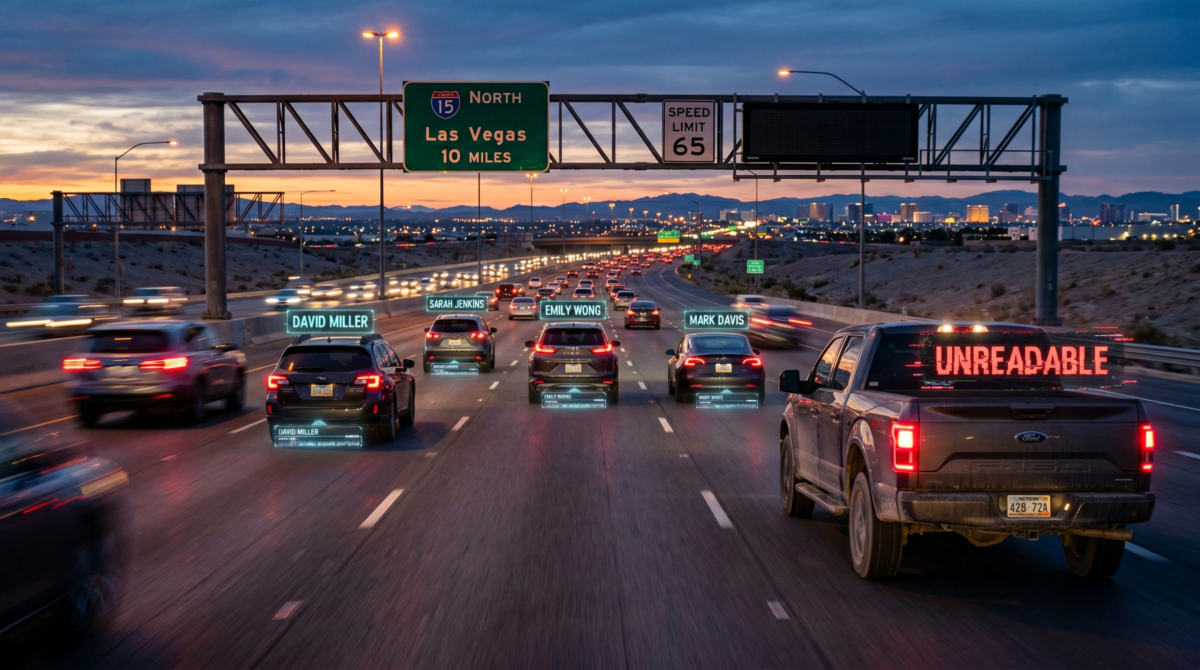
If you are worried about being tracked through license plate readers and the databases they build, there are other things you can do to obscure your footprints. Here are a few examples:
- Use one of the websites, like deflock.me, that will tell you where the Flock cameras are so you can plan your trip accordingly. Keep in mind that they are not perfect, and in some areas public safety may also have access to private security cameras and Ring cameras.
- Invest in one of several systems to make your tags unreadable, but do some research and be mindful that they may be illegal in your state. The secret is to use them only occasionally—not all the time. Let them track you to the grocery store and to church on Sunday. Don’t let them track you to the gun show on Saturday. Also, even if they don’t get your license plate, they will still pick up your vehicle make and model and any distinguishing characteristics, like that dented fender. Another reason for no bumper stickers.
- Have multiple vehicles in the names of different LLCs. Or, have one in your name and use it to drive to work, to drop your kids off at school, and to visit other benign places. Then drive your LLC-owned vehicle when you want to go to the strip club, the casino, Stan’s Preparedness Store, or other places you don’t want to broadcast.
- Every year or two, sell your car to your business or vice versa and get a new plate when you register it. That interrupts the tracking in the database and limits how far back in time they can track your movements. It may also add some costs or be a taxable event; talk to your accountant.
- Garage your vehicle. If you have it registered to an LLC for privacy, that benefit is lost when you park in your driveway for the world to see.
- Rent a car. Yes, the police can figure out who rented a car, but it takes effort. If you are renting for privacy and not illegality, there will be no reason for them to do so, and commercial tracking systems like Flock won’t connect the car to you.
- Wear a baseball cap and dark glasses when you drive. Hey, it’s better than nothing!
The Need Not to Tell the Truth
It may be clear from context, but let me put it bluntly: if you engage in this kind of practice to obscure your identity and enhance your privacy, there will be times when you have to be less than truthful. There will also be times when you will have to refuse to give a nosy person the information that they request, whether that is your social security number or your home address.
I find the best way is to apologetically say, “Oh, I’m sorry, but the reason we use a P.O. Box is because of an ugly stalking incident. Ever since then, we’ve had to be really careful about giving our street address.” This flusters the recipient so sufficiently that they often accept your P.O. Box even if they aren’t supposed to.
For the social security number, just refuse. A simple, “Sorry, but unless you are going to send me a check every month, my policy is not to give anyone my social security number.” Sometimes there is an awkward pause. This is where you smile at them. If you aren’t opening a bank account, getting paid, or doing another financial transaction, there is no reason for them to have your digits.
Charm and humor can often carry the day. Make a joke of it and stand firm rather than being nasty. Save that for their supervisor, who will insist it is their policy. Just insist that it is your policy not to disclose it, and remind them that their policy is not a law. Then ask for the supervisor’s name so you can be sure you spell it correctly when you leave them an online review. This won’t win you any friends, but it can help you get your way.
Keeping your Mouth Shut
Just as there are times you may have to be less than honest, there are times when you have to say nothing. Outside of my family, I can think of about four people who know we are preppers and another four who may suspect it, but none of them know how much food and gear we store. When people come to the house, we lock the storeroom and no one has been inside my storage unit.
Besides my wife and daughter, only one other person has seen the inside of my gun safe. Only a few have seen the outside of it, and they don’t even know I have a second safe. If I ever have the desire to show off a gun to a friend, I get it and bring it to them. I don’t open the gun safe in front of them. That’s a hard and fast policy.
“Gee, that’s a big gun safe,” said the plumber.
Deflect with nonchalance: “Oh yeah, it came with the house. We got rid of the taxidermy the old owner left, but the safe was too big to move. I guess he was a big hunter.”
Distract and change the subject: “Yeah, the old owner left that, the pool table, and the wood stove because they were all too big and heavy to move. We get a lot more use out of the wood stove. It heats the whole house.”
We moved many items in our own vehicles when we relocated because we didn’t want movers talking about what they saw or reporting it to someone else. It is also one reason my vehicles have no bumper stickers, no slogans, and are not especially noticeable. We don’t want to draw attention to ourselves. Keeping our mouths shut is a good way to do that.
Don’t Break the Law
This might be a good time to remind you to check our disclaimers and terms of use.
Let me reiterate that I do not take any of the steps I have outlined to break the law, and neither should you. I am not doing this to hide income or avoid paying taxes. Likewise, I am not trying to defraud anyone. I am using legal means to enhance my right to privacy.
It is my intent to fly under the radar, to occasionally stay faceless and nameless, and to keep my interests in guns and prepping separate from my “normal” life. So when the next iteration of the Southern Poverty Law Center or some ANTIFA group compiles a list of preppers or gun aficionados, I don’t want the names they harvest off websites and forums to connect to me or my residence.
If I end up shooting someone in self-defense one day, I don’t want their attorney to run a quick search on my name and find my posts here or anywhere else. Because who knows what a jury might make of them? But it’s a heavy lift for them to connect Pete with Lisa.
Is that it?
Is that “all” I do? No, I kept a few sneaky things for myself. But if you do some research, you can come up with a few more ideas of your own. The keys to preserving your privacy and enhancing your online security are:
Hide in the Masses. If you look like everyone else (xfinitywifi, for example) it’s hard to pinpoint you.
Obscure Specifics. Use a VPN, extensions like Canvas Blocker, and browsers like Brave to stop website fingerprinting and tracking. Outside of the tracking device we call your phone, this may be the biggest privacy threat when you are online.
Maintain Your Silos. Don’t make the mistake of visiting your bank’s website where they know your real name when you are logged in with your prepper personality and using the Boise, Idaho, VPN location. This takes discipline.
Treat Your Phone as an Enemy Spy. Don’t put social media on your phone. Don’t put any of your “everyday” apps that require a login on your burner because they will use your login, to track you, and tie that phone to you. (Logging in under a different identity is a different story.)
Don’t Disappear, Just Fade Away
Like prepping, privacy takes work. Also, like prepping, you can start with some basic steps and add more down the line. For example, instead of rushing out and buying a $900 ghost phone, buy a cheap burner and a Faraday bag. Wait until you plan to move to engage in some of these address-related tricks. But some steps, like forming an LLC or a nonprofit, may be worth doing ahead of time so you have it when you need it.
Just like someone well-motivated and well-financed can get through pretty much any security system, someone with resources and knowledge may get to you despite these suggestions. All we are doing by adopting some of these practices is making it difficult and time-consuming to be found. Being found also assumes someone is looking for you. Walmart and the coffee shop are not going to make that extra effort. Neither will the data aggregator who wants to collect 500,000 new people every month. But if you owe someone $100,000, they might.
If a hacker has the choice between hacking you and hacking someone who doesn’t use a VPN at the coffee shop and uses p@ssword123 as their password, they are going to pick the latter. But if someone serious is out to get you, these techniques may help, but they won’t keep you safe forever.