This is part three of our series on potential nuclear war scenarios. None of these involve intercontinental ballistic missiles with megatons of power; they focus on smaller, tactical nukes. Part One was on Russia using tactical nukes in Ukraine while Part Two addressed what we would do if we awoke one morning and heard that nukes had been used in Europe. Today’s post, Part Three, is different because the U.S. is directly involved.
Scenario: Response to an Assassination
This scenario starts with the assassination of President Trump. For our scenario, it doesn’t matter how he is killed. It doesn’t even matter if Iran was involved; all that matters is that the U.S. assumes Iran played a role.
For this scenario, we are going to make some assumptions of our own: One, that Vice President JD Vance was not killed and becomes president. Two, he appoints Marco Rubio as his Vice President. Three, war hawks and neocons bang the war drum.
Will the U.S. use Nuclear Weapons?
In Part One of our report, Putin decided to use nukes to “Hit them so hard, no one will dare raise a finger against us.” In this scenario, Vance, who is angry, wants to make a similar decision. But unlike Putin, Vance has better advisors, including Rubio. He is joined by the Secretary of the Treasury who explains that unlike Russia, where the economy is already in ruins and they are considered a pariah by much of the world, the U.S. would suffer and immediate economic and geopolitical harm if it used nuclear weapons first. Forget the impact on the oil market. Stock markets would likely crash, the global supply chain would flounder, and there would be panic in the streets. That could lead to chaos.
Vance agrees, but wants to uphold the former president’s promise to send Iran back to the dark ages. His military advisors tell him it is possible without nukes. He authorizes an all-out attack, but agrees to hold the use of nuclear weapons in reserve. Not off the table—nuclear weapons are never completely off the table—but only as a last resort.
The First Wave
While the country watches as somber politicians attend the parade as a team of horses pull the deceased president’s coffin through the streets of Washington, D.C., officials from the U.S. Treasury zero out the Central Bank of Iran’s digital ledgers, freeze their state-linked accounts, and work with officials across Europe to seize or freeze funds in other banks. Almost before Iran notices the problem, a Cyber Command team at Fort Meade and their colleagues at Joint Base San Antonio launch what has only been practiced in war games: a massive attack on Iran’s power grid, telecommunications infrastructure, and logistical hubs. Moments later, twelve of Iran’s satellites cease to operate, although no one in Iran is aware of this because most of their power and communications capabilities have failed.
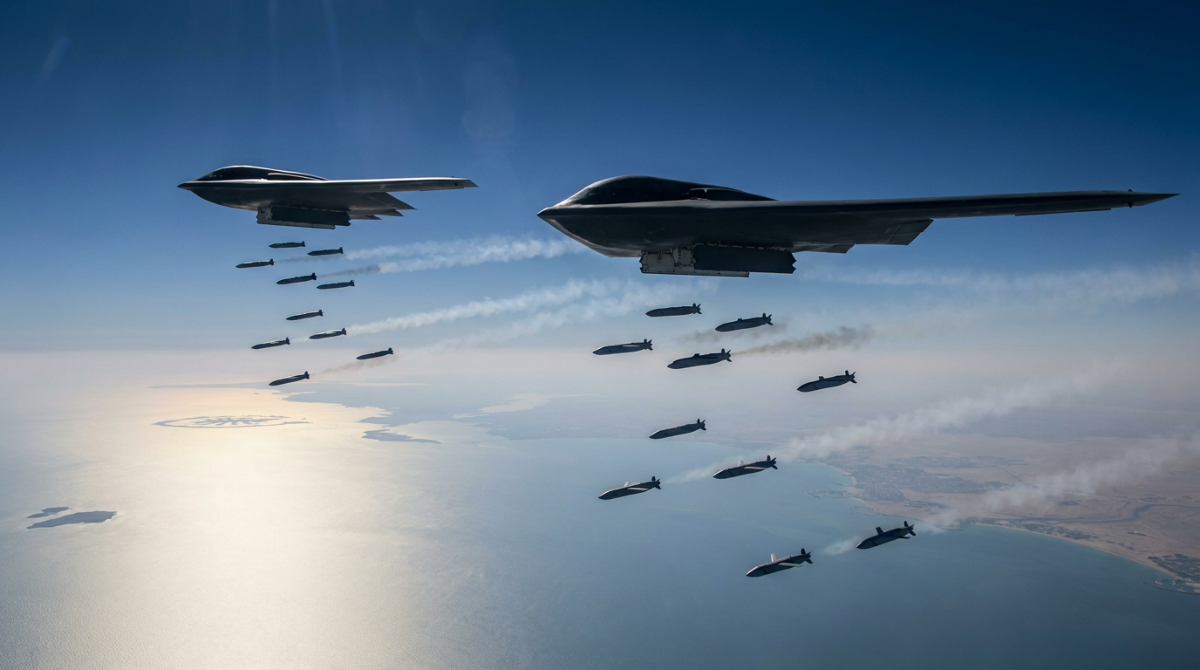
Just a few hours after the cyberattack, the physical attack begins, but no bombs are dropped, no Tomahawks are fired, and no aircraft leave the flight deck. Instead, B-2 stealth bombers launched the night before from Whiteman Air Force Base release a swarm of air-launched cruise missiles armed with Counter-electronics High Power Microwave Advanced Missile Project (CHAMP) warheads. The bombers don’t need to enter Iranian airspace. Each plane launches its payload of 16 JASSM-ER cruise missiles which carry the CHAMP warheads across the country, each one emitting targeted microwave pulses designed to fry unshielded microprocessors, destroy radar installations, and knock out any surviving IRGC communication channels. They not only fly up and down the coast, but criss-cross the nation with multiple missiles cruising Tehran, Isfahan, and Fordow.
The planes fly on to land at Diego Garcia in the Indian Ocean. When the stealthy missiles have done their damage abd bricked most of Iran’s radar and other advance equipment, they plunge into the ocean or self-destruct to prevent an enemy from recovering them. By that time, much of Iran is back in the Dark Ages. There is no power, water, or other utilities across most of the country. The only communication that takes place is face-to-face or by hand-written message.
So far, most of the world has no idea this is happening. Iran is out of communication, but many assume the regime cut off internet access, again. That is about to change.
The Second Wave
Before the B-2 bombers land at Diego Garcia, a flight of Air Force B-1B Lancers, each loaded with dozens of GBU-31 JDAMs, takes off. The 2,000-pound guided bombs are programmed with the locations of specific military targets, including IRGC barracks, military bases, and drone manufacturing facilities.
As citizens across the target country wonder what has happened, aircraft carriers in the Persian Gulf turn into the wind and start launching planes. Other flights join them from air bases across the Gulf. Many are U.S. planes, but not all. The UAE, Kuwait, and Saudi Arabia are ready for a little payback of their own. The planes get targeting data from the U.S. AWACS and the U.S.’s Gulf-wide integrated combat system as they hunt for missile launchers and take out specific targets.
On the second day, Kharg Island is bombed and burns for weeks. It is not alone. Oil storage tanks along both coasts, pumping stations serving critical pipelines, and critical railheads are hit. The sky darkens with smoke. The U.S. has said it doesn’t need the Strait of Hormuz. The next six months will show whether it needs Iranian oil output. While the U.S. might not, other countries do. As a result, oil prices rise 38 percent that same day and almost as much again the following as the market reacts. Iran’s economy had been hurt; now it was on death’s door.
Slow and Steady
The air war continues non-stop for six days and then stops for a day of rest before it resumes at a slower, more relentless pace. Navy SEALs sneak into ports and demo the giant gantry cranes that load and unload ships. Runways are cratered. Civilian radar and control towers are destroyed. A-10 Warthogs haunt the coast, shredding boats with their cannon fire. F16s dominate the skies over the country, seeking targets of opportunity.
Then the B-2s strike again, dropping the same bunker-buster bombs on Pickaxe Mountain that were used in 2025 to target Iran’s underground nuclear development centers. The IRGC’s subterranean “Missile Cities” and its bunkers in the Zagros Mountains are also blown up. People assume it was bunker buster bombs, only to learn that the Israeli’s Sayeret Matkel infiltrated them, snatched high-ranking IRGC Quds Force commanders and renditioned them to Israel, leaving behind massive demolition charges. The resulting explosion showed up on seismographs as far away as India. This led to accusations of using nuclear weapons. “We haven’t used nuclear weapons… yet,” Vance says when asked the question at a press conference. “Any radiation that might be detected is from Iran’s illegal nuclear program.” The word “yet” set off jitters around the globe.
The Prepper Response
It us now Day 12 of the U.S. attack. How have you reacted and how will you react as this scenario unfolds? Is it less threatening or more so than Russia’s use of nuclear weapons? Will your plans change if the U.S. uses nukes?
On our end, this would not require a 6 a.m. trip to Walmart because there is no short-term military threat. Without the use of nuclear weapons, there won’t be that kind of panic in the streets and the shelves are less likely to be stripped bare.
The danger we preppers must prepare for under this situation is economic, not military. It will be like the impact of the current Iran war, but a magnitude greater. Gas and diesel prices will rise above our current levels. Food prices will follow in the months ahead. This will lead to inflation in future months and years. However, Investments in oil, defense stocks, and precious metals are likely to do well. Preppers who own land, gold, silver, and other hard assets will have some protection from inflation.
The economic situation will be worse in Europe and Asia, where they are more dependent on oil imports. European economies are already performing less well than the U.S., and this will likely drive them into a recession. That could drag the world into a recession, which, when matched with high inflation, would be stagflation. That’s like the worst of both worlds.
For most of us, dealing with inflation is no longer new and unusual. Dealing with hyperinflation, however, is something we haven’t done in the States.
If you have enjoyed this scenario, if it made you think and improve your prepper planning, I recommend this post from four years ago: Ask Yourself, What’s the Worst that Could Happen?