This is part one of a three-part post. Parts one and two address the possibility that Russia will turn to nuclear weapons rather than sue for peace with Ukraine and what this means for Europe, the U.S., the world, and specifically preppers. Part three looks at whether the U.S. will use nukes if Iran kills President Trump.
Are you Prepared if Russia “Escalates to De-Escalate?”
Have you stopped to consider what you will do if Russia uses tactical nukes in Ukraine?
Let’s imagine you woke up one morning and your phone alerts, the television, or whatever you rely on for news, was blaring that Kyiv had been hit by four Oresheno missiles thought to be carrying multiple tactical nuclear weapons in a Russian decapitation strike intended to win the war with a single blow.
Would you go about your normal day? Send your children to school? Would you report to work or call in sick? Or would you pack the car and head to your bug-out location? Would you rush to the store and pick up supplies? Hit the ATM to get a wad of cash? Fill up your gas cans?
Do you have a plan for that scenario, or would you panic? Or maybe you would figure that Europe is a long way away and do nothing?
If you don’t have a plan, the time to formulate one is now, not after the news breaks. This is your chance, so let’s look at the scenario and its ramifications.
The Backstory
Here is the scenario, which is grounded in truth with some speculation and conjecture thrown in:
Russia is fed up with repeated missile and drone strikes deep inside the country. Ukraine’s success in bombing cities like Moscow and St. Petersburg, plus critical infrastructure deep inside Russia—especially oil infrastructure and factories critical to the war effort—is angering everyday Russians, politicians, the military, and the influential “war bloggers” who have Telegram channels. They don’t like the emerging story that Russia is now losing the war. The demand Putin “do something.”
Putin knows things are deteriorating on the home front. His power wanes as his strongman image weakens. He faces small mutinies and pushback from politicians and oligarchs who would never have dared to challenge him in the past. At the same time, his inner circle—which has always called for the use of nuclear weapons—pressures him to show Russia’s strength. Putin knows that the world will respond, but how much worse could things get? He doesn’t want to go down in history as the man who used nuclear weapons, but neither does he want to die in a coup or be known as the man who lost to Ukraine.
Then, one night, when hundreds of Ukrainian drones and a few cruise missiles strike Moscow, one of them hits the Kremlin itself. Putin isn’t there; he’s in a bunker hundreds of miles away, but the Kremlin is a symbol. Regardless of whether it was an aimed attack, a drone that was off target, or even one of their own air defense missiles (which is what the Ukrainians claim), his countrymen are up in arms. They demand a response. His inner circle and advisors echo their cries. In response, Putin approves a direct strike on the Ukrainian Presidential Office Building in Kyiv.
The Attack Plan
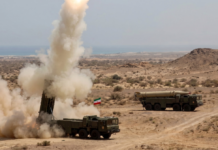
The problem is that Ukraine intercepts something like 90 percent of the drones fired by Russia. He greenlights the use of the Iskander ballistic missile. His military advisors tell him this is still not guaranteed. They’ve fired dozens of them before, and not all get through. One night, they fired 33. No, they tell him, we must use the Oreshnik, their newest hypersonic ballistic missile that has multiple warheads.
Putin asks for plans, and his military responds. They deliver more than he asks for. They design a plan that includes more than 450 drones, two dozen Iskanders, and four Oreshniks, a third of their current inventory. The drones, they explain, will make it look like a normal attack. The Ukrainians will deplete their missile defenses by shooting them down. Because it takes time to reload, this increases the chances of the Iskanders hitting. The Oreshniks will strike after 80 percent of the other munitions, hopefully catching the defenders unaware, giving them even less time to intercept the speedy missiles.
Then someone says, “If we are going to hit the presidential office, why not the Verkovna Rada (parliament), the Ministry of Defense, and the Ukrainian Security Service? Let us show these criminals what happens when you dare to strike the Kremlin!” Other heads at the table nod. Yes, Russian doctrine calls for an overwhelming attack. Why make a statement when you might decapitate much of the government and leave Ukraine in disarray?
Then one of the senior military officials says, “If we truly want to end the war, we should use nuclear weapons. Our plan has always been to escalate to de-escalate.”
Around the room there is almost universal agreement. Inside, Putin winces, but he is afraid to show weakness. He nods. “Hit them so hard they cannot raise a finger against us. Hit them so hard, no one will dare raise a finger against us,” he says.
The Strike
Five days later, wave after wave of Russian drones are launched. Across Ukraine, radars light up and alarms blare, but this is nothing new. The night proceeds like any other until an earth-shattering blast hits the Starokostiantyniv air base, which hosts Ukraine’s F-16 fighters and Su-24 bombers. As reports trickle in, one of three Iskander missile set for an airburst with a 50-kiloton warhead makes it through the defenses and explodes a kilometer above Odessa, a critical port. Suddenly, there is no doubt: Russia has resorted to using nuclear weapons.
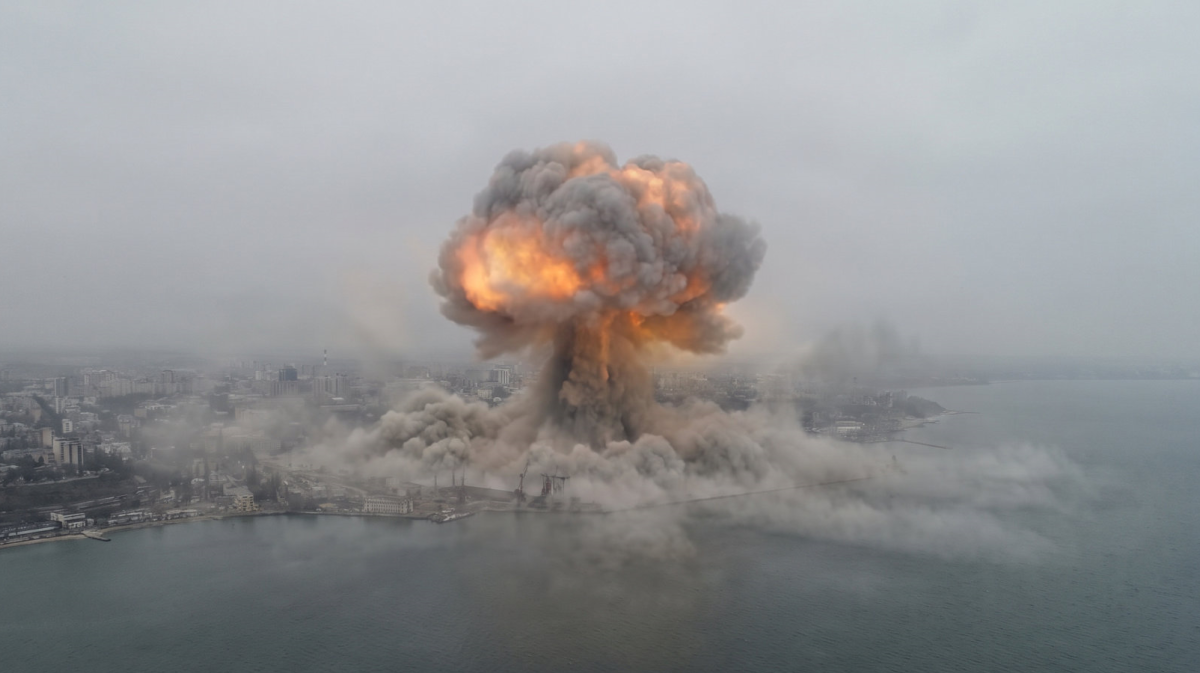
Just as this news spreads, the Oreshniks hit. Three warheads hit Lviv, three strike Dnipro, and twelve hit Kyiv, eight of which are ground bursts with the remaining four airbursts. Moscow has overcompensated. They targeted the government sector, but large segments of Kyiv ceases to exist. Any prior war damage pales in comparison. Apartment buildings that might have been damaged by earlier drone attacks are wiped from the face of the earth. The death of a few dozen school children killed when a school is hit pales in comparison to the estimated half-a-million killed in the attack. In a month, the radiation, thermal injuries, lack of rescue, and other attack-related injuries will bring the death toll closer to one million people.
The News Breaks
Because Ukraine is seven hours ahead of us, by the time you wake up, the news has spread. Communications are disrupted, so there is little on-the-ground reporting, but there is satellite photography. You watch correspondents in European headquarters reporting what little they know: that Russia launched a nuclear attack on Ukraine, hitting between five and eight strategic targets, plus some civilian in nature.
The rest of the world is stunned, outraged, or both. In Europe, the French bluster. The Poles and the Finns send troops to their borders. The Germans appear frightened. The Brits keep a stiff upper lip while calling up troops. The Russians cheer. The Secretary-General of the UN blathers but said little of any worth. China issued a surprisingly strong rebuke over the use of nuclear weapons in a first strike. The president has been silent, not even posting on Truth Social. The media reported he was whisked out of the White House in the middle of the night and possibly taken to Joint Base Andrews, but no one knows where he is.
Around the world, U.S. naval ships and submarines are leaving ports, readying for the possibility of war. Military wives report their husbands were called up and activated, even if they were on leave. At Ramstein Air Base, the media films soldiers deploying Patriot missile systems and other air defenses no one has seen before. Air traffic there increases throughout the day.
The stock market plunges as soon as it opens, triggering circuit breakers that stop trading. The stock markets make an unprecedented step of closing for 48 hours. Oil surges 77 percent and shows no sign of slowing down. Gold is up 43 percent; silver is up 52 percent.
What Next?
No one knows what will happen next, so you have to act based on what you think might happen.
The U.S. has threatened to hit Russia with conventional weapons, but that was if they used one or two tactical nukes on the battlefield. Will that response change given that they used at least two dozen tactical nukes? Keep in mind that what passes for a tactical nuke today is in many cases more powerful than the bombs that were used to end World War II. We’re not talking about a tactical nuke that was fired from an artillery shell to create a breach on the front line; while these were not intercontinental ballistic missiles that can deliver megatons of destructive power, they were still missile-born tactical nukes that were estimated to have delivered up to 50 kilotons of destructive power.
What will Europe do? France and the UK have nuclear weapons. Putin has previously threatened to hit European “decision making targets” and factories supplying drones and missiles to Ukraine. Should they wait, or strike first?
During the Cuban Missile Crisis, people quickly emptied shelves at grocery and hardware stores. Gun sales soared. (And this was before the 1968 gun control act, meaning it was easier to buy a gun.) While there was no mass exodus that clogged highways, there was some migration as those who could left cities like Washington and New York. A surprising number of people who lived near important military bases found a pressing need to visit family in faraway locations. Of course, the population has almost doubled since then, and with social media it is easier to stir up panic today than it was in the 1960s. Who knows how Americans will act today?
What is Your Plan?
Make your plans now and then come back in a couple of days to see part two where we cover possible options.