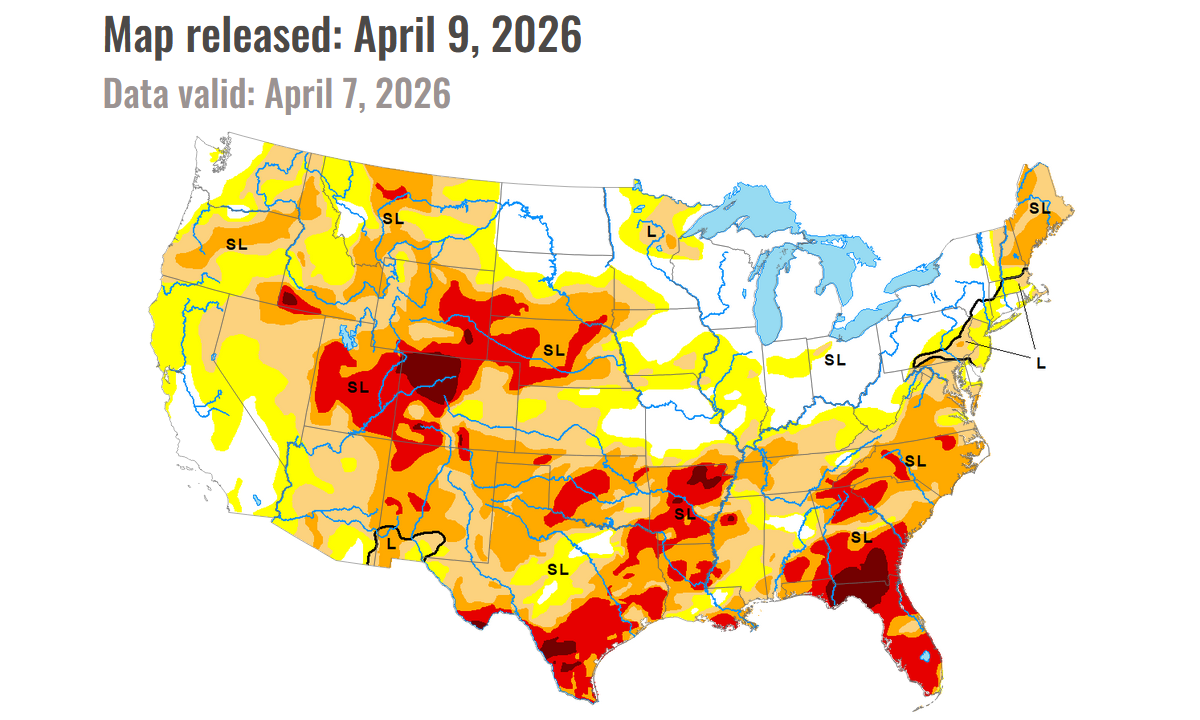
Did you know that almost two-thirds of the country is abnormally dry or in a drought? On the drought monitor map above, the darker the color, the more severe the drought is.
Have you heard how forecasters expect a “Super El Niño,” this year, meaning a once-in-a-decade weather wallop that could sow havoc across much of the populated world? The Science Times warns of “a complex mix of weather disruptions that can impact agriculture, water supply, and daily life globally.” This includes rising temperatures—possibly marking this as the hottest year on record—unusual weather patterns with more drought in some areas and more rain in others, and extreme weather disruption.
In other words, batten down the hatches.
We’re already feeling it with unseasonably warm weather and little rain.
I remember driving through South Carolina and Georgia back when the last big drought hit the South and being amazed at how dry the lakes I could see along the highway were. So much water was missing that people’s docks—where there used to be six or more feet of water—were a hundred or more feet from what little water was left in the lake. Things recovered—in fact, I think a busy hurricane season gave the area so much rain the drought was gone by the end of September—but it was a long, hot summer. I expect the value of lake-front property dipped that year.
Rain and the Water Supply
As a guy who lives on water trickling from a natural spring, the last thing I want is a drought. I’ve never heard of the local springs going dry, but you never know. We got 5/8ths of an inch of rain last week and felt lucky. We could use that twice a week instead of once every two or three weeks.
The good news is that the mountains get more rain than the plains. The bad news is, it can fall one hollow to the West or South and we won’t get any of it. On a drive home from town, we can drive in and out of a heavy shower two or three times, depending on how the mountains push the clouds around. On the other hand, a super El Niño tends to bring rain to our area; we just have to wait for it to hit. That might not be until the fall.
We’ve got some bottled water and some storage water for short-term emergencies, and some fire-fighting water in IBC totes (not for drinking), but we count on our spring. If the spring dries up, I could pump creek water into cistern and use it for showering, washing the dishes and clothes, and watering the animals and garden, but our drinking and cooking water would be run through a big counter-top filter. Then, when the water comes back, we’d have to give the system a chlorine shock treatment.
After Helene, a statewide nonprofit tested our water twice and was supposed to install an ultraviolet water treatment system, but we haven’t heard from them for a few months. I’m not sure how it would fare against creek water. I expect we would need to add a particulate filter at the very least.
How to Prep for This
The good news is that summer isn’t here and there’s some time to prep.
When I think of unusually hot weather and drought, I immediately think that the air conditioning system is going to be more important than ever this summer. I also worry about stress on the grid. The next thing that concerns me is the rising price of beef and the impact a drought might have on the wheat and corn growers who supply so much of our food industry. Less grain means higher prices, which means the (hopefully temporary) inflationary hit we are taking could either bounce back up or get extended.
When we buy hard red wheat for grinding, we get it from Montana. The wheat-growing regions of the state are abnormally dry or in a moderate drought. Since this is winter wheat, it won’t be harvested until mid-July to August. We’ll have to see what happens, but it isn’t looking good. In the meantime, if you need a few 5-gallon pails of wheat, it might be a good time to stock up while you can.
If you plan to head for the shore, the beach, a lake, or somewhere else to cool off this summer, book your reservations. And if you are wealthy? The dog days of summer may be the time to visit Chile or Argentina, where it will be winter.
The Misery Index
One downside of heat you may not think of is that hot temperatures often mean hot tempers, and anger and violence can increase in the summer. I expect this happens everywhere, but it is more obvious in large urban areas, not only because they have more people, but because the cement and asphalt retain so much heat. If our summer temperatures soar, they may reach 87°F. (Days over 80 are rare at our altitude). In a city that could be 107°F.
It won’t only be people in urban centers who are miserable if we experience the hottest summer on record; we all will be. I know cranky people are kind of minor compared to an economic collapse, a war with China, an EMP, and all the other things we prep for, but it shouldn’t be ignored. This is the kind of weather where a fender bender can turn into a shooting, where random assaults on people tick upwards, and the number of crazy people out in public seems to climb. Domestic violence also can spike as anger builds.
You may not be able to stockpile coolness and calm, but you can practice it, and you can try to be aware of its absence. When you see things getting out of hand, you can make yourself scarce so you don’t get caught up in it.
With the mid-term elections coming this fall, there will already be an increase in vitriol and hatred online. No one says you have to read it or respond to it. Just be cool—at heart, if not in an air-conditioned room.