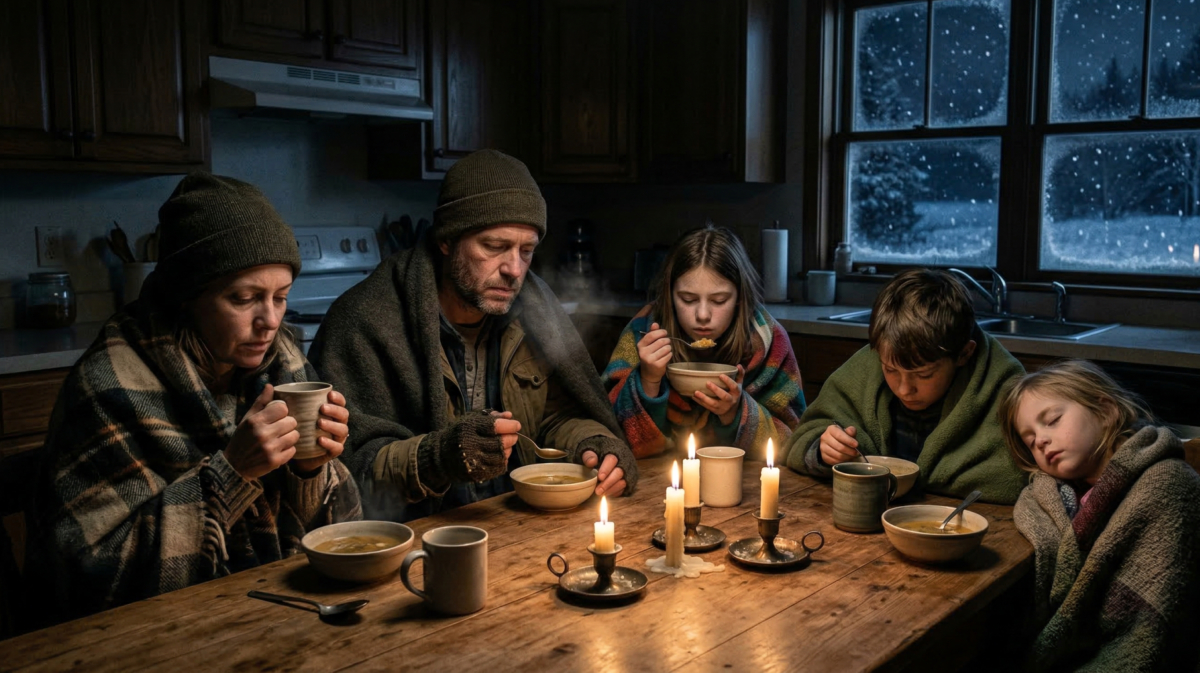
We had a four-hour power outage Monday because of a storm with high winds, but Cuba experienced an island-wide outage, which its National Electrical System called a “total disconnection.” At least it’s warm there, so no one will freeze to death. It was 15°F here when I woke up yesterday. That’s the kind of weather that kills people who don’t have backup heaters, and a Little Buddy and a few one-pound propane tanks may not be enough.
This might be a good time to ask yourself, “How well am I prepared for long-term power outages?” I use outages in plural because while you may experience one lengthy outage, you might also experience multiple outages over a short period of time. That is what often occurs when electrical systems or societies begin to fail.
Most U.S. power is generated by natural gas (43 percent) followed by nuclear energy (19 percent) and coal (16 percent). Hydropower is responsible for 6 percent. Wind power is another 10 percent. As a result, it’s more likely people in the U.S. will get their power shut off because they can’t pay their bills than because of the Iran war. That’s also Cuba’s problem; they can’t afford to buy oil to power their electrical generation. Not the people, not the families, but the government is broke.
Ah yes, the joys of socialism writ large for all to see–if anyone bothers to look. Cuba has been a failed state for some time, and it is reaching the point of no return. Socialism is dying there, much like it has failed elsewhere, leaving the populace poor, hungry, and in the dark.
Regardless of why you might lose power, let’s talk about what you can do, using our layered approach to prepping.
Lighting Lifts us from the Dark Ages
Before there was electricity, people relied on candles and oil or gas lamps. That’s one reason so many whales were killed; to render lamp oil from their fat. While you can’t go out and buy a bottle of whale oil, you can still buy oil lamps, which usually burn a paraffin-based lamp oil or kerosene. Both lamp oil and kerosene are distilled from petroleum products. Lamp oil burns cleaner, while kerosene smells.
Most candles—especially the cheap ones—are made from paraffin wax, a solid version of lamp oil. You can also get candles made from soybean oil. Beeswax candles are the most expensive, and as a guy who produces a five-gallon bucket full of wax every year, I can tell you it is not easy to come by.
Today, I have oil lamps, hurricane lamps, and Coleman lamps stored in our storeroom and garage, along with fuel for each. These are not only among the first things I ever bought to generate light, but they are also the least expensive.
Flashlights and camp lanterns come next on our list. We still have a big, old lantern that uses D-cell batteries, but I remember lamps from childhood that ran on what we called “dry cells” and were much larger than D batteries. Today, almost all our battery-powered lights and lanterns run on rechargeable batteries, and we have standardized on rechargeable 18650s with CR123s as fallbacks.
When it is pitch black, having a headlamp or flashlight will extend your work hours, keep you from stubbing your toe in the dark, prevent you from burning down the house with a candle, and let you see what caused that bump in the night. These belong in your preps.
Refrigeration is Critical to Modern Society
As important as emergency lighting is, you can eat in the dark. But without power, any food in your freezer or refrigerator is going to spoil in a few days, your microwave won’t work, and your electric appliances are as good as dead.
If you have only a few hours without power, your food will last. If you hit that one-day mark, you need to hook your refrigerator and freezer up to a generator, either one that burns fossil fuel or a solar generator. Of course, a good generator will also solve your lighting issues and food preparation concerns. If you are rural, it may even pump your water.
A 2,000 to 4,000-watt solar generator is a good starting point, as long as you have 400 to 800 watts of solar panels to recharge it. Add a 2,000-watt generator, like the Honda EU2200i, and you can recharge your solar generator when there is no sun.
From there, you can move up to larger generators and even a whole-house generator. Traditional generators run on gasoline, although you can get multi-fuel versions that also use propane or natural gas. Larger models and commercial generators run on diesel. Whole-house generators usually attach to your natural gas supply or a large propane tank. We looked into a whole-house generator but opted for solar instead.
The obvious problem with any traditional generator is that it will run out of fuel if the power outage lasts long enough. But if the outage is intermittent, you can run out and fill a few gas cans or buy another propane canister. That’s what people did after Hurricane Helene.
Of course, sunlight is a renewable resource, but depending on where you live, there can be days in a row without sunshine.
Whole-House Options
After living with no generator, and then one of several generators, we bit the bullet and invested in whole-house solar power. During that four-hour outage, our battery dropped from 100 to 89 percent. My neighbor, who lives off-grid on solar, didn’t even know there had been a power outage. We only knew because our app told us.
A post on my thoughts after owning the solar power system for one year gives you the details, including that the system handled 61 out of 63 power outages with no issues.
Our whole-house solar power system is our first layer of defense against power failures. If it fails or the sun is out, we are back to generators. If that fails or we run out of fuel, we are washing clothes in a bucket and hanging them on a line to dry, cooking over an open fire, and hoping we don’t run out of batteries, candles and kerosene. I’ve previously compared living without electricity to being like living in the 1880s, but without the experience or the horses. If the electricity is out, the Internet may well be too. But that’s OK, I’d prefer the 1980s (modern society before the Internet) to the 1880s, horses and all.