
On Monday, we un-froze our pipes. It took a heating pad, the chick-warmer, a heat gun, and 90 minutes, but we have running water again. Since the low this week should only be 16°F, we don’t expect a repeat freeze. That usually takes single digits. It just goes to show you should never buy a house built by a guy who used it only in the summer and spent the winter in Florida.
This experience is a good reason to talk about water as part of your preps. I harp on food, but water is critical.
The Limits of Storing Water
You have no doubt heard that you should store one or two gallons of water per-person, per day. I’m here to tell you that if you do that, you’d better be using a pit toilet or a latrine that does not require flushing, you won’t be doing laundry, you’d better eat on paper plates, and the only bath you will take is a sponge bath.
Surviving on one gallon of water per day is right up there with living on 1600 calories per day. You may be able to do it for a few days, but not for a few months, at least not without diminished capabilities. It may work if you are locked in a bomb shelter and are not doing anything physical, but it won’t work if you are active and living as close to a “normal” life as possible. One gallon of water may be enough for consumption, but not much else.
We thought we had the water question beaten because we have a gravity-fed spring. It even survived Helene. But this is the fourth winter it has frozen out of the six winters we have lived here. We buried the pipe, ad that helped, but we seem to fix one spot, and it just freezes somewhere else.
So we have 37 gallons of stored water in our garage as a backup. We could store more because we still have a 55-gallon blue plastic drum that I kept filled in the garage at our previous house. We don’t fill it here because we don’t expect to need it. If we filled it and all my one-gallon containers, we could store 100 to 105 gallons—enough to last the two of us and the chickens ten days.
Unless you have large storage tanks—I’m talking 2,500 gallons or more—you will need to obtain water from a natural source in the event of a lengthy emergency.
Finding and Hauling Water
Our land has creeks on three sides and one running down the middle of it, so we have plenty of natural water. One neighbor has a pond. Another has a well, although that requires electricity. So there is water available. The challenge is getting the water home once we fill our five-gallon containers or buckets. Our options are:
- Carry it by hand.
- Load two or three into our garden wagon and pull it home.
- Put two to four into the wheelbarrow and push it home.
- Load the storage vessels into a small trailer and pull it home with the garden tractor
- Fill the bed of the Polaris Ranger with containers and drive them home.
- Like number 5, but add a small trailer to carry even more water per trip.
- Same as 5, but with the pickup truck.
The problem is that five gallons of water weigh 42 pounds and the first three require labor. The next four require gasoline and working vehicles. We’d start with option five or six, although we would use seven if we were already driving the truck somewhere. When gas runs low, we’ll re-examine the manual labor and probably opt for the wagon. There are countries where option one, carrying it by hand, is the primary source of water for millions of people. It’s doable. We’re just back to no flushing, minimal bathing, and less cleaning.
My wife says you can’t run a modern household without water. We managed without electricity better than we did without water. There’s a good reason water is number two of the big three: food, water, and shelter.
How to Get Water Close at Hand
Rather than dragging water home from another location, you would be better prepared if you had it piped to your door or, better yet, to your faucet.
I have seen a farmhouse from the early 1900s that had a brick-lined cistern buried in the backyard. A pitcher pump sat on top, but there was also a pipe with a faucet that fed into the basement. The family who built the house probably thought they had it good.
Our gravity-fed spring system gives us running water—at least when it is 10° or warmer. Similar off-grid options for close-at-hand water are:
- Solar-powered well pump
- Manual-powered well pump
- Wind-powered well pump
- Ram pump from a nearby stream or river
- Rain catchment system
Except for a solar-powered system that has batteries, these require a cistern or tank to store water so it is available on demand. If the tank is above your point of use, you can then have gravity give you water pressure. If the tank is at or close to your level, you won’t have pressure, but you will have a ready source of water, and that beats hauling it in that wagon or carrying it by hand. Here’s a look at these in greater detail:
Solar-Powered Well Pump
We have an off-grid neighbor with this setup. She has 1,200 watts of solar panels that charge batteries, which power a well pump. This system gives her water day and night, just like city water. Power outages don’t cut off her water, but I would guess her power might run low if there were four or more days of no sun.
This is a good option and works in good times and bad, but it is a modern system and components will wear out, degrade, or fail. It may be best to stock some extra parts, like a charge controller. Still, unless it gets struck by lightning, I expect she will get twenty years out of her system, although it will produce a percent or two less power with each passing year.
Manual-Powered or Wind-Powered Well Pump
These are mechanical and often use a metal linkage to operate a pump. Old-fashioned hand pumps are pitcher pumps and can’t lift water more than 20 feet. Windmills that pump water from deep below the surface usually use reciprocating piston pumps, as do some specialty hand pumps meant for deep wells.
With a pitcher pump in your backyard, you can pump water when you need it. With a windmill pump, the water fills a tank when it is windy. Then you rely on gravity or a tap on the tank to provide your water.
This is older technology; I can’t tell you it is more resilient or less likely to break than solar, but it is easier for you to fix using hand tools during a long-term emergency.
Here’s an amusing bit about a windmill pump. It drives home the reason you need a tank:
A Ram Pump
A ram pump, properly called a hydraulic ram pump, uses the force of moving water from a stream or river to lift water from the stream to wherever you need it (within reason). The force of the water flow, the size of your pump, and the height combine to determine how much water it can lift. But since it runs 24-hours a day, like our spring, even if it produces a small amount of water, it will fill a large tank over time. For example, half a gallon of water a minute works out to 720 gallons a day.
Modern households consume an average of 90 gallons per-person each day. So 720 gallons is lots of water. Even if your pump produces only a quart of water per minute, that’s 360 gallons per day, enough for four people. Add efficient appliances and low-flow shower heads, and you can get to 40-gallons per day. That’s for normal times. In an emergency, you can flush less, shower less, and otherwise restrict your water use and still come out way ahead of the folks who have to carry buckets of water to their kitchen.
Of course, if you have livestock or need to water your garden, you’ll need more water.
Ram Pumps are made with modern materials. If I relied on one, I think I’d have two spares for every critical part, extra pipe, and maybe even a spare pump.
A Rain Catchment System
This is one of the oldest methods of water collection known to man. Modern roofs and gutter systems can make it even easier. The key to sizing your system is to balance the worst month of rain with the highest month of use. If you live somewhere with a rainy season and get all your rain in a three-month period, then you have to store enough water to last the other nine months.
The rule of thumb is that one square foot of roof produces 0.6 gallons of water when it rains one inch. So if you have a 1,000 square-foot roof, you could capture 600 gallons of water every time it rains an inch. For the sake of argument, let’s assume you average 50 inches of rain a year. That’s 30,000 gallons, or 82 gallons per day. This would be enough to support one person, two if you are careful about your water consumption. If you expect to go three months without rain in a worst-case scenario, you would need a 7,500 or 8,000 gallon tank. If the longest period without rain is six weeks, then you can cut that number in half.
Note that a well-designed system will have a diverter to keep dirt and bird poop from your roof out of your water. With it, the first few gallons rinse the roof so they do not contaminate your water tank.
One nice thing about a properly configured rain-catchment system is that it has no moving parts. Sure, a tree can fall on your roof or a limb can damage a gutter, but this is not dependent on modern technology. It will still need cleaning and maintenance, but there is less to go wrong than with many alternatives. All you need is rain and a filter.
When to Treat Your Water
We drink raw water every day. Our water has coliform bacteria in it, but that’s common for springs. The EPA would like us to treat our water, but we don’t. We have tested it twice and not had E. coli, so we take our chances.
If I was getting water from our stream in a bucket, or from a river via a ram pump, that would be a different story; I’d want to purify it. If I were drinking rainwater, I’d want to filter it, at the very least. I’d have my well water tested, but hopefully it would not need much treatment.
Flushing Water Versus Drinking Water
If you plan on drinking wild water, or water from questionable sources, after the SHTF, I recommend filtering your drinking water. Chances are, you won’t need to filter the water you use to flush or even shower, as long as you keep it out of your mouth.
Two ways to do this are:

- Buy a drip filter with a ceramic filter element and place it in your kitchen. Pour the questionable water into the top and use filtered water that drips down into the lower portion of the filter for drinking and food preparation. We know one woman who even washes her vegetables in filtered water.
We have two Katadyn drip filters tucked away. Each of the three ceramic elements in these units is rated for up to 13,000 gallons, as long as we scrub the filters periodically to keep them from clogging. That’s a massive volume of clean water. - Install a reverse osmosis filter on your kitchen sink. The downside is that these devices are not cheap and require electricity. The plus side is that they are highly effective. You can then use the filtered water for drinking and food preparation.
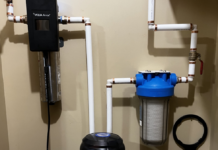
There are other whole-house systems that range from simple particulate filters to UV light that inactivates bacteria to systems for reducing iron or softening your water. Your needs will vary based on your water source and quality, so do the research, conduct some tests, or play it safe and get a filter or other purification system.
Store Water, Source Water, or Both?
The final lesson is to store water for short-term emergencies and have a plan to harvest and treat water during lengthy emergencies. And if you buy or build a retreat, build in a resilient off-grid water system like those listed above. It will be money well spent.
For storage, we use commercially bottled water to drink and bulk water, stored in containers seen in the main photo above, for flushing, cleaning, and watering the chickens.
Whatever you do, don’t believe the survival myth that all you need is one gallon of water per day. If you do, count on being dirty, smelly, and thirsty.