I maintain a multi-part shopping list on my phone. It’s a living list, meaning things are constantly being added to it and crossed off. It is divided into the following categories:
- General Stuff
- Bee stuff
- Harbor Freight list
- Lowe’s/Home Depot
- Sam’s or Costco
- Guns and ammo
- Emergency supplies
- Dream list (stuff I can’t afford)
When my wife tells me, “we’re running low on unsalted butter,” I add it to the Sam’s Club list. Nothing stops her from getting it at the grocery store if we are about to run out, but it reminds me to buy 4 or 8 pounds when I next go to Sam’s Club.
I haven’t been to Harbor Freight for months, but the next time I go, I’ll know to pick up more microfiber towels and work gloves because they are on my list.
Just this week, I picked up tire patches. Not to patch a tire or innertube, but to see if I can fix my old, leaky Dry Fit boots, I already replaced them with a new pair of Muck boots, but I like the idea of an emergency pair. So I’ll see how the glue sticks to neoprene. Or should I say if the glue sticks to neoprene—I may need another adhesive for that.
Slow and Steady Progress
Looking at the progress I have made on the list over the past year tells me I am a lucky man. I’ve purchased boxes of the subsonic .22LR and .300 Blackout I wanted and restocked both range and hollow point 9mm. I got the Kimber CDS9 I was hankering for, and I recently purchased another two 15-round magazines for it. Now I have a new (to me) chainsaw, a new bar, and a spare chain. More chains are on the list. There’s no rush, but I expect I’ll have two more by year-end.
There’s still stuff I want, like that frame decapper and a honey extractor, a 9mm suppressor, an FRT (or two!) and then there’s crazy win-the-lottery stuff on my dream list, like a 20-foot container I can stash up the mountain or the EG4 solar powered heat pump that does not need to be attached to the grid. But overall, I’m pleased. In the six years we’ve been here, I’ve checked off an awful lot of boxes, and while Hurricane Helene may have briefly derailed us—and added lots of emergency repairs to the list—it didn’t stop us.
Some things on the list took work—like the chicken coop and raised beds. Other things required money, which has to be budgeted and accumulated over time.
It’s a Journey
Consider this a reminder that Rome wasn’t built in a day. Prepping is a lifelong journey, not a onetime frenzy of buying. If you’re just starting your prepper journey, give yourself time. Prep regularly, and in a few years when you look back at what you’ve checked off your list, you’ll be proud of how far you have come.
I am living proof of why you should not wait until the last minute if you want to buy a retreat or move to a prepper property. While it’s good to have a place to go if the SHTF, it’s even better if you have some infrastructure there waiting for you, and that takes time to build, buy, or grow.
My parents built their place in the mountains one step at a time, when they had the cash. First, they bought the land. Then they hired a dowser, found water, put in the driveway, and drilled the well. Next, they built the foundation, and it stayed there, a patch of ground with just a foundation on it long enough to grow a year or two’s worth of weeds before they built and dried-in the house. Working on the interior came next. I’d say it was a five or six-year project, but they enjoyed it for the next 35. That’s a worthy investment.
The six years we’ve been here have flown by. I’ll be shocked if I get 35 years here, but another 20 would be nice.
None of us know what the future holds, but we can take some steps to narrow down where we spend it, with whom, how much gear and supplies we have, and what kind of renewable resources are present. That’s what I did and continue to do. I recommend that you consider the same.
When the stock market hits record highs while the University of Michigan Consumer Confidence Index hits record lows, you know it’s a crazy, unpredictable world out there.
My “To Do” List
I also maintain an evolving “to do” list. I start it afresh each month, but I add new things to it and cross things off almost every day. This differs from my calendar—which is for items with a specific time and place. This is for tasks that I can fit in anytime the weather allows.
I put the most important items at the top of the list, along with the most time-sensitive (not always the same thing, mind you) and work my way down. Sometimes the order changes as I move something up the list.
I’ve noticed that firewood and honeybees are almost always on it. This time of year, I am tending bees and cutting firewood, with an emphasis on the bees. In the winter, I am burning firewood and building bee supplies, with an emphasis on the firewood. They are both seasonal things, although in our climate the firewood has a longer season than the bees.
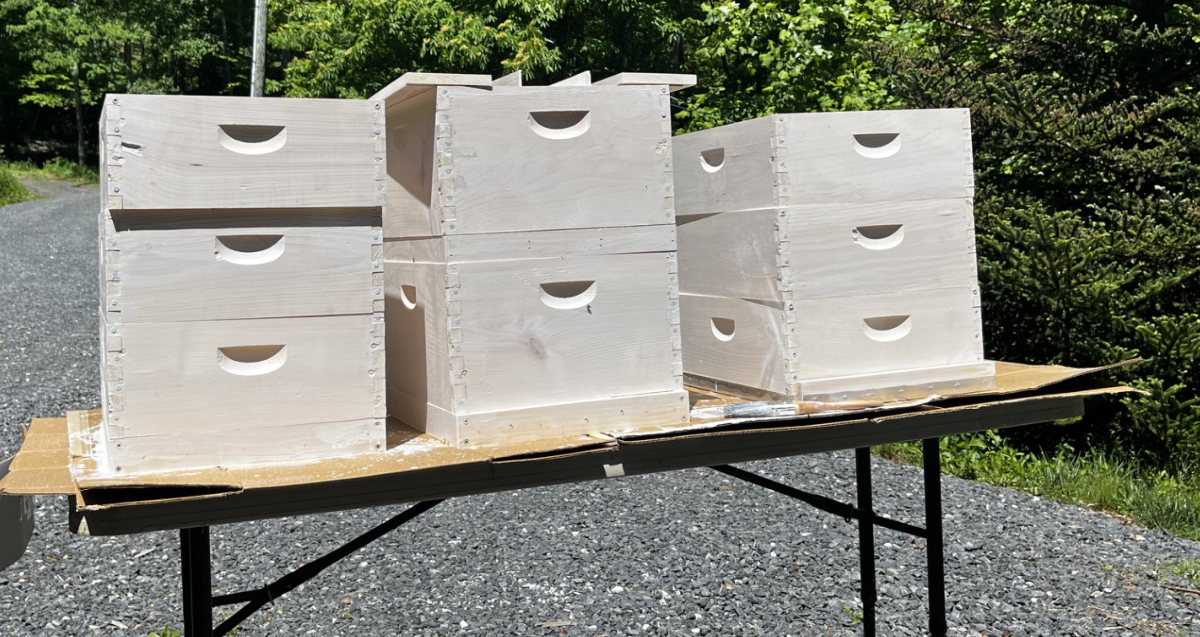
One thing that had been on my “to do” list for some time was to paint the bee equipment I have been assembling. It’s among my least favorite beekeeping activities, but I usually do it twice a year. After buying new equipment a few weeks back, I ran out of excuses. So I stacked up 12 medium supers, a large hive body, a queen castle, five migratory covers and two solid bottom boards and started painting. Only after I was finally done and put everything away did I realize I had not painted the six nucleus hive boxes I had built. Darn. Now I have to paint again.
On Being Well Organized
You can tell that I like lists. Besides my “To-do” list and my “What to Buy” list, I have the “What to buy if the SHTF” list, with things like chicken feed, bags of potatoes and onions, cheese, and gasoline on it. It’s full of last-minute purchases of goods that are not shelf-stable enough to keep on hand for two years.
Then I have a list of what to bring if you are bugging out to our place. It starts with clothing, footwear, eyewear, medicines, and health and beauty stuff. I can feed you for a while, but I can’t dress you, you aren’t getting my boots, and I probably don’t have your brand of shampoo. Next is extra bedding and your own pillows because we only have so many and we have no idea if we’ll be getting four people or eight people bugging out up here. It will depend on a number of variables, including the type of disaster and the amount of forewarning people get. Only after personal items do we get to food, firearms, and other traditional “prepper” stuff.
I also have a list of tasks and roles for people who bug out here after the SHTF. Again, this assumes we have people who bugged out here. I also have a list of things we will be short on and need to be rationed. This includes obvious things like food, but also water. We may have gravity-fed water, but its flow is limited. If eight people move in, they can each take three showers a week and have one day on which to do laundry. (Assuming the solar power system is up and running and it is sunny; otherwise, no laundry and a cold shower.)
Power is another item that is limited if the grid is down. If we are running on solar, then that power goes first to refrigeration, food prep, lighting, communications, and rechargeable batteries and devices, in that order. Solar power is only going to the water heater or the washing machine on sunny days when the batteries are at 90 percent or more. Anyone who complains will be “showering” in the creek.
Organized Gear
The bug-out, homestead defense, EDC, and other bags we have are another way in which I am organized. No sorting through things in an emergency, just grab and go.
Keeping an inventory is also important. Every year or two, I count all our canned goods. I also maintain a running list of #10 cans and 5-gallon pails, separated by category: grains, vegetables, fruits, soups and stews, etc. This helps identify what we need to rotate out by consuming or donating, and what we need to buy more of. If the cans of corned beef hash are disappearing, then we need to stock more of it. That hash, canned chicken, and chili are the things we eat the most, plus the canned beans my wife cooks with. We occasionally end up with extra things like canned pumpkin, which were bought on sale and stick around for a few years. It’s not really my kind of prepping food, but who doesn’t like pie?
I also have a running total inventory of ammunition. It’s easy to keep up because I shoot lots of .22LR, a good amount of 9mm, some 5.56, and a little .300 Blackout and not much else. I should shoot more .308. I keep telling myself that, but rarely do.
Organizing my Library
I have an extensive library of prepping and other books related to survivalism and homesteading. They can teach you everything from how to trap a beaver (or just about any other animal) to how to skin it, recipes to prepare it, and what to make from the skin. Many are the classics, such as Where There Is No Doctor and Carla Emery’s Encyclopedia of Country Living to the Ultimate Sniper, and a number of reprinted military field manuals. Some of these are on the shelf, some in boxes.
Over the past decade, I’ve been accumulating eBooks. Many of these are PDFs available online, often for older books that are out of print and no longer copyrighted. I had one big folder on my hard drive called “Prepping Guides and Books.” It was almost three gigabytes and growing unwieldy. Recently, when I was setting up my Enoch File document management system, I learned there were 330 digital books in one location on my computer. That was not optimal, so as I uploaded them to Enoch File, I divided them into the following categories:
- Beekeeping (of course)
- Bushcrafting and outdoors survival
- Chickens
- Gardening
- Hunting and game preparation
- Gun related
- Nuclear and radiological
- Prepping (everything else)
- Rabbits
- Rebuilding and recovery
- Recipes and canning
- Survival and evasion
- Survival medicine
By doing this, I reduced my main list of books, meaning everything not covered by a category, down to 128 books. Most of them are general survival, financial collapse, or news articles that might have been great when I saved them, but are less pertinent today.
Now you may be asking, what good will ebooks on Google Drive do you if there is no internet? Easy. Once I uploaded everything over there and organized it, I dragged those newly sorted folders back over to a thumb drive that is now stored in my ammo can Faraday cage with my radios.
I’ve mentioned Enoch File once before. It’s a personal document management system that lets you store, organize, find, and retrieve digital documents quickly and easily. I’ve been using it for about a month and find it to be intuitive and that it forces me to be organized. You can try out the free version or get the first month free on the premium version—or take $3.99 off the annual cost of $29.99 by using coupon code Pickled. So check it out, and thank you, because I get a piece of the pie when my readers sign up.
Learning From the Past
One of the most enjoyable things about separating 330 books and articles by category was reviewing what was in there. Here’s a quote from an article I saved back in 2022:
“The collapse of techno-industrial civilization is likely to occur on the present business-as-usual mode of social functioning, probably by 2030, but there are scenarios where it could be before Christmas 2022, if the West and Russia slide into nuclear war.”
Gee, not much has changed. It’s a good reminder that we have been worried about nuclear war for the past five years… or the past 70, counting back to the Cold War. Seventy some years and we’ve survived. That’s not a bad thing to remember when you feel doomsday approaching.
I also found my EMP or CME prep list, and my list of “What to do if China Attacks Taiwan.” They may have both been made it into blog posts, but I have the original document personalized to my family here.
Being well organized is like adding an extra team member; it makes you more productive, able to react quicker, and you never wonder what to do next. Whether you keep a list in a notebook or on an electronic device, the important thing is that you start keeping lists or use another system to plan and organize your life and your preps.