
It was supposed to be sunny on Tuesday, but it rained until 3 p.m., giving us another half inch. I still had time to run out late afternoon and insert a couple of escape boards in the beehives at our house and check my new queens. One is laying well; the other, not so hot.
Yesterday, I went out there again and pulled three more supers of honey. That will make 16 so far this year. We should net out at more than 400 pounds of honey after the August harvest. We could earn more than $5,000 on honey if we sold it all direct or to retailers, but that’s going to take some work. And if I have to sell it wholesale in 5-gallon pails, we wouldn’t get half that. I expect we’ll end up somewhere in between. Either way, it will pay off the investment in the extractor, which is working great.
One of the unspoken downsides of harvesting honey is that everything ends up sticky. The floor gets stick of course (we have already washed it down once), along with ours shoes, and the doorknobs. We wear rubber gloves and keep a bucket of water handy to rinse them, but your forearms, elbows, and, in one case behind my ear, all end up sticky. Sure, you rinse off, but the next time you sit down in your chair, the armrests are sticky, or you get in the car and the steering wheel is tacky.
Too Much Honey?
Four hundred pounds of honey is 552,000 calories. I figure that’s an extra 150 calories per person—about 7 teaspoons—per day for ten people for a year. If the SHTF and we are low on food, that plus eight or ten eggs a day will be a big help. But with only two of us, that’s quite a bit of honey.
Can you have too much honey? Perhaps not, but you can have more than you can easily sell. I am looking for more local outlets to carry mine. I am also giving more of it away, so I carry two one-pound jars in my truck, and when I run into a neighbor or even a close acquaintance, I give them a jar. “First pound is free!” I tell them. I’ve gotten new customers this way. I have a few individual customers who now buy two or three quarts a year because I once gave them a free jar. And for the neighbors, even if I never get a sale, it helps build a relationship. They may not remember my name, but they’ll remember the bee guy who drives up and down the road in a white suit and gives them free honey.
Chicken Update
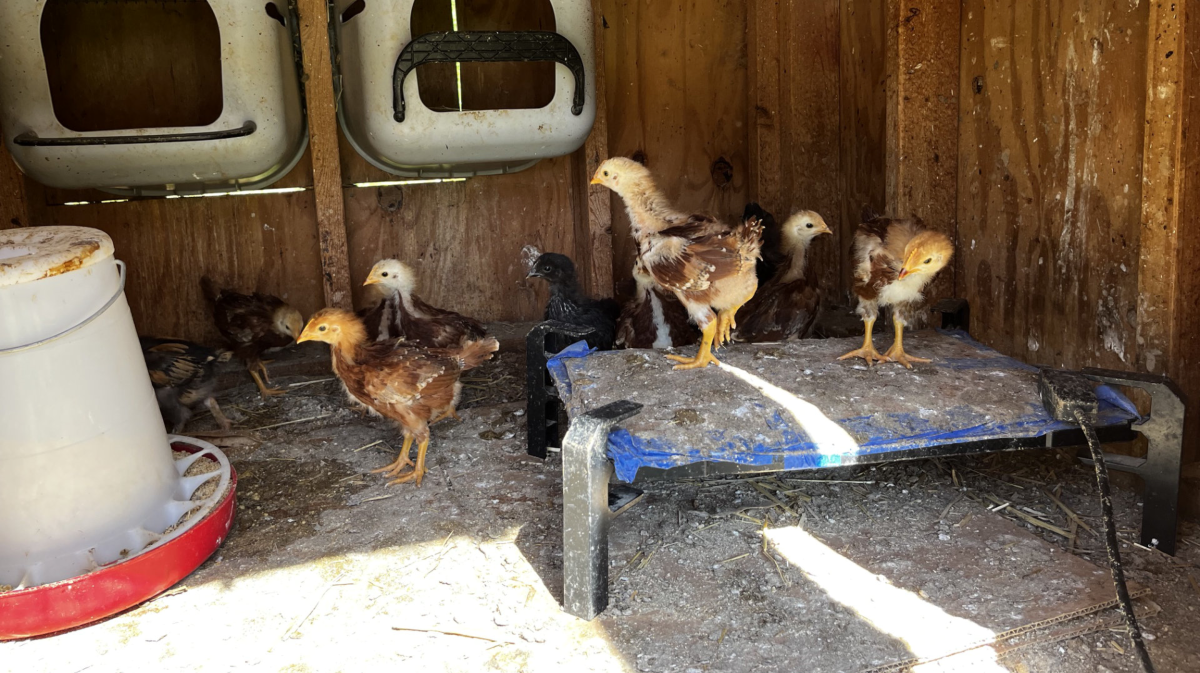
The chickens are now three weeks old, and they look more like birds than ever before. One of the Rhode Island Reds had a tiny crest crowing on its head, so we figured he was the rooster. Two days later, they were all growing tiny crests. So much for our advanced reasoning and logic.
As a rule, I don’t name my chickens because they are not pets, but also because they all tend to look alike. But the roosters stand out. We’ve had Big Boy—who really was quite large—and Rooster Joe. This one might just be called Red.
I told a couple who raise chickens how I shot mine, and I think they were horrified. They kill theirs in a killing cone with a knife, which I have done in the past, so I am not sure how they can judge me. I mean, dead is dead. Is getting hung upside down and having your throat cut a better way to go than a bullet in the head? I hope to never find out, but I will think twice about who I tell that story to.
We set aside seven or eight dozen eggs before we killed our old hens off, but we have fewer than two dozen eggs left. We’ll have to start buying them now. At least the prices are down. One positive is that I will feel better about going out for breakfast! It always seems like a waste of money when you get eggs for free at home.
The Calendar
July 16 is the middle of meteorological summer, which should not be confused with astronomical summer. The first starts June 1, the second starts at the summer solstice, which is around June 21. We are also more than halfway through the year. August is two weeks away, and that’s when our pre-winter preps start to rev up. We’ve eaten the peas, but the beans, cucumbers, peppers, zucchini and other garden produce is still to come. I just helped my wife set up the dehydrator, so I know she is planning to preserve some of the bounty.
It may be hot, but in two or three months, we’ll start getting cold. I have adapted to the higher temperatures, and when the house drops to 74°F, I feel chilly. (Right now our AC is set to 77°) In the winter, when it climbs to 74°, we feel hot. I think working the bees helps me adapt to the warm weather because it is something I do once or twice a week, and I have to wear a jacket. I mean, seriously, who wears a jacket when it is 84°? Just us beekeepers.
My body has become seasonally acclimatized, just in time for the process to slowly reverse itself. But the hot weather is not over. We’ll have some more hot days this month and through August. At least it’s nice and cool at night.
The Chimney Sweep Visits
Our chimney sweep had to postpone once due to the rain. He came on Monday night and climbed onto the roof in between showers. He doesn’t wear tails and a top hat—which is the traditional garb of old-time chimney sweeps—and he carries a Shop-Vac, which they didn’t have back in the 18th century. But the importance of removing the built-up creosote from your chimney is every bit as important today as it was in Victorian England.
He said our flues had a bit more creosote than we had in previous years, especially near the top of the chimney. We debated whether this was because of the blast of extreme cold or the use of more tulip poplar wood than normal. We settled on the latter. No idea if that is true, of course, but we did burn more of it than usual because Hurricane Helene knocked so much of it down. It’s also a reminder for me to keep throwing those creosote removal tubes or pouches in every week or two.
I get our chimney swept every June or July. Around here, more fires in residential buildings are started in the chimney than by any other cause. So get yours cleaned, and if it is old, get it inspected. If it is made from tile or rock, the mortar can wear, crumble, and fall out, leaving a path for heat to escape and set your house on fire.
Side Gig Opportunity
If you are looking for a side gig and live somewhere people burn a lot of firewood, or if you are moving to a rural area and need some cash, consider becoming a chimney sweep. It’s one of those jobs that many people don’t want to do themselves, and that means it pays well.
You don’t need much equipment, so it doesn’t cost much to get started. Just a truck, an extension ladder, a few different sizes and shapes of brushes, and several of the flexible extensions that screw into it. The best chimney sweeps carry a drop cloth to keep their customer’s rooms clean and vacuum up not only the creosote dust and debris, but any leftover ash. I know my wife likes it when the sweep leaves the hearth area cleaner than he found it.
My sweep has a day job and does this nights and weekends, but you could probably build up to a full-time gig. And once you make some money, you can buy things like a camera and sell customers an inspection. We don’t really need this because we have a modern chimney made of metal pipe, but people with old tile chimneys do.
If I were doing the job, I’d work out a deal with a local stove dealer and firewood supplier to give each other referrals.
Mountain Living
Before the rain hit, I drove up the mountain in the Polaris Ranger but got stopped well before the top. A huge tree was down across the road. It hadn’t been there two weeks before. That section of road was so steep I did not want to park, so I cautiously backed down—a challenging proposition—until I could finally turn around.
Once the ground dries up, I’ll have to walk up there and take a closer look. I don’t know what kind of tree it is or if it will make good firewood. I also don’t know how easy it will be to cut away the section across the road.
Earlier in the week, my wife told me we had caught a mouse, and since it is my job to empty and reset the traps, I headed into the garage to check it out. Our four traps had actually caught three mice. One had been there long enough that I didn’t want to re-use the trap. If you have a mouse problem, take my advice and get the Tomcat traps. I have found them to be the best of the traditional wooden base mouse traps. I purchased a case of 48 of these Tomcat traps several years ago, and I have not been disappointed.
Ah, the joys of mountain living.