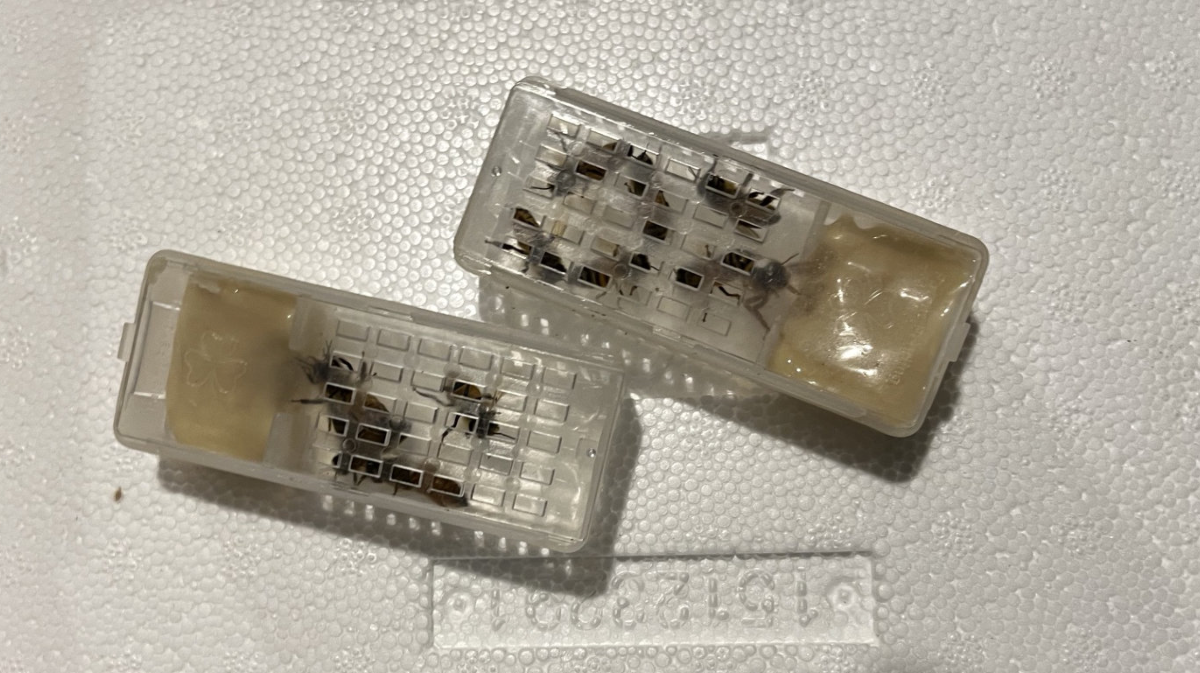
A fellow beekeeper raises her own queens and has extra mated queens. She asked me if I needed any. Since I had two under-performing hives, I said I would take two. The plan was to pick them up on Thursday afternoon.
That meant I was in the bee yard on a hot Wednesday afternoon wearing a bee jacket, gloves, and a veil while trying to find the queens I wanted to replace. While I often spot a queen when inspecting a hive, it always seems harder when you have to look for them. It’s like they know you are after them, so the queen runs from you. In one hive, I had to set out a new box, pick up every frame, look it over thoroughly and place it in the new hive body. Then I found the queen—she wasn’t on a frame; she was on the side in the old box. I crushed her so that I could introduce a new queen the next day. (Hives need to be queenless to accept a new queen.)
In the other hive, there was no queen. How do I know? Because there were no eggs and very little brood. Also, there was one queen cell that was quite long. It was charged, but it was not capped. That means that if all goes well, that queen cell would be capped in a day or two, hatch about six days later, go on a mating flight a few days after that, come back, and eventually start laying eggs. This assumes she survives the mating flight and gets well-mated. (That these queens were not laying well makes me think they were not well-mated.)
Strong Queens Make Strong Hives
A queen needs to be impregnated by 20 to 30 different drones so that she has sufficient sperm to last several years. The more mates, the more genetic diversity, which is also a good thing for overall hive quality. Since these hives were in my home bee yard, and it is the only apiary for miles, I think getting the queens well-mated is a challenge, especially in early spring. The next time I make a walk-away split or create a nuc and raise my own queen, I need to move them to my other bee yard so they will be mated better.
I took the frame with the cell and moved it into a nuc I created just for it. I gave the nuc two frames of food, a frame of mixed brood from another hive, and a shake of nurse bees. It also has a foundation to draw out. This will give the future queen a nice “starter home.” If she does well, I’ll move her into a larger hive later this year. If she fails, I will not lose a whole hive.
That leaves the larger hive I took the queen cell from queenless and with no resources to make a new queen. By the time I got home Thursday with the new queens, the hive would be desperate for a new queen. And since this is a full-size hive in two deep boxes, she could get started laying right away. That will preserve my investment in that hive.
A strong, productive queen means a strong hive. That means the hives should make it through winter and come roaring into spring production. And if the still-waiting-to-hatch queen in the nuc does well, that will be yet another strong hive for 2027.
The Heat Dome Hits
Something like two-thirds of the country is experiencing a dose of brutally hot weather this week, and that includes us. Of course, brutally hot in the mountains is different from brutally hot elsewhere. We’re experiencing heat in the mid to upper-80s, but when you are in the sun, it feels far hotter. The humidity is also bad.
I’ve lived in areas where it often gets into the triple digits, but I never homesteaded there. I’m outside far more here than in the past kufe where I mostly dashed to and from my car in weather like this.
To combat the heat, my wife wakes up early and gardens until 9 a.m. I wait until the sun goes behind the mountain, casting all our property in the shade, and work outside at 5 or 6 p.m. when things have cooled down. We’ve stopped showering in the morning and started taking a cool shower when we come inside. This helps.
Of course, we have air conditioning (AC), but we’re keeping the indoor temperature between 75 and 78°F. Even my basement, which was 72 a week ago, is up to 75. That’s not unbearable. But this is not the week to bake something in the oven or do anything else that generates heat.
I had to make a three-hour drive the other day, so I packed a small cooler with ice, three bottles of water, and a Gatorade, just in case. My truck’s AC works great, but you never know when you may end up on the side of the road. Just as I pack a hat, gloves, a coat, and a wool blanket when I make a winter road trip, I customize my survival kit for the summer, too.
Under-Powered Solar Power
We usually make more power than we consume on a sunny summer day, but not this week. While we made 54 kilowatt-hours on Thursday, we used almost 90. That’s three times as much power as we consumed on an average day in early June. While the solar power helps offset our costs—we only pay for the 36 kWh (90 minus 54) we don’t produce—it is unusual for us to buy any power in the summer. That just goes to show you how dang hot it is.
It also shows us how much extra electricity demand there is when everyone runs their AC at once and why there are threats of power outages caused by a lack of power generation. The danger is not at 1 p.m. when the sun is high, because that is when the fields of solar power panels make the most electricity. The danger is at 5 p.m. when everyone comes home and kicks on their AC. This also coincides with the sun sinking lower in the sky and making less solar power. If we see rolling blackouts, I expect they will be in the late afternoon and early evening.
Our solar power system is not designed to run the HVAC. We would need a third battery to do that. That’s a wish list item, but if we continue to see this kind of heat every summer, we may need to consider it.
Happy Independence Day!
I remember celebrating our nation’s 200th birthday, and I can tell you that there were no counter-celebrations back in 1976. Gerald Ford was president, and while he wasn’t very popular, no one tried to assassinate him. Patriotism was commonplace, the only communists were in Russia, and no one complained when we had what at the time was the biggest and best fireworks display on the National Mall. I guess those were the good old days, although I didn’t know it at the time!
Don’t be surprised if I don’t post on Monday. We have a full weekend ahead of us.
Whatever you are doing to celebrate the 250th, have fun, stay safe, and try to avoid heatstroke.