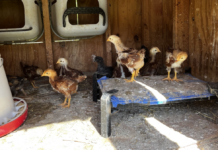

Late last week, our new chicks arrived. Most of them are Rhode Island Reds (eight females and one male). I got them because I wanted to try an old-school, traditional breed that was still a good egg producer. I also ordered four Black Star females, which have done well for us in the past. They lay an egg almost every day and are good-looking birds that are not as aggressive as the Red Star hens we’ve had. Out of the dozen chickens I killed two weeks ago, the only one I regret not finding a home for was our remaining Black Star.
I also ordered two Buff Brahmas, which are larger birds. They are cold-hardy and are supposed to be excellent mothers. They are not as efficient as the other two breeds, producing fewer eggs per pound of feed, but my hope is that they will go broody, sit on a nest, and raise their own chicks next spring. Also, I have observed that chickens will sometimes gang up on each other. Being larger may protect these two from the others.
Five years ago, when we got our first chicks, we had several Speckled Sussex hens, which were also supposed to be good mothers. They never went broody, so I am trying again with a different breed. While I have a small incubator and we could raise our own chicks, I’d like to have a mother hen do some of the work.
Taking care of the chicks is easy. I give them fresh water and check their food supply twice a day. I haven’t had to clean their coop yet, but that will be a once-a-week job.
The Third Time Around
This is the third time we have raised chicks, and I have lost track of how many dozen eggs we have gotten in return. I am putting to use all the lessons I learned from my prior chick-raising. I will share some with you here in the hopes that someone will learn from our experience rather than having to go through it themselves:
- Raising chicks indoors—even in the garage as we did—will result in a fine layer of baby chicken down or tiny feather bits coating everything. By the time the chicks are ready to go outside, your room and whatever is in it will have a coat of what looks like heavy dust. It requires a serious cleanup effort. To avoid that, we put them straight into the coop.
- Summer is the best time for us to raise chicks. April can be too cold to raise them outdoors, and even May nights might be uncomfortably cold. We use a chick warmer, but as they get bigger, they don’t all fit under it.
- It gets cheaper each time around. Not because the cost of chicks drops—it has gone up—but because we have all the equipment. We have multiple chick feeders and waterers, the warmer, and so forth. The only thing I had to buy this time was a bag of medicated chick starter feed. I even had chick grit left over.
So if you lose a few of your first chicks, or if you have a tough time with it, don’t give up. It gets easier and cheaper the second and third time.
New Honey Processing Equipment
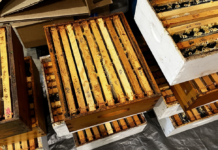
I have a small hand-crank extractor which holds three frames. We manually turn the crank to spin the frames, and centrifugal force shoots honey out of the honeycomb. Then we turn the frame around and do the other side. It makes for lots of cranking. We used it the first year or two as beekeepers, but it’s slow going. It’s manageable if you have a hive or two, but when you get more than three or four supers, it is very time-consuming, and it doesn’t get all the honey out of the comb.
For the past few years, I’ve been borrowing a 9-frame electric extractor. That works well, but when I returned it earlier this month, I still had honey on the hives I wanted to harvest. I had been planning to buy my own, so I bit the bullet and did so. I got an 18-frame extractor, which means I can spin out two honey supers at once.
Another reason I acted now is that the 18-frame extractor was on sale through June 30. Because of the sale, it was only 16 percent more expensive than the 9-frame. For about $150 more, I ended up with twice the capacity. It was hard to say no to that deal. I will be storing it in the storage unit, so the larger size isn’t taking up valuable garage space. The only downside is it is heavier to lift in and out of the pickup truck bed.
Next year, I may get a heated de-capper so I can get the wax off the frames faster. That will speed my honey production efforts. We’ll see.
While I was at the bee supply store, I also bought enough jars for about 180 pounds of honey.
Rain and Honey
I haven’t set up the extractor yet, but I will when I have new honey to harvest, and that won’t be long. I had planned to insert escape boards in the hives this weekend and pull some more honey later this week, but it has rained almost continually. While that is bad news for the honey, it is good news for everything else. We are still in the middle of a drought, so an extra inch-and-a-half of rain is welcome. And this was a good, steady rain that should soak in rather than run off.
When it rains, the bees cannot fly, so they eat their honey stores. But that’s OK; they’ll make more.
Our spring honey is a dark, robust honey that tastes of spring fruit blossoms with a smoky caramel flavor that came from the tulip poplar tree. It is similar to, yet distinct from last year’s, which had an anise aftertaste. It is unusual for the honey from one year to be the same as the year prior because no two years have the same weather and plants bloom at different times. Last spring’s honey was our most popular. So far, this one is selling well, but it is re-orders that will show how popular it is.