
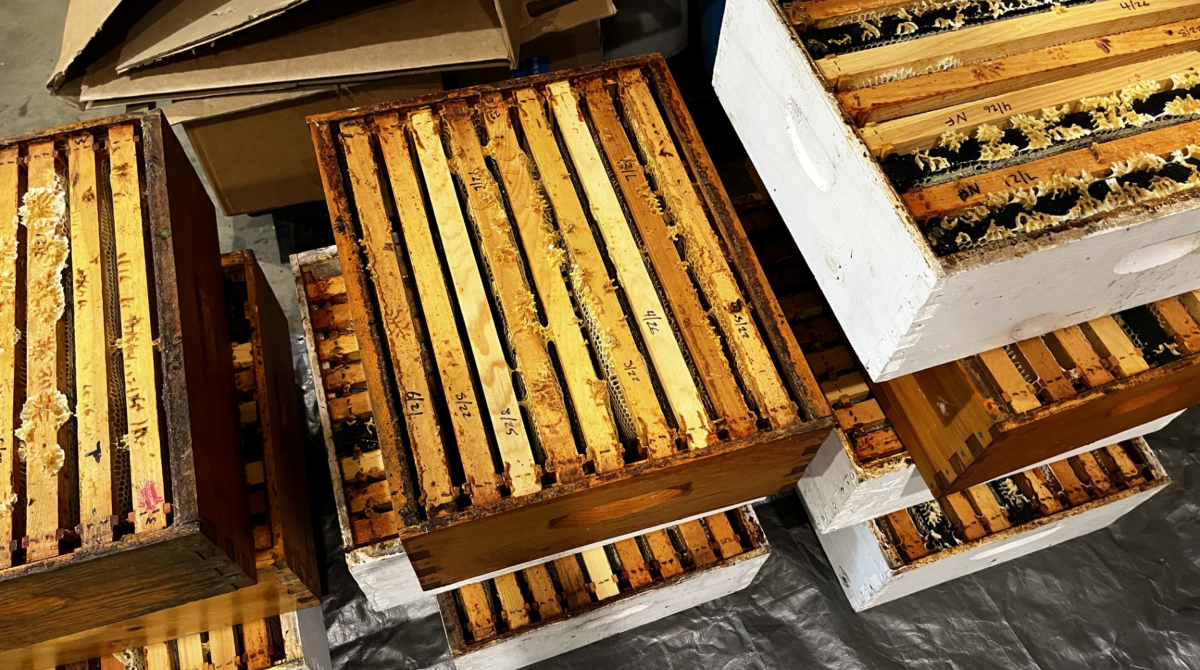
On Thursday, I headed out to the bee yard and inserted escape boards into five of the six hives. Why only five? Because I only have five escape boards. I could use eight or ten. I’ll have to get a few more next year if my number of hives keeps expanding.
The supers were loaded with plenty of nice new white wax and capped honey. I removed the full supers, added an empty super for the bees to work on, inserted the escape board above it, and stacked the loaded supers back on top. I am now out of drawn comb for my hives, but I’ll have plenty as soon as I extract these.
On Friday, I assembled the new extractor. This was easy as it primarily entailed bolting on the legs and then wiring up the controller.
After giving the escape boards two days to thin down the number of bees remaining in the supers, I went back to pull them off the hives on Saturday. In the absence of my daughter or a mentee to help, I enlisted my wife, and we pulled ten supers off the hives, leaving seven that the bees were still working on. Most of the supers were quite heavy. That’s going to be close to 300 pounds of honey, meaning I will fill just about every jar I have. And that’s on top of the 96 pounds we already harvested. Definitely my biggest honey crop yet, and it is still early in the year. As long as the weather cooperates, we should pull more in late August.
Firing up the New Extractor
We extracted two runs of 18 frames on Sunday, which made more than 120 pounds. The new SAF Natura 18-frame extractor runs more smoothly than the older extractor I had been borrowing. The motor is quieter, and the new control panel is also quite nice. Instead of a dial, this one has a digital push pad. You can go from one to ten, back down, or stop. You can also switch directions, spinning clockwise or counterclockwise. I didn’t realize this made a difference, but some research showed me that the bees give honey comb a slight tilt. By switching directions, you get the maximum extraction from both sides of the frames.
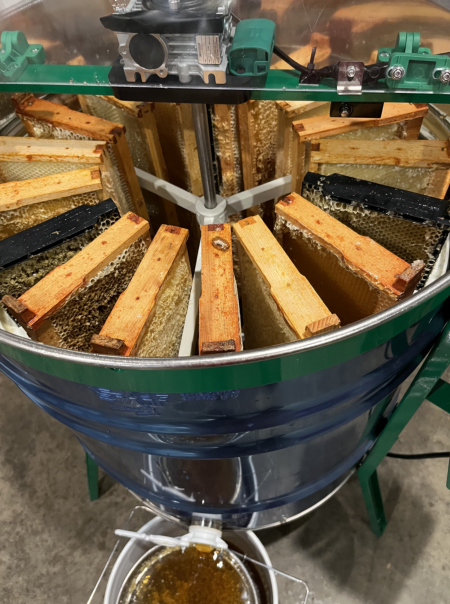
On our first run, we worked all the way up to top speed. On the second run, there was one heavy frame, which had been badly decapped. So as the load got lighter, that frame stayed heavier and made the extractor off balance. This made it bounce and complain if we got above seven. But that is to be expected. I have never used an extractor that did not act like a washing machine when it is out of balance.
My biggest complaint is that the extractor needs to be about an inch higher, or the legs an inch longer. I can barely fit a standard five-gallon bucket under it, and when I insert a metal sieve to filter out the wax and occasional bee body parts, I have to wrestle it into place. It does not fit well at all. I may address this by finding some feet that can be screwed through the holes on the bottom of the legs. Even half an inch of lift would be useful.
The Problem with Wet Honey
We could only extract four supers because they were capped. The other six supers were completely or partially uncapped. I tested the honey, and it was above 18 percent water content. I prefer it to be below 17. Last year, we had some that was 15, the lowest I’ve ever seen. It was quite thick.
Low moisture is important because wet honey will ferment when the moisture is above 19 percent. (That’s probably how those Vikings first found out about mead.) You know how they say honey lasts forever? Only if it has a low moisture content.
In the hive, the bees flap their wings, which is called fanning, to help dry the nectar—which is usually 60 to 80 percent moisture when harvested—and turn it into thicker honey. The bees dehydrate it with wind from this fanning. When they are satisfied with it, they cap honey by putting a layer of wax over the honeycomb cells. Most of the frames we extracted on Sunday were 100 percent capped. A few were 80 percent. This guarantees that the honey is at the right moisture content.
Since I don’t have wings, I have to use a dehumidifier set at 35 and a box fan to blow the dehumidified air over the boxes of honey frames. In a day or two, it should be low enough to safely extract and bottle without any concern that it will ferment.
Once the rain stops, I’ll take the escape boards we removed from these hives when we harvested and put them on the hives in my bee yard. That will generate several more supers to extract. I expect to be extracting honey on and off this entire week.
The Flavors of Honey
The older frames of honey are the same dark, robust honey that we harvested last month. The frames filled with honey since then are a lighter shade, but some frames are mixed. I wanted to extract a run of dark honey and a run of light honey, but despite trying to sort the frames, it was impossible. Some of the honey that looked dark was light honey on dark wax. A few frames had dark honey on one side and light honey on the other. In the end, we got a blend of honey that is a little lighter than the last batch we harvested.
My wife says she likes the taste of this batch better than the honey we harvested in June. I have to admit, it is tasty. I expect the amber color will help it sell.
When you buy raw, local honey, the flavor differs with every harvest. When you get it at the grocery store, that isn’t usually the case. Please support your local beekeepers and don’t buy honey that was harvested in Vietnam or Brazil.
Rainy Weather and our Drought
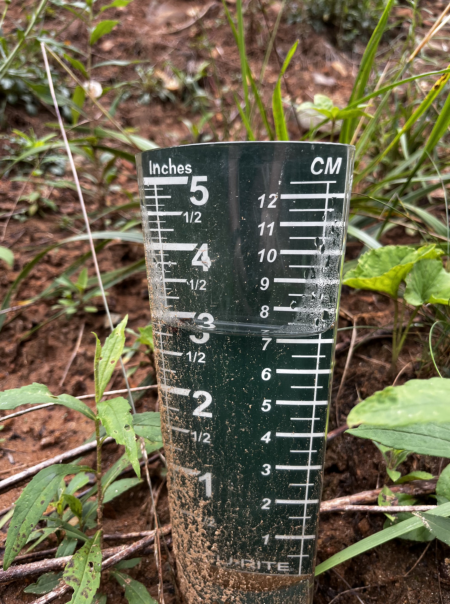
We had an inch of rain early last week, which was nice. Then it rained much of Friday night into Saturday, cleared up for a few hours, and rained on and off that evening. Sunday was damp until it poured in the afternoon. I mean, heavy rain. We ended up with three inches of rain over the weekend, a good amount. More is expected on Monday.
Of course, the beneficial rain in our neck of the woods was the remnant of a storm that caused flooding in Missouri and parts of Tennessee. There’s a big difference between getting 3 inches of rain over 36 hours versus getting that much in an hour or two, or getting a foot of rain in a day.
Every time we see a flood, we feel bad for the folks caught up in it because we’ve been there, done that. But our creeks and rivers have remained low.
Does this three inches of rain mean the drought is over? No, but it is a step in the right direction. I think we still need ten or fifteen or more inches of rain to catch up to an average year. But we’ll take what we can get.
My wife read on Facebook about a woman whose spring stopped giving them any water. That’s a fear for us, too. So far, so good. I don’t know how long it takes for water to percolate through the soil and make its way into whatever aquifer or seam of water feeds that woman’s spring, but this latest rain has got to help.
Hot Weather Returns
Much of the country is in for hot weather again this coming week. For us, that means mid-80s. At least our air conditioning has been fixed. It was a simple repair. All the tech had to do was replace the capacitor. I am considering buying my own so I can replace it next time. I already have an insulated screwdriver so I can discharge the old one and prevent a dangerous shock.