

After going more than a year without buying a gun, I broke down and bought one at a gun show. I’d had my eye on this model for a long time: the Kimber CDS9, which stands for Covert Double Stack 9mm. If you aren’t familiar with it, the CDS9 is probably the smallest 9mm double-stack 1911 made. It’s smaller than my Glock 48 but holds more ammo. More importantly, it is a single-action, rather than striker-fired, giving it a better trigger.
I already have an inside-the-pants holster that is a little long, but fits it. I also picked up some extra magazines, giving me two 13-round mags and three 15-round mags. About the only thing standing between it sitting in my safe and making it my primary EDC gun is the break-in period.
I shot 90 rounds through it. Every round fired, always a good thing, but the last bullet failed to fully load into the chamber on all four magazines. When I tapped the back of the slide, it went into battery. I will lube the gun before my next range session, but I expect the failure to go into battery will be cured after running a few hundred more rounds through it as part of the break-in period. This is not an uncommon problem on new guns that are tight, and Kimbers are known to be made to tight tolerances.
The gun fits my hand, and the trigger is pretty good. I also like the optic, but more on that later.
Coming Full Circle to the 1911 and its Safeties
There are tales—and a few of them are no doubt true—of bad guys grabbing a good guy’s 1911 and not being able to shoot him because they can’t operate the safety. The generation of shooters that grew up on Glocks just isn’t used to frame-mounted safeties.
I have competed with two different 1911s, so I have experience with the 1911’s safety. In the matches, you have to put your gun on safe before you holster it after the load-and-make-ready command, so you get pretty good at flicking the safety down as you bring the gun onto target during the draw. This safety is smaller, as befits a carry gun. I can take it off easily, but putting it back on is more difficult and requires me to adjust my grip, not just flick my thumb. I will train to make sure I don’t stand there during some emergency, gun drawn, pulling the trigger, wondering why it doesn’t go bang.
If a piece of web gear, clothing, tourniquet spindle, seatbelt, or even a finger gets caught in the trigger guard and inadvertently pulls the trigger back, a Glock—which has its external safety on the face of the trigger—will fire. A gun with a manual external safety that is not located on the trigger will not, at least not if the owner uses the safety correctly.
No Grip Safety
The original 1911 had the manual safety on the frame and a grip safety that required you to grip the gun securely to fire. By the 1980s, most manufacturers added a firing pin safety to keep the gun from firing when dropped on its muzzle. Some 1911s and double-stack 1911s (often referred to as 2011s or some variation on that theme, like the 2K11) have eliminated the firing pin safety because it makes the trigger pull a little rougher. In competition, they want their triggers light, fast, and fluid.
This little beauty is not for gun games, so it has the firing pin safety, but they did away with the grip safety. That’s a decision I am comfortable with. In my opinion, the combination of a frame-mounted safety and a firing pin safety makes the grip safety almost entirely redundant. In fact, I expect I’ll be more comfortable carrying this locked and loaded mini-1911 than a loaded Glock.
Picking my EDC Ammo
I did some research on what ammo is best for short-barreled 9mm handguns and saw no reason not to stick with the 115-grain Hornady Critical Defense I have been carrying. I might go with a 135 +p or 147 +P police load, like the Federal HST, if I was carrying a Glock 17 or other full-size gun, but the Critical Defense performs well in short-barreled weapons. My new gun has a 3.64-inch barrel, half an inch shorter than the Glock 48 I currently carry or the Glock 23 I carried before that.
That’s still longer than the snub-nose .38 revolver I often carry as a backup. This gun splits the difference between a compact EDC piece and a small backup pistol. I suppose it is considered a subcompact, but with the 13-round magazine in place, my whole hand fits on the grip. That’s more than I can say for the bulkier Glock 26 or 27.
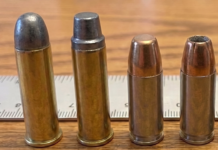
One of the knocks on the Critical Defense is that they do not penetrate as well as the Critical Duty ammo and other heavier bullets. If I end up carrying this gun in bear country—and it’s not my first choice for that role—I will probably go with a magazine of FMJs or make every other round an FMJ.
Evaluating the Holosun EPS and Battery Logistics
I mounted a green dot Holosun EPS Carry on the CDS9. EPS stands for Enclosed Pistol Sight, with enclosed being the operative word. I expect it will stay cleaner than the open (non-enclosed) Holosun 407K I have on my Glock, which tends to fill up with dust after just a few days of carry. This is a high-end optic, with the choice of three reticles/aiming points, the shake-awake technology, and a tiny solar panel.
The only downside is that it takes CR1620 batteries while my other pistol optics take the 1632 battery, which is 1.2mm thicker. I wish Holosun would stick with one coin cell for all its pistol red-dot sitghts. I now need to stockpile a third type of coin-cell battery. I ordered twenty Tenergy 1620s, a brand I know and trust, for only $6.99, but I can’t find any rechargeable ones. (I have rechargeable 2032s and 1632s for when post-SHTF.) Most of the spare batteries will reside in my gun safe, but once I start carrying the CDS9, one will go into my EDC bag and another in my car kit along with a spare 15-round magazine.
Time to Train During Break-in Period
I picked up some official USPSA targets and ordered 1,000 rounds of 115 grain Blazer brass ammo so that I can do some training. Drills, not just target shooting.

For my recent range session, I sighted the gun in at 25 yards. It was shooting low, so I adjusted it. It is still shooting a tiny bit low and to the right, but it’s so close at 25 yards that I am not too worried. I’ll keep an eye on that as I practice and consider adjusting it a couple clicks in the future.
I would often shoot three to five rounds, move offline from the target on a diagonal and engage with three to five more round before moving offline again, sometimes in the same direction, sometimes in the opposite, then shoot a few steel plates, and then move again. These rounds were fired rapidly between 5 and 25 yards, with the majority at 12 to 15.
Most of my rounds were in the Alpha zone, as you can see in the image. Only one round went into the D-zone. The five rounds that were high were all fired strong-hand only. I am satisfied with this target.
Buy Ammo Before Copper Prices Rise
In addition to the case of 9mm, I bought two 25-round boxes of .32ACP for $6.95 each. I own only one gun that shoots .32ACP, and because I inherited it, I have only one magazine for it But for less than $14, I just doubled my ammo stockpile for that caliber. I may never use this gun, but one day it may arm an older person who is recoil adverse or a young person who needs some last-ditch protection. That extra box allows them a chance to practice. Plus, if the time comes when I need to trade a gun for something we desperately need, that little .32 is on the top of the list. Having 100 rounds will make it more valuable. Or, I can trade a box of ammo to someone and keep the gun.
I also picked up 50 rounds of .25ACP for $19.95. I don’t own a .25 ACP, but I have a friend who does, and he never has much ammo. If the SHTF, I’ll have some for him. It may only be FMJ, but the person’s he’s pointing the gun at won’t know that. I have a small amount of two other calibers I don’t own, just in case a neighbor or friend needs some.
I have said this before, but it bears repeating: Stock up on ammo now. Here is why I recommend you do so:
Ammo is Cheap
Ammo prices are good, but they won’t stay that way. Just as the price of gold and silver is rising, so is copper. With all the electric power upgrades needed for data centers, lots of copper is going into wires and cables. This means more competition for the copper that goes into brass cases and the jackets on jacketed bullets. (Some high-performance rounds are solid copper.) And save your brass! If you don’t reload, sell or give it to someone who does, or take it to a metals recycler.
Availability is Good
Right now, there is plenty of ammo on the shelf. If we go to war, the supply will dry up in a hurry, especially for military calibers, including the 9mm. One manufacturer has already stopped production because they cannot obtain enough components. I’ve lived through two or three rounds of ammo shortages. It’s frustrating to see the store limit how much you can buy and then raise prices. Beat the rush and stock up now.
Bullet Technology is Excellent
Bullet design and technology have made serious strides just since 2000. Today’s self-defense and hunting bullets are better than they were when I first started shooting. New hunting and sniping calibers continue to push the envelope, resulting in flatter-shooting cartridges that are more accurate and use more effective bullets. What’s not to like?


For carrying in bear country i don’t think you want to have personal defense rounds in your magazine. They aren’t designed to penatrate thick hide and bone. They might but would probably have very little energy left.
Check out solid core ammo for that. Federal makes a line for several calibers.
Thanks, Trevor; I agree. I usually carry a revolver loaded with a lead .45 Long Colt round loaded for modern guns when I intentionally go into bear country. But as a beekeeper, bear country may come to me, and then I have to use whatever I am carrying.
John Browning didn’t design the 1911 with a grip safety originally. He didn’t want one in the gun, but the US Army insisted on it. So there you go. Not having a grip safety is closest to his original design. You’re good to go!
Ha! Good to know, thanks.
Comments are closed.