
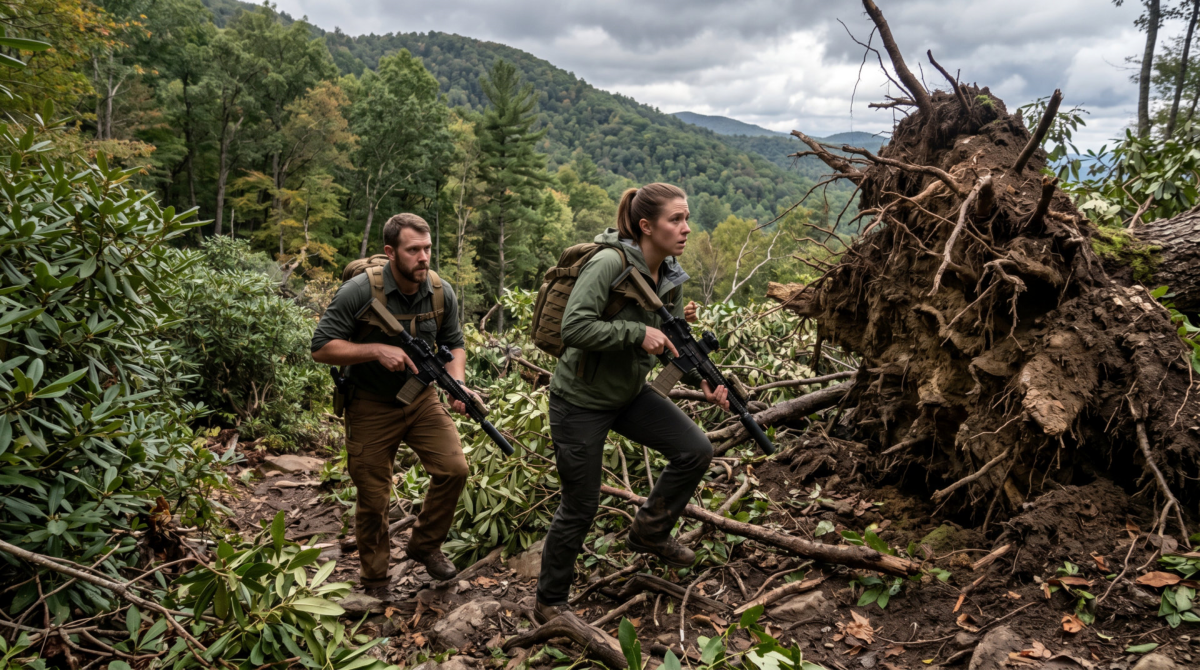
Earlier this week, I opened my Homestead Defense Packs (HDP) and went through both of them, checking food expiration dates, taking note of what could be added, and just refreshing my memory of what was inside each of them.
To refresh your memory, let me recap the purpose of an HDP. These are small daypacks that are intended to be grabbed if we have to 1) defend our property from an unexpected attacking force and/or 2) if we have to escape into the mountains to avoid going up against a superior force. These are not bugout bags. They are intended to give us ammunition, snacks, water, and first aid supplies to sustain us for a day or two in the field while we fight a guerrilla war against whoever took over our place.
Sound a bit like a fantasy? Maybe it is, but it’s the only plan I have in a scenario where we are overrun by a superior force. Better to blend into the woods and fight another day than to die fighting a battle we cannot win. And if we escape with both the suppressed .300 blackout AR pistol and the suppressed 5.56 AR pistol (both to be SBRs one day in the not-so-distant future), it may give us a chance to whittle the opposition’s numbers down while operating on territory we know better than they do. If a military unit shows up with heavy weapons, our plans will change, but if it is Bubba and his buddies from three hollers over, that’s another story.
Our prepper property has everything we need to survive, so yes, we will fight for it. Hopefully, we won’t be standing alone.
Pack Differences and Similarities
It’s been a minute since I put these together, so I was a bit surprised at the differences between the two packs. The pack with .300 ammo was heavy on first aid and lighter on food than the 5.56 pack. The food in it was mostly calorically dense snacks, from the ubiquitous meal bars to gummy bears and hard candy. My other pack had less candy but two MRE entrees and one full MRE meal. The first pack also had a sniper veil, which the other did not, and a CAT tourniquet. The second pack had only a pressure bandage. I have since added one.
It appears to me that the pack in .300 BO was designed to be used by itself while the 5.56 was intended to complement or support the other pack. Note to self: Be sure to grab the .300 and its bag.
Despite these differences, there were many similarities. Both packs had four loaded magazines, a pair of tactical gloves, a camo boonie cap, a pair of socks, a quart water bottle, water purification tablets, a suppressor cover, a wrench, and a flash hider. The latter were in case we needed or wanted to remove the suppressor. Each bag also had a mixed assortment of odds and ends, like a survival straw, a compass, a small notebook and pen, a fire starter, a folding knife, and a small Otis cleaning kit with pull-through cable. The pack with more food had a spork and a collapsible camping cup or bowl. It also had two packets of oatmeal, which I suspect we would have to eat cold.
I put the socks in zip-lock baggies to keep them dry, added some rolled gauze to both first aid kits and replaced a few old bars with some new ones.
The Caches
There are now between five and ten 50-caliber ammo cans hidden/buried in different locations on and beyond our property. One cache spot holds two cans, one with 1,000 rounds of 5.56 and the other with 1.000 rounds of .300BO. Others cans hold a couple loaded magazines and 120 additional rounds of each caliber. There are also caches with an assortment of calibers, including .22LR, 9mm, and 12 gauge. It wouldn’t surprise me if there is the odd box of .38Spl and .40S&W out there as well. You know, just in case.
There is also a larger cache further away that has sleeping gear and more food. That one can sustain us a few days, if needed, or we replenish there and move on.
I checked several caches late last year while putting the 1,000-round ammo cans in place, and everything looked good. I like to do it in the fall so the falling leaves cover any signs of digging, but I don’t expect to check again for a year or two. Everything was safe, secure and watertight.
Multi-Use Bags
While intended for homestead defense, these bags are ideal to grab if we need to bring a rifle anywhere in a hurry. OK, so there is already n AR15 and magazines in the truck, but if I throw a gun into the Polaris or we have to take my wife’s car, I know that grabbing the HDP in whatever caliber AR I grab means I know I have the bare minimum of supplies for that weapon. And if four mags doesn’t sound like much, keep in mind that each gun is stored with four other mags, one of which will go in the mag well. I expect I’d stick two in my back pockets and have a total of seven.
Then there are various gear options to choose from, including a plate carrier, chest rig, and tactical belt, all of which have pouches to carry additional equipment. We MUST grab the bags; the other equipment is optional, depending on the severity and timing of the situation we face.
There might come a time when it would be great to have my precision rifle and be able to engage targets at 800 yards. I can imagine scenarios where my semi-auto 12-gauge with an 8-round tube would be the perfect choice. And there are also times when it would be nice to have a light, quick-handling pistol-caliber carbine like the one I put in my Vertx Gamut. Since we can’t predict what we’ll face, those SBRs split the difference nicely. They give us more range and stopping power than the 9mm, with more capacity and easier handling than the precision rifle. Plus, since I have both supersonic and subsonic rounds for the .300, I have options.
Other Options
With any luck, we’ll never need our HDPs or our caches. We picked a spot in the middle of nowhere to avoid being overrun in a crisis. We’re far enough from town that attackers have to go through miles of road hundreds of other folks before they get to us, assuming there are “attackers.” I’d prefer to help out, stopping “invaders” well before they reach our road, not to mention our house. But one of our prepper mantras is to prepare for the worst but hope for the best. These bags may be for one of the worst-case scenarios, but that doesn’t mean they don’t need to be checked and re-checked from time to time.
Having gear is an important part of preparedness, but it’s also a responsibility. I’ve written about checking batteries in optics, shooting and lubing firearms, and charging rechargeable batteries. Maintain your bug out bags and your other gear to the same standards.


How do you store the buried ammo cans so that water, moisture, freeze/thaw cycles etc don’t ruin what’s inside?
So far, the ammo cans with their rubber seals have been fine. In a couple cases, I put a piece of plywood over the can. I’m not sure that does anything. I used to pack stuff in quart and gallon size zip-lock bags, but I sometimes use the vacuum sealer now. I think I included a photo of a vacuum sealed pistol in an earlier post.
I have not put canned goods in these caches because of the freeze thaw cycle, but it shouldn’t bother MRE components.
Comments are closed.