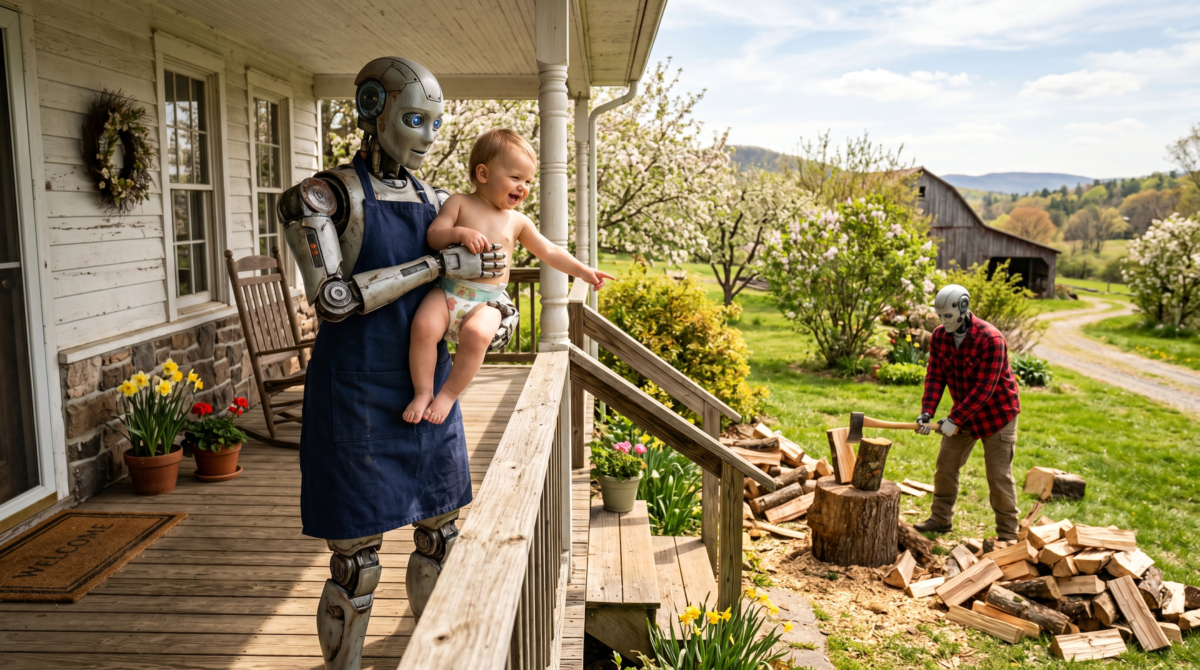
I’ve read several articles lately predicting humanoid robots would be available to work in your home soon to do “caregiving and light housework.” It’s not just Elon Musk’s Optimus, but robots from other companies as well. Some may lease for as little as $600 a month, or $20 a day. That’s cheaper than a maid or a babysitter.
I guess most Americans aren’t lazy enough already; now they need robots to do their laundry, load the dishwasher, clean the floors, scrub the shower, and all those other household chores. Pretty soon babies will be changed, fed, and burped by robots because Mom will be too busy filming TikToks on her phone. But I’ve worked with AI enough to know getting a robot to do what you want, when and how you want, is going to be frustrating and require patience, especially at first.
Of course, since so many women are working outside the house and still stuck doing most of the housework, household robots could benefit them a lot more than a Roomba does.
I Need More
I’m waiting for the advanced model, one that can run a chainsaw, log splitter, weed eater, and a tiller. Or should I say, one that can be trusted to run this equipment safely and effectively.
I don’t want my robot hanging out inside; I want it outdoors running patrols night and day with thermal and night vision. I want it to be able to slaughter, pluck, gut, quarter, package, and freeze a chicken, or skin and butcher a deer I kill. My robot needs to be capable of using a hose to water the garden or fight a fire. And speaking of fire, I’ll want it to cut and stack firewood.
I’ll still walk the dog and keep the bees, because I don’t really consider those to be “chores,” but maybe it can lift the heavy boxes full of honey or paint the new wooden equipment.
Painting! How can I forget? Five years ago, we spent thousands of dollars to have our log home and decks pressure washed, sanded, and stained. If a $600-a-month robot can do that, I’m all in. And if it proves adept at climbing ladders, it can clean the gutters, too.
Not for Us Rural Folk
Somehow, I think the demands of homesteaders and farmers are a long way from folding laundry and doing other light housework. Of course, at the rate things are going, we might get a model designed for rural folk in another three to five years. You’ll be able to tell them from the suburban models because ours will wear flannel and work boots, and they won’t know how to make a latte.
The day may come when I am too old or weak to run the chainsaw. My 90-year-old neighbor is slowing down. He still runs his riding mower, but he doesn’t weed whack. He gave up hunting, and I don’t think he’s going to get his garden in this year. That’s what awaits me a couple of decades in my future; I imagine having a robot to split and stack the firewood, fill the wood bin, and chop the kindling could come in handy. It might even allow me to stay in my home longer.
When humanoid robots reach the point where we can trust them with a chainsaw, all those blue-collar jobs that were supposedly safer than office jobs will be at risk from AI and robots. I won’t need to pay the chimney sweep, the HVAC repairman, or the electrician; my robot will do all that. And when I need more gravel for my driveway, I’ll call the dispatcher and he’ll send an automated truck over to automatically spread it on my driveway. Afterwards, a robotic tractor with a box blade will ensure it’s spread out evenly. I guess the benefit for me is I won’t have to tip anyone.
Dependence is a Vulnerability
Right now, one of our biggest threats to society is a sudden and lengthy loss of the Internet and/or electricity. Loss of the internet would be bad because so many people lose communication, information, and the ability to do financial transfers. Loss of electricity is worse; it not only knocks out the Internet but also refrigeration, heating and cooling, cooking, and lighting. All the conveniences of modern life, gone in the flick of a switch. In a lengthy outage, most of us will be back to cooking over an open flame and using candles when the batteries run out.
Now imagine someone who relies on their robot to do all their work. To feed and care for them or their children. Robots need the Internet so they can reach out to the AIs that help them make decisions. When your Wi-Fi goes down, your robot becomes dumber and, likely, more dangerous. It also needs electricity to power its servos, motors, cameras, and onboard computer and communications. Without an external source of power, Robby the Robot is going to power down in a matter of hours. And all those people counting on it will suddenly be on their own.
Automation versus AI
I’m fine with an automated harvester that a farmer programs to harvest this field of corn or soybeans. Give it a geofence to keep it on the field, set some parameters, and away it goes, driving in the most efficient pattern to harvest every kernel or bean, stopping only when it runs into a problem. That kind of automation helps the farmer.
I’m against a harvester that tracks the weather, evaluates the field, and decides on its own that it is time to harvest. Then, while it is running back and forth in neat lines, it calculates the yield per acre and negotiates the best price at which to sell the harvest, all while the farmer is in a lounge chair being fed bonbons.
In the future, I don’t want my robot to decide when to cut down a tree and select which tree to harvest for firewood based on its own criteria, even if it is criteria I have approved. I want to point it at the tree, discuss which way I want the tree to fall, give it detailed instructions on how to cut and split the firewood and where to stack it. Maybe I can compromise and tell the robot and its AI brain, “Show me the ten trees you think should be cut down to meet my firewood burning needs and explain why you selected them.” Seven would be good choices, two questionable, and one a terrible choice. Because while AI can help you make a good decision—or you can help it make a good decision—it cannot yet make good decisions all the time. Smart humans are still better at seeing unexpected consequences because we have imaginations. AI has parameters. It can’t foresee something that has never happened.
Outdoors versus Inside
I think I’ll treat my first AI-driven robot like a dog with questionable training and keep it outdoors. Like that dog, I’m also going to be ready to put it down with a .308 if it develops threatening or dangerous behaviors.
I’m in favor of dumb houses with appliances and thermostats that cannot be hacked. We don’t even have Alexa. Why would I let a walking, talking computer with cameras and other sensors into my home? It’s going to have the capability to record everything we do and say, and I’m sure they are keeping the monthly rental cost low by selling that data.
I’ll let it report on how much firewood I burn and maybe even how many eggs we harvest, but I’m not going to give it the capability to tell my dentist how often I brush my teeth, my doctor if I miss a pill, or the government how many rounds of ammunition I have. Nor do I want it to send me ads and coupons for Hellmann’s mayonnaise when it sees we are using a different brand. My phone is bad enough, even with all the trackers disabled.
The way I looked at it, any robot that can be your caretaker can also be your jailer.
Hmm. Maybe a power outage isn’t such a bad idea after all.