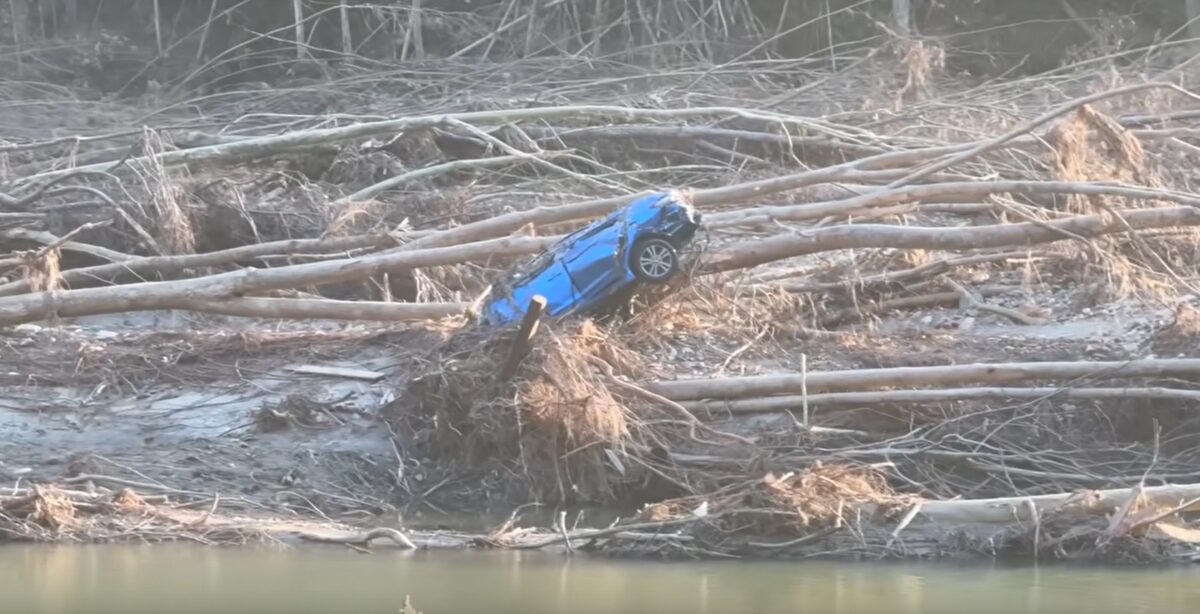
Many people around here posted things to social media remembering Hurricane Helene, which tore through this area two years ago, killing more than 100 people, destroying hundreds of homes, and upsetting thousands of lives. Rather than recap the damage (you can see my real-time reporting starting here). I prefer to talk about what we learned from living through one of the worst disasters the East Coast has ever seen.
Hurricane Isaias is heading up the gulf and could take a path over land similar to Hurricane Helene. We’re not too worried because it doesn’t look like it will bring 30 inches of rain, but it has our attention!
What Helped
Here are some preps that we benefitted from:
Solar Power
What helped us the most was having solar power. Half our panels were out, so we limped along on about 3.5 kW instead of 7.5. The repair was supposed to take place the Monday after Helene hit. Obviously, it did not. There was no way for the solar technicians to get within 30 miles of our house because so many roads and bridges were washed out.
Between our generator (there was no sun the first couple of days) and the solar panels, we could keep our refrigerator and freezer running. We ate many meals out of that freezer in the six weeks in which we could not escape the mountain. I suspect we had enough food in there for 90 days or more.
I learned later that a friend about 2 miles away tossed the contents of her freezer, which included much garden produce. She didn’t want to keep running her generator because there was little fuel available. I think that was a bad call. Within two weeks, the local gas station was pumping gas with a pump powered by a 12-volt automotive battery. Within three weeks, the power was back on.
Friends and Neighbors
We helped friends and neighbors, and they helped us. When our elderly neighbor was evacuated for medical reasons, we cleaned and winterized his house. He had a whole-house propane backup generator, but no way to get more propane, so he turned it off. In return, he let us do laundry at his house using power from the generator. We not only did our own laundry, but laundry for at least three other neighbors. We stretched a clothesline across his deck and dried the laundry the old-fashioned way. It worked well, although the towels and sheets were stiff.
We also cooked for people and allowed them to take hot showers at our house. When you’ve been bathing in the creek for a week, a hot shower and clean clothes are a luxury.
One neighbor lent us his Polaris Ranger so that we could leave our house. While the road was out, there were some old logging roads that clung to the side of the mountain. We were able to take those in the Ranger to get off the mountain. One neighbor let us use an old car. It had been in an accident, so the seatbelts, headlights, airbag, and a few other things didn’t work. That’s OK, it got us to town where we used someone’s Starlink to get online and make phone calls. It was nine days before my family knew we had survived.
Other friends brought us groceries. We would drive down the mountain in the Polaris to meet them.
Starlink
We did not have Starlink before the storm. Now we will always have one . It brought our days and nights of isolation back into the modern era where we could make phone calls, send emails, browse websites, and even stream movies. I think it arrived at about day 17. Elon gave us three months free. Yeah, I know HAM radio has advantages, but Starlink is my first choice for crisis communications.
Because UPS could not reach us, we had the Starlink delivered to a friend in another county who had escaped much of the damage. He drove up to see us in his Jeep and dropped it off.
A few days after that, on day 19 or 20, the power came back on. Early rumors were that it was going to be out three months, maybe longer. It was out less than three weeks. Our electric utility and all the subcontractors deserve a hand for their hard work. They had 80 percent of the county up and running in less than a month. In most cases, they had to install new poles, and pull all new line because there was so much damage it wasn’t worth salvaging the old infrastructure.
In comparison, it took our fiber optic supplier 10 months to restore service. Another reason I am a Starlink fan.
Our Preps
We had never prepped for a hurricane or a flood here in the mountains because we didn’t think we would get one. But our preps were still helpful. We had at least 30 gallons of gasoline and lots of food. We barely ate any of our long-term storage food, although my wife tried some Spam. (She had previously said she wouldn’t eat Spam until the end of the world. We figured this qualified.) She liked its taste better than the smell of it cooking.
We had a multi-band radio in a Faraday cage, and I broke it out so we could get the news. Our best source turned out to be the local AM radio station. Every day at 1 p.m. they would tell you everything you needed to know, like what locations were giving away cases of water, which ones had food and clothing. They also reported on which pharmacies were open, how to get emergency medical care, where they were serving hot meals, and how to register with FEMA. They also interviewed the various county emergency managers and told you where to go to report missing people. It was small-town, but effective.
Our Mistakes
I made two big mistakes: First, I had two empty 5-gallon gas cans, and I did not fill them because I didn‘t think the storm would be that bad. Famous last words. I now have even more gas cans, and I refill them as soon as I rotate out the gas.
Second, I thought about moving one of our cars down the mountain and parking it at a neighbor’s house. In hindsight, I wish I had done that. If I had done so, we could have driven anywhere we wanted instead of begging and borrowing vehicles from others. When a heavy snow is predicted, we now park our car down the mountain, just in case. We have our own Polaris Ranger now, so we can drive up and down the snowy mountain in it. We’re already planning to move the cars down the mountain for this weekend’s storm.
My wife’s mistake was that she considered evacuating. Her niece was getting married, and she had been planning to go to the wedding. Instead, we were trapped on the mountain. No way to get to the wedding unless she could get somewhere and rent a car. I refused to go. I said I would stay home and feed the pets and livestock. In the end, she decided there were too many ifs and unknowns and decided to bug in with me. It was a good call.
Other Big Positives
I don’t own any heavy equipment, but one of our neighbors owns a skid loader, an excavator, and a large tractor with multiple implements. I don’t think we’d have made it off the mountain without his help. He improved the entire one-mile road before the state ever showed up. This was a common occurrence as neighbors with heavy equipment and chainsaws rescued and helped neighbors implement temporary repairs.
We were also helped by two or three volunteer organizations. They cut down trees, cleared out dirt from the landslide, and made temporary repairs to our carport. Later, Samaritan’s Purse paid a contractor to repair and rebuild our private road. That included three culverts and many loads of gravel.
Two Years Later
Today, we are more ready and more aware f the threat hurricanes represent than we were, but there is no way you can be 100 percent prepared for a storm like Helene. Mountains wash away. Streams overflow and become rivers. Trees blow over, blocking roads and damaging buildings. Houses get destroyed. People drown. It’s inevitable; we can’t stop the weather.
We’re just hoping it won’t happen again for another 25 years.