
I am of the mind that for a serious prepper or survivalist, prepping should be an underlying foundational activity that affects much of what you do and how you live your life. It has influenced much of mine, from where I lived and worked, the vehicles we drove, to where I chose to retire.
For the past 30 years, I have moved from large cities to smaller and smaller ones until I now live on our prepper property on the side of a mountain in the Appalachians. Starting in New York and getting here was no easy path, and it had multiple stops along the way/ The end result, however, is what we wanted.
Likewise, I built my food supplies over time. I remember buying my first six #10 cans in the mid-1990s, because six was how many fit in a box. My first order included things like macaroni noodles and garbanzo beans. Later, I purchased super pails of hard red wheat, soft white wheat and an 11-pea-and-bean mix. Of course, that required a grain mill, so I saved up and purchased the Country Living Grain Mill. it was considered the Cadillac of grain mills, and seemed to cost almost as much. I still have it and a healthy supply of spare parts and accessories.
I bought my first AR15 in the 1990s. It was an A2 model that is outdated compared to today’s state-of-the-art, but would still be an effective fighting weapon. I also purchased my first Glock, and probably my second and third, in the 1990s. I have diversified since then, but those early gun purchases, which included a Ruger 10/22 and a Remington 870, would still be an excellent choice for a prepper or survivalist armory.
Growing Over Time
I can look at the dates on #10 cans on my storage shelves and see where I made major purchases. I bought a lot of food before Y2K, and then more after it when Y2K was a bust and the storage food market collapsed and storage food went on sale. In 2013 we added to our stockpile, possibly because our original cans were getting old. I have buckets of rice, beans and pasta from that time period as well.
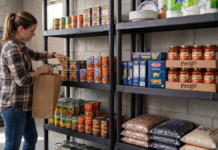
The house I bought in 2002 was the first one that had a dedicated prepper pantry in its basement where we stored canned and dried food purchased at the grocery store. I had to keep the door locked to keep the kids from grabbing food. They liked Chef Boyardee and thought having MREs was a treat. I probably could have taken them to McDonald’s for less than the cost of an MRE, so we only ate them when they approached the end of their storage life. This house also has a prepper pantry in the basement, but no one sneaks food from it. We still try to rotate it and keep track of what we need to replenish.
I remember when we could bug out in a single car, and later when we decided we would have to pack two (having three kids contributed to that decision). If you are at that point in your preps, don’t give up. Stay on your prepper journey, even if you move slowly, and you will continue to make progress. Only when viewed from a multi-decade timeline can I see the full extent of my prepping progress.
So, don’t be hard on yourself if you have made less prepping progress than you wanted. There’s time.
Recent Steps
At this stage of the game, much of my prepping is replenishment to keep us at a high level of preparedness rather than taking that level higher. For example, my original plan this year was to buy more long-term storage food in buckets and feed our oldest grains to the chickens. Hurricane Helene changed that as we spent time, energy, and money repairing and recovering. It also led to the purchase of a Polaris Ranger, which used up the prepping budget. I’ll just push the food out to 2026.
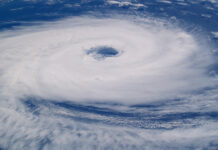
While I would have preferred avoiding the whole washed-out road, landslide disaster, and three weeks without power, Helen was a learning experience, and we have changed our preps accordingly. For example, after Helene, our preps changed to focus a bit more on the homestead, ensuring we have plenty of food for the livestock, and bolstering our firewood production and gasoline storage.
I also haven’t bought any guns or ammo this year. Well, I may have picked up a few boxes of 9mm FMJs to replace what I have used in practice sessions, but no cases of ammo. No serious weight. And I modernized an old Glock, but that was half the cost of a new gun.
Just an example of how you have to adapt your prepping plans as the situation changes.
Recent Preps
We still go to Sam’s Club for a large shopping trip every six to eight weeks. This week was one of those trips, and while most of the food I purchased when into our refrigerator or freezer, I added an eight-pack of Spam to our prepper pantry. I could not help but notice Hormel has updated Spam’s packaging, and the canned meat product is now called “Spam classic”. Maybe that is to differentiate it from hickory-flavored or bacon-flavored Spam.
The last time I went to Walmart, I picked up two 28-ounce cans of Keystone canned pork and a few pouches of Hereford taco meat. That’s a new item that I use in bugout bags, caches, and in our prepper pantry.
I am probably spending twice as much time beekeeping this year as I did in 2024, in part because I have more hives. Beekeeping is more fun this year, possibly because I am a better and more experienced beekeeper. I am now setting the stage so 2026 can be even bigger. It is not lost on me that more hives means more honey, which translates into more income.
A Cycle of Life and Preparedness
One day, I’ll be too old to prep, but I will still be a prepper, even if that means the only prepping I can do is stockpile my prescription meds. I am already reaching for my reading glasses more often than I used to. I actually wore suspenders and a belt while working outdoors the other day, a true sign I am well on my way to being a crotchety old man. Don’t worry, I will never wear black socks with sandals, but only because I refuse to own sandals.
I expect the time will come when I can no longer lift a 50-pound bag of chicken feed or carry a 6-gallon super pail. Heck, these days I can barely lift an 80-pound bag of concrete mix. And beekeeping requires lifting heavy supers and hive bodies. I know plenty of beekeepers in their 80s. If they can manage it, I expect I will be able to as well.
I can also foresee a time—hopefully not for 20 years or more—when I give away my guns instead of buying new ones. I am not looking forward to any of that, but I can’t complain. Prepping has been good to me, and good for me. I have no regrets, and the time may yet come when it saves my life and the lives of my friends and family. That will keep me going for another few decades.