
I don’t recall where I read it or who said it, but last weekend I saw someone say that China doesn’t want Russia to win the war, they just want them to not lose it because as long as there is war in Europe, the United States can’t focus on the Pacific. In other words, China considers the war in Ukraine a nice distraction.
That’s an excellent point, and it gets to the crux of the matter: China, not Russia, is the long-term threat.
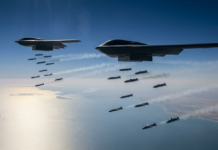
President Trump knows this, and he has used the trade war to fire a few shots across China’s bow. I believe the B2 bomber mission in Iran was a warning to both China and Russia, as is the rapid development of the B21 bomber, which is even more capable, and the F47 aircraft. Many of his programs, from shipbuilding to bringing manufacturing back to the U.S., are aimed at taking away the advantage China has built over the past 30 years. He is likely too late, but better late than never.
While China does not yet have military parity with us, they are in a strong economic position because the U.S. is so dependent on them for a wide array of goods. China remains the factory of the world, and we are changing that very slowly.
History is Rhyming
While the Soviet Union and the United States had MAD, mutually assured destruction, to keep one side from using nuclear weapons, China and the U.S. are not yet convinced that they are mutually dependent on each other economically. While a cessation of trade between the two would hurt both countries, I think China would suffer more substantial damage. However, the Chinese population probably has a higher tolerance for pain than spoiled Americans.
Just as the USSR collapsed when it could no longer keep up with American defense spending, I think we are approaching a time when China may collapse under the burden of its economic problems. Their economy is showing many cracks, and their bubble is likely to pop before ours does. The U.S. actions may bring that day on faster, but it would likely happen at some point. It’s almost as if there is a race to see which economy will collapse first, ours or theirs.
There have been rumors that there is an internal power struggle at the highest level in China’s government and Xi is on his way out or is losing some power. There are some data points that lend credence to this theory, but it is still rumor, not fact. Of course, we don’t know who would replace him and whether they would take a tougher stance or a more conciliatory tone with the U.S.
What to Expect
Let’s assume that China’s goal of being ready to invade Taiwan in or around 2027 remains intact. If so, I would think they will wait until 2028 when Trump is no longer president. If so, we should have two to three years to prepare for the next war in the Pacific, the next war between superpowers, and the next world war. How do we do that?
First, focus on the basics, which means food, water and shelter. Imagine supply chain disruptions that make those following the pandemic look like a walk in the park. If you need anything that is made in China, buy it in the next two years. This includes things you wouldn’t expect, like tires for your car, and large and small appliances.
Second, stay out of Asia. I would not visit China or any country under its influence. As the timetable for a potential war in the Pacific grows closer, also avoid visiting countries along the Pacific Rim, except for New Zealand and Australia. If war breaks out unexpectedly, you don’t want to be in Singapore or Thailand and find out that all the flights have been canceled.
Third, think about where you live and if it will be safe if we go to war with China. There are many reasons I don’t want to live on the West Coast, and this is just the latest one. But consider also where you live now and what might happen if China uses cyberattacks to disable utilities. Think about communications disruptions that could be caused if they cut international cables or take out satellites. Can you live without air conditioning? Can you live without the Internet?
Think Back to WWII
Here’s one thing I try to remember when contemplating a potential problem that lies a few years into the future: the Jews who correctly saw what was coming and left Europe in or before 1936 fared far better than those who did not. In ten or fifteen years, do you want to look back and realize you were one of the smart ones who saw the writing on the wall, or one of the unlucky ones? Refer to my recent post on overcoming normalcy bias to see why people have a tendency to think nothing bad will ever happen.
From history, we can see World Wars last from four to six years. Here are other things we can learn from history and apply them to our preps:
- This should be obvious, but large-scale wars lead to large-scale loss of life, especially among those of military-age. However, civilian casualties can be expected, too.
- Wars cause significant economic disruption. However, fortunes can be made and lost during wars. Make your investments accordingly.
- They also lead to shortages, not only of food, but of energy and everyday items. Production may shift from consumer goods to war materials.
- Wars often lead to important developments and innovations, which can be adapted to the consumer market when the war ends. In WWII, this included rocketry and nuclear weapons. In the next war, advances will probably be around AI and robotics.
- The government becomes more controlling during wars and similar emergencies. This might manifest as curfews, travel restrictions, arrests of suspicious people, or confiscation of property that can support the war effort. Despite our constitutional protections, emergency war powers often allow this under special circumstances.
Two to Three Years
It is human nature to avoid working on deadlines that lie months or years in the future. We always assume we have plenty of time, until we don’t. It takes a mature person with willpower to prep now for a war that may lie years in the future or may never occur at all. If it helps, remember that there is war in Europe and this could lead to WWII. Russia could use nuclear weapons. A NATO country could get involved, dragging the U.S. into it.
So what are you waiting for?