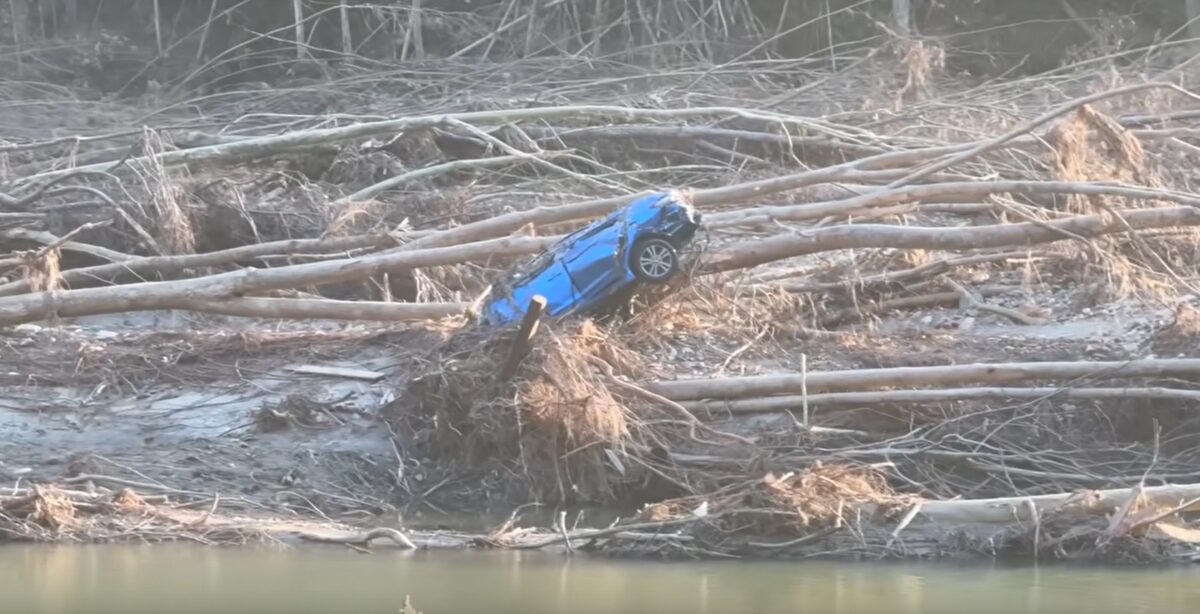
Exactly one year ago, it had rained for a few days, saturating the ground. The next day, September 27, we got hit by Hurricane Helene which caused catastrophic flooding.
Yesterday, it rained an inch-and-three-quarters. More rain is expected today and for the next five days. The ground will no doubt get saturated. There may be some small-stream flooding. There is also the possibility that Hurricane Imelda might head our way.
Just what we needed — a repeat of last year’s disaster.
In the worst-hit areas, Hurricane Helene dumped from 20 to 30 inches of rain in a 24-hour period and damaged 2.3 million acres of forest across Georgia, the Carolinas, and Tennessee. At least 250 people died as a result of the storm. Many more lost homes. Millions of lives were disrupted.
The good news is this year’s storm is following a different track. It would hit us from the east instead of the south, and hopefully with slower wind speeds. The mountains might even break it up some.
The bad news is that this is a very unpredictable storm because Hurricane Humberto is close to what will be Hurricane Imelda. That makes it very difficult for the computer models to predict what will happen. Right now, there seems to be a decent possibility it will come ashore in South Carolina, but I think anyone from Northern Florida to Virginia should be preparing.
How powerful and how wide Imelda will be also remains to be seen.
Playing it Safe
We try to be prepared for disasters that strike us by surprise, but we also have a list of things to do before a hurricane. This allows us to prep even more. On Thursday, I started working on the list.

First off was charging my 18650 batteries, old rechargeable AAs and AAAs, and our rechargeable lanterns and other devices. What’s ironic is that the batteries were charged exactly a year ago, 9/25/24. It feels like déjà vu. Most of my 18650 batteries were at 4.0 volts. Fully charged is 4.20 volts. The lowest had degraded only to 3.94 volts. The charger added between 150 and 500 milliamp hours per battery. That’s a loss of 6 to 19 percent over a year.
I also charged up the battery in my EDC flashlight and three different headlamps. A hurricane may not require a gun-mounted light, but I checked to ensure all of mine are working and the two that are rechargeable are now fully charged.
I have 12 bags of chicken feed; that’s 600 pounds worth. It is also twice as many bags as I had on hand last year, and I have four fewer chickens. My target is to keep 13 bags on hand, so I am darn close. I plan to monitor the weather and hurricane predictions. If it looks like the storm is heading towards us, I may buy another three bags.
We’ve got plenty of firewood, and my last delivery has been sorted, split, and stacked. We can last through the winter without lifting a saw or an axe. I even have plenty of kindling ready to go. Two cords of the firewood are dry and tarped, although high winds have a way of ripping and tearing tarps.

System Improvements
Last year, our solar power system was working at only 50 percent capacity when the storm hit. We had to limp along on the power produced by ten panels instead of 21. As of right now, our system is working at 100 percent. Of course, a new storm could damage our system even though Helene did not. It is engineered to withstand high winds, but fingers crossed.
We also upsized our generator since Helene. I now can produce 7.5 kilowatts of electricity. I test-started it just a few weeks ago, so I know it is in good running shape. We will use it to charge our solar system batteries if necessary, or to run our fridge, freezer and other household items if the solar power system fails for some unforeseen reason.
Earlier this year, I installed our landslide blockade, which is simply a row of pallets anchored into place with two five-foot T-posts driven at least a foot into the ground. When the FEMA engineers came to inspect our landslide site, one of them told me, “You know, things like that can actually work.” Well duh. I wouldn’t do it if I didn’t think it could be effective.
Last year, the woodpile stopped much of the landslide, protecting most of our carport and front porch, although the compressor for our heat pump got knocked about. Our woodpile is now serving as backup to the pallet fence. With any luck, there will be no landslide, but if there is one, we’ll hope the landslide blockade and the woodpile work together to keep the house and the carport safe once again.

Communications
We are still using Starlink, and I even got around to mounting the antenna on the house rather than having it resting on the ground. Hopefully, the antenna will survive high winds, giving us communications during and after a storm.
Starlink not only gives us internet, which allows us to access local websites for news and weather forecasts, it provides us with streaming services for news and entertainment plus our telephone connection. Without Internet, we’re cut off since we are outside cell coverage. Of course, that didn’t matter last year because all the cell towers were knocked out.
Mobility and Infrastructure Improvements
Last year, our vehicles were trapped on the mountain because of damage to a bridge and the washed-out ford. If the storm looks like it will affect us, we’re planning to park at least one vehicle below the ford this time around, and possibly the second below the bridge.
After borrowing our neighbor’s, we purchased a Polaris side-by-side or UTV of our own, which should give us mobility using old logging roads. We may have to cut our way out if trees are down again, but the chainsaw is working and I have extra chains and a bar and plenty of oil.
On Friday, I will top off the gas tank of the UTV and then fill any empty gas cans. I’ll also fill up my truck. My wife filled her gas tank on Thursday. Last year, I had two empty gas cans when the storm hit. Not again.
Speaking of the ford, it has been replaced by what is often called a “land bridge.” Around here, that means a culvert or two with dirt and rock piled over them followed by the roadbed. We’ll have to hope it holds up better than the ford. We also replaced an old metal 24-inch culvert with a modern polymer 30-inch culvert. While six inches in diameter doesn’t seem like much, the math says the 30-inch culvert can carry more than twice as much water. Since the polymer culvert is smooth inside instead of corrugated, I expect the flow rate would be even higher. That should make it less likely to get ripped out by the force of the water.

Our road has also been rebuilt, but the rain may do some damage to it. We are so pleased with our post-Helene improvements; it would really suck to see them get washed away by another storm.
What are the Odds?
The possibility of another landslide is probably our biggest danger, followed by damage to the road and bridges. As long as we don’t get an excessive amount of rain per hour, damage should be minimal.
We were lucky and suffered far less than many, yet we still spent thousands of dollars in repairs and cleanup, and things are not yet back to pre-storm normality. They may never be.
The logical side of me says all will be well because the odds of two hurricanes causing 100-year floods in two consecutive years is quite small. The emotional side of me is still concerned. Either way, we’ll be preparing, just in case.
Hurricane Helene and its aftermath were the subject of many of our posting in the past year. If you are a new reader or want to refresh your memory, you can read many of them here.