
I used our new vacuum sealer for a nontraditional use: I vacuum packed a handgun.
Our NESCO vacuum sealer, which I wrote about on Monday when we used it to vacuum pack fresh meat for freezer storage, is designed for sealing food, but it will vacuum pack anything you can fit into a bag. But why would I want to seal up a gun? The answer is simple: to prevent, or at least minimize, rust.
Rust requires three things: iron or metals, such as steel, that contain iron; oxygen; and moisture. In a perfect vacuum, there is no oxygen, and any water should have boiled away and gotten sucked out, meaning no moisture. But this isn’t a perfect vacuum. We’re talking about a $130 consumer-grade food sealer, not a laboratory or industrial vacuum pump. It is only going to pull 10 to 14 PSI of negative pressure. Vacuum sealing it is, however, better than doing nothing.
Plus, I sealed the bag in my basement, where the humidity is only 23 percent, thanks to the wood stove burning 24/7. That’s better than sealing it on a summer day when the humidity is in the 80s. Whether you seal guns or other gear, you want to start with a dry environment.
Then there is the problem with the bags. As I mentioned on Monday, this sealer won’t seal Mylar bags, which are much less gas permeable than the plastic bags that come with these sealers. Over time, some oxygen molecules are likely to migrate into the bag. At that point, I will just have to hope that the electroless nickel finish of the gun, which makes it resist oxidation or rust, will keep the gun rust-free.
A Steel Gun from the Early Days of CCW
The gun I sealed away is an old .40 caliber Firestar. This all-steel, single-action semi-auto is like a mini-1911, and just as heavy. Weighing in at more than 30 ounces empty, it is a solid gun that was so well thought of when it was new that it was named “Handgun of the Year” in 1991.
By the time Y2K rolled around, these guns were confined to the dustbins of concealed carry history, thanks to the emergence of lighter double-stack polymer-framed Glocks and other compacts and subcompacts that offered higher capacity.
The Glock 48 I usually carry, for example, is much lighter, weighing in at 18.5 ounces, and it holds more ammo. One reason I haven’t carried the Firestar for more than 20 years is its six-round capacity.
Despite its weight, the Firestar is a decent gun. I was comfortable defending myself with it 20 years ago, and I would still be today. It has a good trigger, and it is accurate enough to do the job, but it has become a safe queen. At least, it was until I decided it’s steel construction and toughness made it the perfect gun to bury.
Caching Guns
I have buried ammo and food in caches on and off my property, but I have held off burying guns. It just seems so—I don’t know—final. Like what if something happens to me and that gun just sits there underground, never to be recovered? Will some archaeology student in the year 3418s dig it up and be as excited as when someone finds a buried Celtic sword today? If so, I hope they will be impressed by how well preserved it is.
My purpose in burying a gun is that if firearms are confiscated at some future date, they won’t find this one. I picked this compact Firestar because I won’t miss it. In a pinch, I can be armed. And one gun may give me a pathway to getting more.
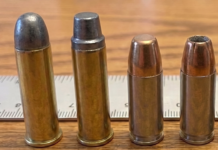
I’ve packed the gun and a few other goodies into a 50-caliber ammo can. That includes 100 flat-point 180-grain rounds of ammo and 20 fancy JHPs. These are still in factory boxes, but I am considering vacuum sealing them, too, just to add a level of protection.
I also have 4 magazines, two of the flush-fitting six-round mags that came with the gun and two of the factory 7-round “extended” magazines. I could seal the mags in one bag to help minimize rusting and then make my own “battle packs” of 30 rounds. Open one of these mini battle-packs and I would have enough ammo to load all four magazines, one for the chamber, and a few extras to top off a mag.
Other Gear
I am also thinking of throwing in a couple of rolls of silver dimes. Since silver tarnishes, I could vacuum pack them, too. I’ll also add some desiccant to reduce any moisture in the ammo can. Then I’ll do some research to find the best way to keep the can sealed if the rubber gasket should deteriorate. I’ve heard of using grease on the gasket and tape around the lid, but that’s a future post.
I have a feeling this new sealer is going to come in handy!