When Hurricane Helene hit this area almost two years ago, many local towns lost their sewer plants because they were near a river. Several municipalities I know of lost one or more of their water supplies, often because mud and debris carried by the flood plugged up the intake on a river. In a few cases, the floodwaters just ripped away the infrastructure. Even cities like Asheville were under boil water advisories for months.
While state tax dollars and FEMA money covered some of the water system repairs, that wasn’t the case for individual homeowners whose wells were overrun by flood water, potentially contaminating them. Many springs were also damaged, and in some cases the pipes that run down the mountain were uprooted and broken when trees fell over. We know one woman who had to walk down the road to her brother’s house to take a shower because her water was out for months, and that is not an isolated story.
A state organization concerned about what the flooding might have done to local wells, springs, and municipal water systems provided free water testing as part of a project to assess the damage. We took part, which meant picking up their water sample bottles, filling them with water from our faucets, and returning them at the drop-off point.
Get the Lead Out
Our water tested positive for coliform bacteria and lead. I was not worried about the coliform bacteria because it was there when we tested the water before we purchased the house. The lead was below EPA levels, but any lead is bad as lead can accumulate in our bodies.
After doing some research, we replaced some brass valves in our spring system. Our water is naturally soft with little dissolved mineral content. That means it is “hungry” for minerals and is probably leaching lead from the brass fittings. I have since learned that our original brass valves were designed for gas, not water, and they were never considered “lead free” like valves designed for potable water. With any luck, replacing the valves will cut down on lead contamination.
Accepting Free Stuff
Then the non-profit that did the water testing offered us a free remediation system. Using grant money, they offered to install a UV water treatment system for us at no cost to us. We accepted their offer.
For decades, I didn’t like accepting charity. I felt like I could pay my way and that others needed it more than I did. Our Hurricane Helene experience changed that. So much was given as part of relief efforts that there was extra. The relief centers were begging people to come and take stuff. At first, they were crowded as folks who had lost everything or had little to start with stocked up. Then people stopped coming. The centers cut back on their hours and eventually announced they were closing and told anyone to please come and get stuff. So we did. We got at least four cases of bottled water, a couple of cases of MREs, medical supplies, a wool blanket, a 20-pound propane canister, and a 5-gallon gas can. The latter two were full, but I valued the tank more than its contents.
Then we faced the challenge of repairing our private road, which would have cost tens of thousands of dollars. Samaritan’s Purse paid for it. We were so grateful that we now donate to them annually.
Over time, I realized many charities have funds they can only spend on specific projects, so they want to give the money away so they can show their donors what they accomplished. Also, I figure I paid taxes for more than 40 years; it’s about time to get some direct benefit back.
TLDR: We now accept free stuff.
UV Water Treatment
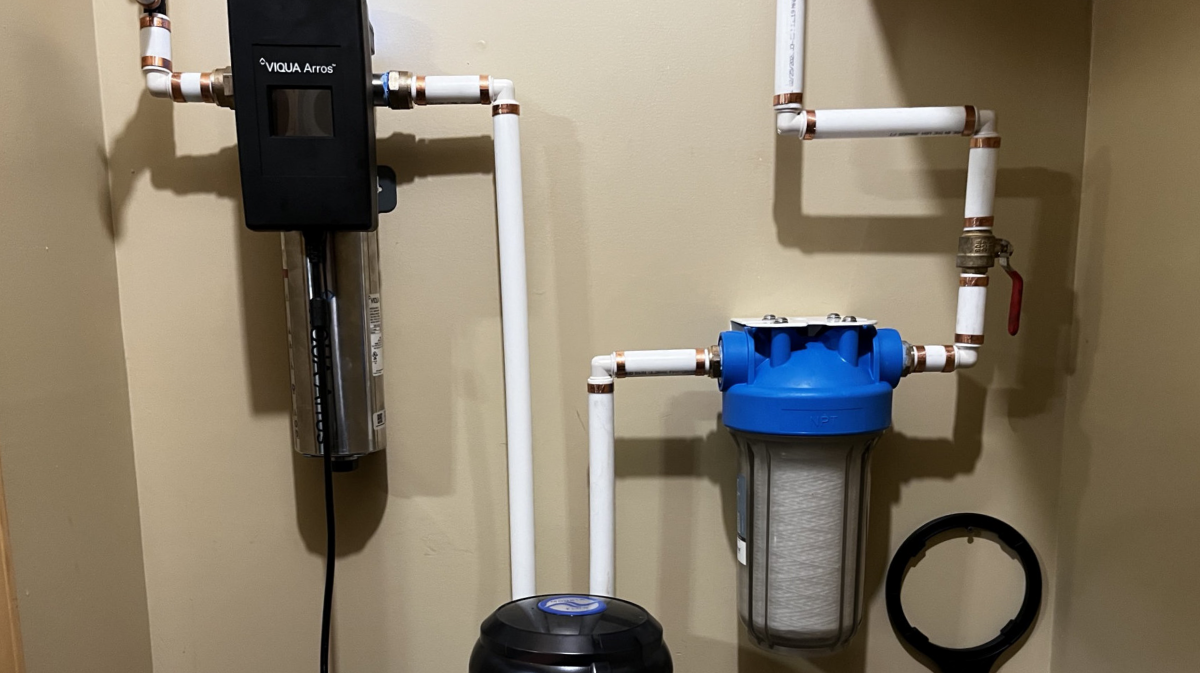
The day of the water installation arrived, and we learned that not only were we getting a Viqua Arros UV water treatment system to kill the bacteria, but a pre-filter to keep out any particulate and a huge activated charcoal filter to remove the lead. All for free.
The UV light will ensure any coliform bacteria or E. coli that is in our spring water doesn’t infect us. That will make the water safer for us, but also for washing eggs or being consumed by infants or people with weak immune systems.
On the downside, the UV unit needs a new bulb every year. That’s about $200. The charcoal filter will be replaced at the same time. It runs about $300. Just keeping the bulb on in the UV device will cost $75 if we use grid power. Our “free” water treatment equipment is going to cost close to $600 a year.
This raises the question of when is good enough, enough? Because it has been my experience that good enough is far less expensive and easier to obtain than perfect. Our normal water was not only good enough, it was pretty darn good. Is it worth $600 a year to make it better? More importantly, in a grid-down scenario, is the 1,200 watts consumed by the UV bulb over the course of 24-hours worth it?
My conclusion is that we will pay the $500 for “perfect” water now, but we won’t use the UV filter in a grid-down scenario. Especially not over the winter when there are days we barely make enough power to keep the refrigerator and freezer running.
We lived for six years with untreated water. In a grid-down scenario, I’d do it again without a second thought.
Stocking Spares and Lessons Learned
I have to decide whether I want to keep an extra set of filters on hand. The sediment filters are cheap and can be purchased from Amazon.com or at Home Depot, so that is an easy decision. I may skip stocking the expensive ones, or I may only get a replacement UV bulb. You know, in case of supply chain issues.
The primary lesson of our free water system is that every time you add a new piece of equipment or a new technology to your retreat or prepper property, you then have to support it. In this case, a free water filter will cost us $600 a year as long as we live here. It also requires maintenance (time) and electricity (money or a drain on the solar panel). And it may have limited use after national or regional disaster.
For example, if you buy a tractor, that is not your only cost. You have to add implements, service it, and stock diesel fuel. If all you need to do is bushhog a field a couple times per year or spread gravel on your driveway, it will be cheaper to pay someone else to do it.
When I bought a new chainsaw, I bought a new bar and four chains. That was an added cost, but to me it is more important and less expensive than the annual service on our new water system. It is also a onetime cost rather than a recurring one. Plus, chains can be resharpened; there is no way to repair a UV bulb. If the water system hadn’t been given to us, we would not have purchased it.
As you build out your preps, keep this in mind and remember: simplicity has advantages, especially in a long-term country-wide TEOTWAWEKI situation.