
It suddenly seems like we have left summer behind us. It’s been two months since the summer solstice, and the diminishing sunshine has banished high temperatures. Oh, the sun is still warm on our skin, but on cloudy days, rainy days—which have increased—and at night, its absence is felt as well as seen on the thermometer. I don’t miss the higher temperatures during the day, but I am not yet ready for cold nights.
This is the time to wrap up the last of those summer chores and tackle the ones we didn’t want to do when it was too hot. In the first category, I just did some power washing, including blasting the mud left after the landslide off the side of our house. My fall chores include splitting more firewood and finishing the fuel bunker.
In the garden, my wife has pulled up the tomatoes, harvested a huge batch of red peppers (the green ones remain on the plants), and is giving the dehydrator a workout. The cucumbers are going straight to the chickens, much to their delight. The green beans are still bearing. (I ate some with dinner last night.) The spinach, kale and two kinds of lettuce starts go into the ground this week.
The good news is that it looks like the fall wildfire season will not be much of a threat due to he amount of rain we have received so far.
Winter Preps

It still seems a bit odd to me to be planning for winter while it is still August, but the mountains make winter come quicker than it does on the coast or in the South, where we have lived previously. I’m doing things like wrapping heat tape around pipes and making sure we have dry firewood. The next time we get a forecast showing several days of rain, I’ll tarp it up another cord before the rain comes. I like to have the cord we are burning covered and a second covered in reserve. When I finish the first, I move the tap to a new cord. The rest are left out to season in the wind and sun.
We have three big boxes of kindling and a surplus of things like old newspapers and the cardboard tubes from inside paper towels, which we use to start fires.
I’m hoping for confortable temperatures and sunshine next week. There’s still more to do.
Chickens and Bees
The chickens are now consistently laying 11 or 12 eggs per day. Whether it was rain or the hot weather that caused them to slow down, they are over it. We have given them a reprieve and will let them live and lay another season.
They have also stopped pecking the eggs, which was costing us at least four eggs a week. Maybe the chicken that did that is the one that died. Just two weeks ago, I came out and there was a dead bird down in the corner of the chicken run. No idea what killed her as she wasn’t bitten by a predator or pecked to death by her sisters. I can only guess she was unwell.
I went almost two years without losing a bird, and this summer have lost three. That’s another contributing factor in our lower egg production rate.
The beehives continue to do well. I don’t think they are making as much honey as they have in past summers, but I won’t know until we harvest. Quite a few things are blooming early, so I suspect some of our normal fall honey production was shifted to the spring harvest. It has been an early year.
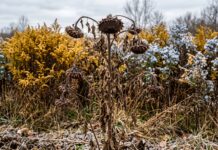
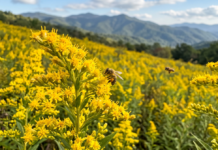
One of the early bloomers is goldenrod, which is just beginning to turn yellow. This makes a weird-tasting honey, so I have to hope it doesn’t peak before I harvest. I could harvest now, but I will have help on hand over Labor Day, so I am holding off until the end of this week.
Changing Plans
I was hanging out with some guys the other day and told the story about not being able to back up the log splitter using the UTV because I could not see it. “You need to put a flag on it,” said one of them. Now why the heck didn’t I think of that? So the front trailer hitch is out. The next time I need to back that up, I’ll slap a temporary flag on it.
I am also reconsidering using Rocksett to attach my suppressor to the gun. My bottle of Rocksett arrived, and I broke with tradition and read the instructions. Then I went down the rabbit hole of internet research on thread lockers and muzzle devices, and I am now reconsidering. My decision is not yet made, but I plan on making some changes to my setup and testing it out again before I commit to using Rocksett. Afterall, I opened a 420-round box of ammo, why not use up some more of it? I expect to make another post on this topic in the future.
In the meantime, if anyone can tell me how to use a torque wrench on a screw-on suppressor, please let me know in the comments below. I’m not talking about a muzzle brake or a muzzle break that serves as a suppressor mount. That I have done. But how to use a traditional torque wrench on a cylindrical object like a suppressor escapes me.
Landslide Prevention and Water Management
We had a local inspector come out and look at our landslide. He made a preliminary visit and said he would send out FEMA engineers in a couple of weeks. We also expect a visit from a forestry organization to evaluate the damage in the forested portion of our land. We have no idea what their recommendations will be or how much any work will cost. No one can tell us if we will qualify for any FEMA aid or other grants, but we figure it’s better to get their input than cross our fingers and hope we don’t have another landslide.
I also continue to do things like improve our gutter system and work on managing the rain runoff. We’ve had rain, but no gully washers for about a month. It’s the intense rains where we get more than an inch or two in an hour that cause problems.
The remains of the landslide has changed since Helene. While it was bare land scrubbed free of life, parts of it are bare land with ragged trenches carved by recent runoff. Other parts of it are covered in weedy growth and dozens of new black locust trees. We usually would cut those down but are leaving them for now. Their roots may be the only thing holding the hillside up.
The forest has aLSO changed dramatically. Wherever there was a big blowdown, there is now much more sun. So where we may have lost desirable trees like oak, maple and cherry, we are seeing less desirable trees, such as tulip poplar and locust, replace them. Hopefully, the forestry people will have a workable and relatively inexpensive solution.