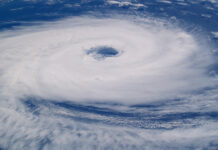

Twenty years ago this week, Hurricane Katrina stormed into New Orleans and rearranged the face of the city and much of the surrounding area. Water rescues and helicopter rescues went on for days, often broadcast around the world on cable news channels. More than 1,800 people died, and 1.5 million across Alabama, Mississippi, and Louisiana were forced to leave their homes. At the time, it was a catastrophe of unexpected and almost unimaginable size and scope.
One thing often forgotten is the looting that went on in the aftermath of the hurricane. In addition to seeing videos of Coast Guard and National Guard helicopters lifting people off roofs, those of us watching from the safety of our homes saw video of people looting local stores. In many cases, this was excused after the fact by claims people needed food, water, diapers and other items to survive, so they took them from stores. But much of the video footage focused on people who took athletic shoes, large-screen TVs, alcohol, furniture, electronics, and other goods. Hardly what I would consider survival necessities.
Is it Ever OK to Loot?
Sadly, looting often happens after a SHTF event. In most cases, looters are criminals who take advantage of other people’s misfortunes to steal their goods. We know this is common from news coverage and the fact that police block off neighborhoods in California after forest fires and shut down bridges to North Carolina’s outer banks after a hurricane. Only residents are let back in to avoid looting.
There is a legal defense to looting (and other crimes) called the Necessity Defense. I am not an attorney, but as a layman, I will compare it to justifiable homicide. The looting or homicide is still a crime; however a specific threat—whether it is starvation or defending yourself from an attack by someone with murderous intent—justifies the crime. So yes, if you looted the corner grocery store because it was day four after the storm and your kids were hungry, that can be excused. If it was day four of the storm and you wanted to score some new Nikes, then it cannot be excused.
Obviously, creating a mob scene as an excuse to loot, otherwise known as conducting smash and grab robbery, is not OK. Neither is looting during or after a protest, regardless of whether the protest is “mostly peaceful” or not. These are just crimes of opportunity.
As people who prepare, preppers should not need to loot. We should have all of our basic needs covered for weeks, preferably longer.
Scavenging
At what point does looting become scavenging, and is scavenging legal and morally acceptable? In my opinion—and again, I am not an attorney and this is not legal advice—when an item is abandoned, it becomes fair game in a survival situation.
That begs the question of when something is abandoned. In an SHTF scenario, I think it can be considered abandoned when the owner/possessor of the item or property is no longer alive or unable to reclaim the item or property in a reasonable amount of time.
For example, there are houses near us owned by what we call “part-timers,” people who come up to the mountains anywhere from two to six times a year. If much of the East coast is hit by a tsunami of giant proportions and we survive because of our altitude, I can be fairly certain that the owners of these houses, who live in coastal areas or in Florida, will not be showing up to claim their property.
Under these circumstances, I am not going to move into their house or take their furniture because I expect they have heirs, some of whom may have survived. However, if they do not show up in 60 or 90 days, I would not be averse to taking the gas can of fuel from their garage, the propane tank off their grill, or even their cut firewood if that is what I needed to enhance my post-disaster survival after much of our state is destroyed. Better yet, the surviving neighbors could gather and split up items from the house that each surviving family needs. Someone may need the box of pancake mix from the cupboard more than the gasoline, for example. And scavenging as a collective seems fairer.
Survivor Benefits
Likewise, if a global disaster results in the collapse of our society and a large die-off, a small segment of the population might survive, either by luck or planning. (Government studies predict a 10 percent survival rate after a well-executed EMP attack.) Perhaps you were in a subway tunnel when the nukes went off, and you lived. Maybe you were one of the lucky few who were immune to the virus that caused the deadly pandemic. Or you prepped to survive an EMP.
If the vast majority of the population is dead, then I see no problem with your going into an abandoned Walmart and helping yourself to the canned food, crackers, peanut butter, and pasta. Heck, while you are there, break into the pharmacy section and take a supply of any prescription drugs you need. I consider this scavenging, not looting, in part because whoever owns or has a claim on the contents of the store is dead. The items can be considered abandoned and might otherwise go to waste.
You would be even smarter to find the warehouse that supplied Walmart. If there is a massive die-off, the survivors will not only have warehouses full of goods to salvage, but container ships in ports and rail cars on railroads.
I look at this as what Will Smith’s character did when he was alone in New York City in the movie I Am Legend.
Salvaging
I define salvaging as recovering and/or repurposing something that was lost due to TEOTWAWKI. An example can be found in the book World Made by Hand, which I reviewed back in 2021. In it, the old dump became a source of materials after the world collapsed. If you take the leaf springs off an old rusty car abandoned on the side of the road and use them to build a crossbow or to make a large knife, that is salvaging. Going into a radioactive area or a bombed-out city and bringing back goods for use or resale is another example of salvaging.
Salvaging is allowable in my book because it would take place well after the collapse and is making something useful out of something that is waste.
Well after the SHTF, salvaging would not only be allowed, but should be encouraged to speed the recovery and regain some small part of our prior life. For example, survivors may not be capable of rebuilding an operation that mines and refines steel, but it is a much shorter leap to make a sand mold and pour a casting using salvaged steel.
It could take decades to rebuild the automotive industry, but if there are abandoned cars and trucks all over, then rebuilding the industry could wait. We just need mechanics. Microchips are another good example. We may never regain the level of expertise found today in chip factories in Taiwan, but why would we need to if there are abandoned server farms that have no electricity or connectivity and likely won’t for the rest of your lifetime? Salvage and re-use what you can.
Plan Ahead
The time to make moral decisions is before you face them. Think about various “what-if” scenarios while you have time to explore the issue from multiple angles, do research, or talk about it with others. Knowing what you find acceptable in an extreme situation will allow you to act quickly should the time come rather than waste time thinking.
While I may rush to the general store in the immediate hours after a disaster strikes and buy some chicken feed and other last-minute supplies, I know I am not going to slip in through a broken door to fill my backpack four days later. Of course, that doesn’t preclude my showing up weeks or months later hoping to barter for more feed.
Likewise, I know I will not raid the part-timers’ garages and kitchen cupboards until 1) we need those items and 2) we can say with a high degree of certainty they will not show up planning to live at what they may well consider their retreat.
Determine where you stand on issues like kill-or-be-killed. Think about where the line you will not cross lies.
In a post-apocalyptic world, we may face situations and scenarios many modern Americans cannot comprehend. That does not mean, however, that humans have not faced similar situations in years past. Study history, especially the ugly parts. Look at Europe in the late Middle Ages and the Early Modern Period, especially in times of war and plagues. After a major SHF event, survivors may find themselves living in some kind of ugly mashup of 2025 and 1625. The key is to remember that humanity has survived all sorts of terrible things. If they hadn’t, we would not be here.