The honey harvest is about 90 percent complete, meaning all I have to do now is finish the cleanup. Here’s how it went:
On Thursday, I opened up all three hives at the out yard and stuck escape boards under the supers. The supers were not as heavy as I had hoped, meaning this bee yard, which was our biggest producer in the spring, made little honey over the summer.
Then, I repeated the process with two of the larger hives in our home apiary. These were packed with honey.
On Saturday, I brought home the supers from the out yard, using a leaf blower to blow off any bees that lingered on the frames. Most of them were gone because the escape board allows the bees to leave the supers but not come back in. In the spring, I pull only the frames that have lots of honey. In the fall, I remove the whole super because we will not be harvesting again. This can require some heavy lifting, but it goes quickly.
Once you remove a super from the hive, the bees will flock to it, trying to get the honey. I have to quickly place them on a solid board in the pickup truck bed and slap a lid on top to keep the bees out. When I bring over the next super, I blow the bees off, open the lid, stick the latest super on top of the previous one, and then put the lid back on top. I repeated this on the two hives at home and then put three of the escape boards back on the remaining hives.
Extraction
On Sunday, I set up the extractor, the decapping station, and made sure we had plenty of buckets. My daughter and her friend arrive to help. We got in about four hours of work.
Our first step was to sort the frames of honey. We ended up with three colors —dark, medium and light. Depending on when the bees harvested the nectar and from what plant, a super can be all one color or it can have multiple kinds of honey in it. During this process, we found that our 19 supers resulted in only nine or ten full supers. Some frames had just a little nectar or uncapped honey, so we fed that back to the bees.
We use what is called a hot knife to decap the honey. This is a knife that is plugged into an outlet and gets hot, allowing it to slice rapidly through the comb, opening up the cells. When we plugged the knife in, there was a click and the room went dark. I checked the circuit breaker, and it was fine, but further investigation showed a GFI outlet had been tripped. I took the knife and plugged it into an outlet in a nearby bathroom. That GFI outlet also tripped. There we were, about to start, and our knife was busted. So we fell back to using the manual knife, which has a saw blade-like edge, to cut the wax cappings off the frames of honey. This works, but it slowed down the process.
We harvested the last supers Monday and extraction continued. Because we only have four buckets with honey gates on the bottom—which allow us to pour honey out of the bucket without tipping it—we had to bottle some honey just to free up the buckets.
Filtering and Bottling Honey
When the honey emerges from the extractor, it flows into a two-layer metal mesh filter. The first layer catches the largest chunks of wax and any solids, like bee parts, that are in the wax. If you have eggs or lava in your honeycomb—which we do not—it will keep these out of your honey as well. The third filter is plastic with a screen that has holes 400 microns in diameter.
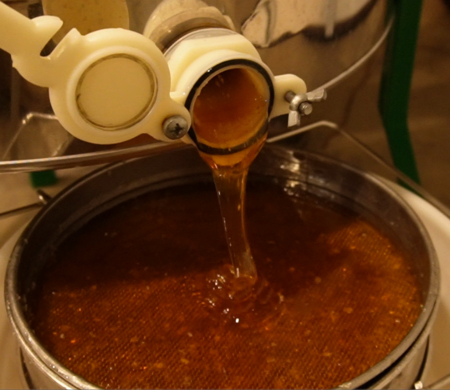
Once the bucket has about 4 gallons of honey in it, we lift it onto a table and open the gate so the honey pours into a bucket below it, which has a 200-micron screen. That’s large enough not to stop pollen, but small enough to take out any remaining solids that might be visible or detract from the honey.
I bottled honey in quarts, 1-pound glass bottles, 1-pound plastic squeezable bottles, 12-ounce bears, 8-ounce bears, and 8-ounce plastic squeeze bottles. Different retailers prefer different sizes, but we are producing more and more in quarts. I used five cases of quart bottles this year, accounting for almost 180 pounds of honey.
Data
The out yard produced about 45 pounds of honey. Our home bee yard generated about 150. Add in the 125 pounds we harvested this spring, and that’s 320 pounds of honey. That’s 50 pounds more than last year, but we had more hives. Most of that increase was in the spring, as our fall harvest was only 10 pounds larger than last year’s fall harvest.
Overall, this was not a strong year for honey. It was a strong spring, but the summer produced less honey per hive than our average.
At retail prices in this area, 320 pounds of honey would generate about $5,000. Since we sell most of our harvest to retailers for 25 percent off, we’ll likely see less than $4,000. That’s less than I have spent on the bees and equipment, if you don’t consider my time. As side gigs go, it’s a small one.
If you are curious about how useful beekeeping is for preppers, 320 pounds of honey is more than 440,000 calories. Sadly, we cannot live on honey alone. Even honey and eggs won’t do the trick, but I dare say a few hundred extra calories per day from honey will be useful, and we can use the rest for barter. In a post-SHTF scenario, we would use honey as a sweetener in baking and in coffee or tea, on oatmeal, as a spread on breads, and instead of maple syrup on pancakes. It can also be used in cooking, to make a glaze or to flavor barbecues and baked beans. If you have a homestead or are aiming for a high degree of self-sufficiency, I recommend getting three or four hives.
Taste
Taste won’t matter to most customers who do not realize honey taste varies by the nectar source. If they buy pasteurized honey in a big box store, they are getting generic stuff that is bland and boring, and possibly not even made in the USA. Raw honey is for people who appreciate the many different flavors, want to support their local beekeeper, or like local honey’s benefits in fighting seasonal allergies.
We occasionally have a honey tasting and allow people to sample multiple honey flavors. Of course, this often ends in the sale of some honey, so it is a good marketing technique.
In our opinion, the dark honey was excellent, but not quite as good as the dark honey we harvested in the spring. The medium honey is also very good, with a traditional honey taste that has a bit more complexity and depth than store-bought honey. This looks the most like “generic” honey, so it should sell well.

We had less of the light honey than usual, and it is not quite as good as last fall’s. The color is very close to last year’s, but not quite as yellow. It may be we got less sourwood in the mix this year.
My plan is to have more hives in the out yard next spring and then to move them to the home apiary after the early harvest to maximize their production. I also hope to grow my bee yard a little more. Two of this year’s three splits did not produce any honey, but they should be big, healthy hives next year. Now, all I have to do is help them get through the winter.