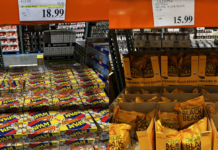

I ate a can of chili the other day as part of our policy of rotating out canned food. It made me realize that a 15-ounce can of chili doesn’t go far, which led me to a list of other considerations and resulted in this article.
For example, I consider canned chili to be an excellent prepper food. The can of Hormel chili I opened says it is “about two servings” of 350 calories each. A serving has 19 grams of fat, 28 grams of carbohydrates, and 16 grams of protein. That’s an excellent blend of macronutrients, one reason I think it is a good prepper food. There are also many varieties of chili, including chicken chili, vegetarian chili, and beanless chili, so you can stock your shelf with a variety. It’s also quite flavorful and can be mixed or served with other items.
For my dinner, I ate the entire can. I added some grated cheddar cheese and had a few crackers, so my meal was closer to 850 calories.
In a disaster scenario, I doubt we would have cheese, and I would not have wanted to “waste” crackers. Plus, I would have shared the can with my wife. To stretch the meal, we would either add macaroni elbows, making chili mac, or serve the chili over rice. Doing so would result in a meal of about 550 calories each unless we added lots of rice or pasta.
Why 1700 Calories is a Slow Death Sentence for Preppers
If we have three meals like this in a day (and breakfast will probably be even fewer calories), that’s less than 1,700 calories. That’s not terrible if we are indoors, warm, and inactive. However, if we are outside working in the garden, chopping or hauling firewood, walking up and down the mountain to see neighbors, running patrols, or coordinating some kind of guard duty, it would put is at a serious calorie deficit. We would need more food to avoid being hungry, maintain our ability to perform manual labor, and keep our mental abilities sharp.
I intentionally lost 15 pounds this year (it was 18 before the holidays). I could lose another 18 or even more without endangering myself, but at some point, we’re going to need more than 1700 calories per day. And that’s just counting calories. It’s not talking about good nutrition, vitamins, and staying healthy.
For example, survival requires fat, which is why we store oils. Not only are fats a source of energy, your brain needs them. If all you eat is rice and beans, you’re going to need some additional fat. Chili solves that problem. So does eating two eggs for breakfast because eggs are mostly fat and protein. That’s why we raise chickens.
The Best High Caloric Foods to Stretch Your Prepper Pantry
What is the answer to adding more calories to meals after the SHTF? It is not vegetables from the garden unless we grow potatoes. While most green veggies have plenty of nutrients and can help fill your stomach, they don’t have many calories on a per-pound basis and little or no fat. Besides potatoes, beans, winter squash, and corn are other garden products that can provide more calories, but we don’t have enough space to grow corn. We have successfully grown beans, but it takes a 100-foot garden row to produce 25 pounds of dried beans. A 5-gallon pail can store 30 or 40 pounds of beans.
If we are lucky enough to have some wild game, we wouldn’t need to open a can of chili. We might use some of our beans and spices to make chili out of that meat and pressure can it for later consumption. In an SHTF scenario, fresh meat will be available intermittently and in limited quantities, so entrées will have to include meat rather than being meat. This is why chili, soups, and stews should be on your prepping menu, because they allow you to stretch your ration of meat.
Based on what we have stored here at the homestead, rice and homemade bread are our best solutions to add calories to meals, with fresh eggs the best source of added fat. A good-sized slice of artisan sourdough bread will add close to 200 calories to a meal. It also adds bulk, is chewy, and is satisfying. Because we store wheat and have grain mills, it’s going to be a staple product for us in the end times.
The Dangers of Sharing your Stored Food After the SHTF
After Hurricane Helene, when we all knew things would one day get back to normal, we made meals for neighbors using our stored food. Although we didn’t expect to, we probably received more food from the recovery centers than we gave away. Thanks to them, I have fresh MREs on my shelf and in my caches.
In a disaster likely to last months or years, we’ll have to be more careful. For example, if I have 52 cans of chili, that’s enough for my wife and me to enjoy a chili dinner once a week for a year. But what if the disaster looks like it will take years before we see a recovery? 52 cans of chili doesn’t sound like much in that scenario. That’s when the 5-gallon pails of rice and pinto beans come into play. If we share with very close neighbors—and the two closest neighbors have a lot to offer in return—then the prepper pantry doesn’t last long at all. We’ll be tapping our long-term storage sooner than expected.
The problem is people who live a mile away. As much as I might want to be charitable, I don’t see it happening if there is no chance of resupply. Barter is a possibility, but donations are less likely because every calorie we give away is one less for us, and we may need every one. The tough question is what do we do when someone with whom we are friendly shows up? My hope is that someone else, preferably someone who doesn’t know them, turns them away at the bottom of the road before they reach our house. Otherwise, we may offer them a meal or some oatmeal. This may sound cold, but at some point, their lack of preparation is their problem. Mine is keeping my people fed.
How Guests Drain Your Food Storage
If Karl and his family make it out here in a disaster, then we’re suddenly feeding five people. If my daughter makes the trip, we could be feeding six or seven. Our 52-cans of chili will then last three or four months instead of a year.
We have to hope that Karl has time to bring his own food. That’s the plan. If they can drive the entire way, they could bring three pickup-trucks, one with a trailer, which can hold quite a bit of #10 cans and 5-gallon pails. We recently reviewed the list of items for them to bring besides food, from clothing and personal hygiene items to bedding, guns and ammo, and chainsaws. Our list was the basis for this article.
We’d also have hope the last-minute orders we expect to place on Amazon and Sam’s Club show up because it would be great to double the food in our prepper pantry. Of course, that depends on the scenario and the immediacy of the disaster. Are the trucks rolling, or is everything shut down? Is there power, or are the grid and the Internet down? Can we safely make one last run to Walmart and other local stores? Those are unknowns, and that’s one reason I want to stock more buckets of wheat and perhaps buckets of chicken feed.
I just ordered 15 five-gallon Mylar bags and 2500cc oxygen absorbers. I’m thinking of putting up:
- 5 pails of hard red wheat
- 4 pails of beans
- 3 pails of rice
- 2 pails of pasta
- 1 pail of oats
Fifteen five-gallon pails is about 500 pounds of dried food. I use the 750-pounds per person per year rule of thumb, so that means it’s not even one year’s worth of food. But it’s a step in the right direction.
Is an Offsite Storage Unit Cache Worth the Risk?
One challenge with storing more food—especially in buckets or boxes—is our lack of space. We may have to consider renting a storage unit. So far, the smallest unit I have found nearby is 10’x15’. That’s more room than I need to store food, so I’m going to keep looking. A 10×10 would be a better fit and should be cheaper. Of course, space has a way of filling up…
For example, I could store extra beehives woodenware and related equipment there in the off season. That’s what I’m going to tell the rental place I need it for when I rent it. Those 5-gallon pails? Why, we use them for honey processing. And if I move my extractor and other honey processing equipment in there, it means more room in the garage, which will make my wife happy.
I could also rent it under my company name, making it harder to connect to me.
Off-site Storage Strategies for Guns and Ammo
I have used commercial storage units twice in my life, and based on my experience, I prefer those that are climate controlled, but the nearest climate-controlled storage units are 45 minutes away by car. That’s not ideal during a disaster.
The one I am looking at is between me and Walmart. That means we can make an emergency shopping run to Walmart, and if there is still room in the truck, we can swing by the storage unit on the way home and pick up some stuff.
During my divorce, I stored guns and other personal items in a storage unit. The guns were hidden inside a U-Haul wardrobe, surrounded with old clothes on hangers. I also stored ammo at the bottom of boxes filled with books. The idea being the books helped explain why the box was so heavy. I learned to store ammo that was in Styrofoam or other tight containers that didn’t rattle and give it away. Today, I would not put much in the way of guns and ammo in a storage unit, but if I can bury a gun in the woods, why not store an old rifle in a storage unit?