When I was in junior high and high school, I was a member of the military book club.
For those too young to remember, book and record clubs were organizations that sent you books or records. If you liked them, you kept the books and sent them a check. If you didn’t, you returned the books. It required an element of trust, but it worked. Netflix started out with a similar methodology where they sent you DVDs in the mail.
My favorite military books were those about World War II. I remember reading books like Run Silent, Run Deep about submarines in the Pacific. I read about Admiral Nimitz, General MacArthur, D-Day, the British Spitfire, Rommel the Desert Fox, and many related topics.
Perhaps that sounds weird some 40 years later, but keep in mind that it was only a generation behind us, and my parents grew up during WWII. My grandfather was stationed in San Diego with the Navy during the war. My mother would tell us of pulling the blackout curtains at night, worried that the Japanese would bomb the mainland as they had Pearl Harbor. I guess it would be like kids today reading about 9/11 or Desert Storm and hearing their parents talk about where they were when the Twin Towers fell.
My friend Justin and I would go to the theater and watch war movies. Things like The Eagle Has Landed, A Bridge Too Far, and Midway with Charlton Heston and Henry Fonda. With Vietnam just behind us, I think America wanted to watch movies in which we won.
The Blitz
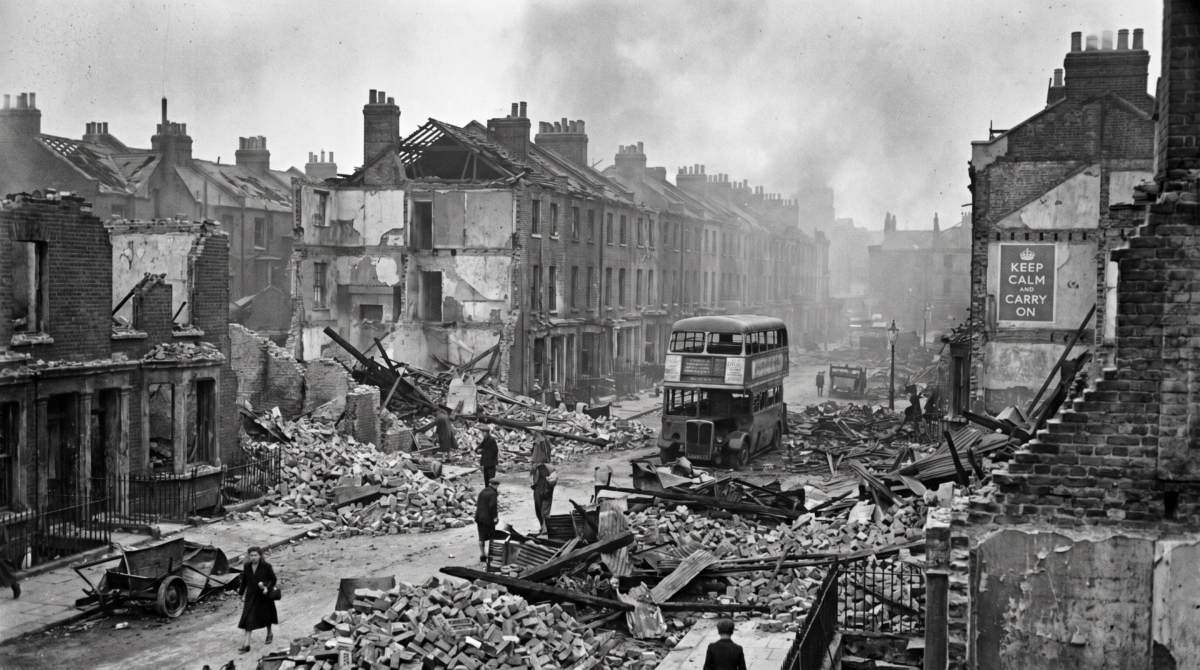
It is one thing to read about war as a kid, when the P51 Mustang is a fascinating flying machine and death seems a distant and unlikely event. It is another thing entirely to read about war with a lifetime of experience—including some pain and loss—upon which to draw. I recently and rather unexpectedly read a book that took place during the Blitz, when London was bombed by the Germans on a regular basis. When incendiary devices burned the East End and bombs destroyed not only the factories, but the houses, the homes, and almost the people themselves.
And while this was a horrible event, one which I hope to never experience, it reminded me of two things: One, it’s probably like this right now in parts of Ukraine. That’s something to think about.
And two, even when things look grim, there is hope. Because not only did the Allies turn the tables and beat the Germans—it was just a few short years from debacle at Dunkirk to D-Day—but the country recovered. London rebuilt and was reborn to be a great city again. The war gave birth to what is rightfully known as “The Greatest Generation.”
So if we one day face mass destruction, if we live to see all we have built torn down and are left with little other than the clothes on our backs and a meager crust to eat, we need to remember that there will be a recovery. Maybe it will come in three years; perhaps it will take eight or ten. Either way, I will take hope in the reminder that in every calamity in the known history of the world, some have survived and gone on to better things.
Calamities and Disasters
If there is one constant in world history, it is calamities and disasters. Some are manmade, like wars. And lest you think wars are a recent occurrence, let me remind you war has been around for thousands of years. Much of our history and literature is about war. Some disasters are natural, like the ice ages, Pompeii in 79 CE, the Mount Tambora eruption in 1815, to more recent disasters like hurricanes Katrina, Sandy, and Helene. And let’s not forget the Black Plague in the mid-1300s and the Spanish Flu in 1918, both of which made COVID look mild in comparison.
And yet, countries, people, and society emerged stronger than ever. Europe’s population is about 20 times larger today than it was after the Black Plague wiped out about half the population.
Not only did England recover after WWII, but so did the rest of Europe, much of which had been invaded and fought over. Even Japan and Germany, the defeated parties, recovered.
Our Job as Preppers
In the book I read, the leading lady lost her parents, and the leading man lost his entire family to the war and the bombings. It seemed like someone was being picked off every chapter. And yet, they persevered. They struggled, and they faced despair, but they also kept a stiff upper lip and refused to give up. Many became heroes in their own small way.
It is a reminder that our job as preppers and survivalists is not only to survive, but to help others to do so and to bring about the recovery.
The further I get from the city, the more willing I am to help my neighbors, mostly because there are fewer of them, they have more resources, and I know them better than I knew my neighbors in the city or suburbs. In the city, unknown neighbors can be a potential threat. Out here, few are unknown, and most can be a resource, perhaps a partner. Some may still be a threat, but we generally know who they are before the SHTF.
Neighbors may have land we need for raising food but not the labor force. They may have a tool or a skill we need, or we may have supplies or knowledge they need. We may survive better with them than without them. Time will tell. I am sure some will not wish to cooperate or may prefer to go it alone, but there are some we will look out for, and vice versa. Not because we are members of the same prepper group, but because that’s what neighbors and friends do for each other.
Teams versus Lone Wolves
I am not a person who likes crowds. I am happier at home than at a party, but I am no lone wolf survivor. I believe we need a team of people to maximize our chances of survival after a massive calamity. Some of my team may arrive from the city if time allows. If not, we will build one here.
What are your plans?