
Early in my prepper journey, my preps focused on food, water, diapers, and bugging out. My gear was small and portable, which made sense because we lived in large cities and knew survival could very well depend on getting out.
After I left the city and got our first house in the suburbs, my preps expanded to include more food. As my daughters got older, boxes of feminine hygiene products and bottles of shampoo replaced diaper sand baby bottles. I acquired a drip water filter designed to sit on the kitchen counter and use gravity to force the water through a filter. This was also the era in which I was competing in USPSA matches and reloaded four different calibers, so I had guns and ammo covered.
My first #10 cans included macaroni elbows, garbanzo beans, powdered milk, and powdered eggs. As Y2K grew closer, I added a variety of vegetables, dried beans, oatmeal, soup mixes, and other foods, but my biggest food storage resource was hard red winter wheat in super pails and two hand-cranked grain mills. These days, we still keep lots of wheat on hand, but we have far more rice and beans than we did 25 years ago. We still have the two grain mills—although we have only used one—plus a motorized grain mill.
Advanced Preps
As my prepping lifestyle expanded, so did my collection of preps. I moved beyond basics and into intermediate and then advanced tools and gear.
When I refer to “advanced preps,” I’m going beyond the things you are likely to find on a list of the top 100 preps, like lighters, a camp stove, headlamps, and dental floss. Advanced items are more specialized and more expensive than your basic preps. Most are not portable, so they are intended for use at your retreat or home during a long-term SHTF scenario rather than something you will want to carry when you are making a quick getaway.
Meat Processing Tools
If there is any chance that you will be eating livestock or wild game, you need tools designed for processing meat, including a meat grinder. While the best meat grinders for good times are electric, you can still find hand-crank models. They can be slow and cumbersome, but they work, which is the important thing.
While a variety of knives can be used to skin and butcher meat in a pinch, you can buy kits that include knives and a bone saw. Some kits may have rib spreaders. Others might include a gambrel to hang the animal by its rear legs. These knives differ from the fancy butcher block set you display in your kitchen. For butchering, I prefer knives with handles that are unlikely to slip and will not absorb blood or provide a home for bacteria to grow between uses.
Food Preservation Equipment
If find yourself in a world without refrigeration, you will need to rely on one or more of the food preservation methods outlined below. Your advanced preps will include the necessary equipment and ingredients.
Water Bath and Pressure Canning.
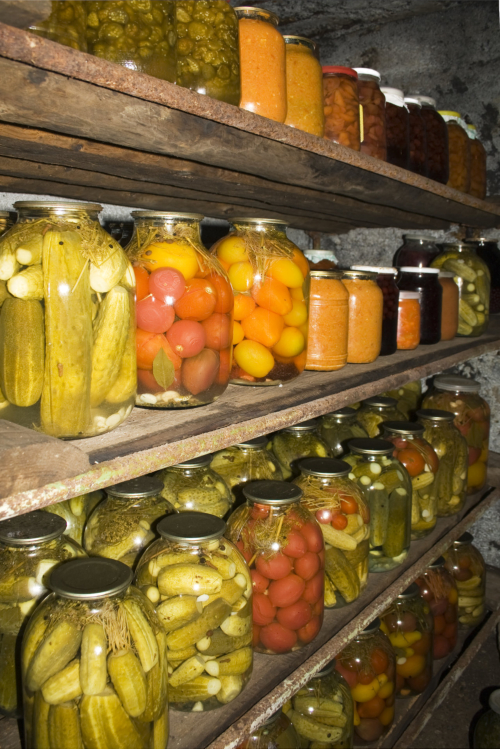
At the very least, this requires a canner, jars, lots of lids, accessories like jar lifters, funnel for filling the jars, and an instruction book. Some practice doesn’t hurt, so start canning now. Start with fruits (a jelly, jam, or applesauce), then vegetables, and finally progress to meats.
Pickling and Fermenting
These are two different processes, but the equipment often overlaps. Salt, vinegar, and spices are usually necessary for picking, while lacto fermentation can be done with a vegetable—often a root vegetable—and salt. Again, you will need some instructions, and it can’t hurt to get some practice.
Drying and Dehydrating
In the absence of electricity, you can dry items in front of a window or hanging from the eaves. Some have used their car on a hot day as a dryer.
Smoking and Salt Curing
This historical method of food preservation is not used as much today because we have access to better methods, but I’ve seen country ham sitting unrefrigerated in stores, so it works. Items like summer sausage and fish are often smoked and then salted to extend their shelf life. You can build your own smoker, but you will need a source of wood. Do some research to find out what woods in your area are recommended as smoker fuel.
Keep in mind that smoking for food preservation is not the same as the smoking done to add flavor to meat while cooking it for immediate consumption. The cuts of meat also differ.
A Note on Salt: Salt used in pickling, fermentation, curing and similar food preservation techniques should be acquired prior to the crash. A cheap ox of salt from Walmart won’t do. Pickling salt is sold in the canning aisle, but you can use kosher salt, sea salt, and other salts that do not have iodine and anti-caking agents in them. Himalayan salt is not recommended because the additional minerals in its formulation may interfere with the process, or cause cloudy brine or sediment.
Blade Sharpening Tools
If we ever find ourselves in a grid-down scenario for a long period, manual tools with blades are going to become far more useful than they are today. Whether you are butchering your own meat, harvesting your own grains, or chopping your own firewood, blades grow dull. Even a chainsaw chain needs to be sharpened. (I recommend the Stihl 2-in-one Filing Guide.)
You can get a variety of basic tools for touching up your knives, some of them with files or diamond blades at pre-set angles, but I prefer to pick the angle to suit the application. Something made for chopping, whether it is a meat cleaver or an axe, will have a different angle than a knife you use for filleting a fish or slicing an onion.
A basic Arkansas stone will get the job done, assuming you have some skill and a good eye. Consider the double-sided sharpening stones, which have a coarse or medium side and a fine side. Small ones can be carried to touch up your blade in the field. This is good if you are forced to butcher a fresh kill in the field and pack it out in sections. For home use, I prefer the Lansky sharpening system, which I use when I sharpen our kitchen knives and my pocket knife. This allows you to pick several preset angles, and anyone can be taught to use it to put a sharp edge on a knife in just a few minutes.
While you can use a stone or a puck to sharpen your axe, files are also useful, especially if the blade is badly worn or hit a rock. A flat bastard file will work for most tools, including the point of your shovel.
Small Engine Repair Kits
You can buy a spark plug gap gauge tool for less than two bucks, but few people have one or know how to use it unless they are mechanics. Most people just get a new plug.
After the SHTF, getting replacement engine parts could be much more difficult or even impossible. That includes spark plugs, oil filters, carburetors, fuel lines, gas filters, and spark plugs. If you expect to rely on a gasoline or diesel motor after the SHTF, I recommend you buy some spare parts. It is also a good idea to do your own maintenance now, rather than drop the device off at a local shop. That way, you can access YouTube videos and other instructional information that might not be available at the end of the world as we know it.
In addition to the list above, I would also consider a replacement pull start cord, air filters, starter fluid, and a carburetor repair kit. If your device has wheels, keep an inner tube on hand.
Motor Oil and Other Lubricants
Be sure to include motor oil in your planning. I believe I have 18 quarts of motor oil on the shelf, most of it 10W30. I also have a five-quart jug of the oil my UTV uses. A container of transmission fluid can also be useful. The ability to change the oil and other fluids on a small engine can keep it running reliably.
I’ve written previously about bar and chain oil and oil for 2-stroke engines. Grease is an important addition to your list of important lubricants. Keep a grease gun handy. I have an old oil can, not unlike the one they used on the Tin Man, a jug of hydraulic fluid, and cans of WD40 and spray silicone on my shop shelf. I also have multiple kinds of gun oil and grease.
Part two will be published later this week and includes a very important prep.