
Now that I am feeding ten beehives instead of the six or eight, I am going through sugar more rapidly. It almost feels like I am trading sugar for honey. That’s not exactly a bad deal considering I can buy sugar for about 70 cents per pound and sell honey for 10 to 15 dollars a pound. But it’s a reminder to harvest less honey in a prepping scenario where there is no sugar available, leaving the bees resources on which to live.
Every time I go to Walmart, I buy a few four-pound bags or two ten-pound bags, whichever is cheaper. When I go to Sam’s Club, I usually buy two ten-pound bags. I expect I had close to 200 pounds on hand before I started feeding. It takes 32 pounds of sugar per week to feed all 10 hives now, and when I make two-to-one syrup, that’s going to increase.
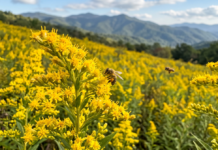
The bees are prepping for winter, just like we are. They are bringing in yellow pollen from the goldenrod, which is plentiful. They are getting more orange and white pollen and whatever nectar they can from the ironweed, asters, a few remaining cosmos, and other assorted flowers. The pollen will help them raise healthy fat-bodied bees to get through the winter, while the nectar, sugar syrup, and the leftover honey will give them energy to keep warm.
The hives are still packed with bees, and there are still drones inside, so they have not started kicking them out yet. A large hive can consume quite a lot of honey in a week, so I am feeding them about a gallon a week, and they are consuming it before I refill it.

Angry Bees
I have never been happier to own a full bee suit than last week. I had to tear down the hives and count the frames of brood so I could determine how many mite treatment strips to give each hive. (They get one treatment strip for every five frames of brood.) Because I don’t like to remove the supers and break into the brood boxes while they are producing honey, I hadn’t done a deep inspection of the hives since May. All the bees resented my efforts, but three different hives aggressively objected to my invasion of their space. I was puffing smoke like a grunt calling in choppers, but it didn’t matter. The bees were all over me.
Somehow, I—the guy who has been stung 17 times this year—survived unscathed. A bee even worked its way into my veil, but I was quick enough to crush her before she could sting me.
Normally, when a few bees are aggressive, I can walk 30 or 40 feet away and they return to the hive. Not this time. They followed me as I circumnavigated the exterior of my house. One pesky bee even followed me into the garage. At the other bee yard, I had to get into my car and drive away before I could remove my bee suit. They know winter is coming and want to protect their stores.
The good news is that several of the hives had no mites, but a couple and five or six. Knowing bees drift from hive to hive, I treated them all, just to be safe. Last year, I used Apiguard and lost several hives. This year, I am using Apivar, which has been effective for me in prior years.
Beehive Insulation
Because I have more beehives than last year, I cut some 2-inch thick Styrofoam insulation to fit into the hives. I will put a section in an empty super on the top of each hive to help them keep warm and then add a sheet of Reflectex under the lid.
I am also planning to take the two weakest hives and put them on top of each other, using a screened bottom board to separate them. Both hives are in double deeps, but one will probably be consolidated into one box before the winter. I’ll decide when I remove the mite treatments in October.
The advantage of placing one hive on top of the other is that the heat generated by the bottom hive rises and helps the smaller hive on top stay warmer. I’ve never done this, but other beekeepers report good results with the practice.
I’m going into the winter with ten hives and hoping to come out with at least eight. Some of this—such as the feeding and mite treatments—is up to me as a beekeeper, but much of it depends on the queens and the weather. The cold autumn is giving us a head start on winter hive prep, and I am taking advantage of it to bolster the hive’s health. We just have to hope it doesn’t signal an extremely cold winter.
Regardless of what the weather is and how many hives I have next March, my plans are to do some splits and breed some queens next spring so I can add a few more hives to my apiary next year. Maybe I’ll have enough to sell some nucs. Since the going rate is $200, selling nucs can be quite profitable.