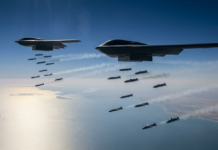

The United States and Israel have once again called Iran’s bluff, launching a massive air attack in broad daylight, killing its supreme leader and eliminating much of the Iranian leadership, while losing no U.S. military personnel or equipment, as of this writing.
So far, this appears to be a well-coordinated and effective attack targeting Iran’s Revolutionary Guard, missile storage depots, launch systems, and other military targets. While little video from Iran is getting out because of communication and internet restrictions, Iranians located around the globe are celebrating the death of the Supreme Leader and the potential fall of the regime.
Iran has fired on Israel—where one woman is reportedly killed and 120 injured—as well as U.S. bases in Bahrain, Kuwait, Qatar, Jordan, and the UAE (including strikes on Abu Dhabi). Iran has also launched attacks against Saudi Arabia. Significant damage and casualties have occurred across the Middle East, although there are currently no reports of U.S. military casualties.
What’s Next?
When Israel attacked Iran in 2025, the war lasted 12 days. It is yet unclear whether this one will be longer or shorter. That may depend on how quickly a new government steps in.
Before the U.S. and Israel decide to back off, they will have to do target assessment to determine how effective their strikes have been. There may be bunkers they want to hit again. I expect we will see a lull in a few days, followed by another round of attacks.
Iran is reported to have thousands of ballistic missiles, but the real question is how many launchers do they have? Knocking out one launcher may make it impossible to fire 50 missiles. And when Iran fires a missile, the United States can pinpoint its launch point and launch a counterattack to destroy it. I expect some ground-attack aircraft will be kept in the air to ensure a rapid response.
China and Russia
So far, it looks like China and Russia will sit this one out. No Chinese-made cruise missiles have attacked U.S. carriers. No Russian surface-to-air missiles have shot down U.S. or Israeli planes. The Russian navy ships that conducted exercises with Iran a couple of weeks ago are gone. If China did deliver its long-band radar that is supposed to detect stealth fighters to Iran, it has not made a difference in the war so far. (Although the Chinese may gain useful data from its deployment, no one knows if it was deployed or not.)
While these countries are not actively involved, you can bet they are watching, learning, gathering intelligence, and making assessments of what this means to them. Russia will look at it through the lens of Ukraine and Putin’s desire to take back the Balkans and other parts of the former Soviet Union. China is looking at it from the perspective of what it will mean if they attack Taiwan. You can bet the leadership of both countries is wondering if their bunkers are deep enough because it is one thing to sacrifice your soldiers, but another to put yourself in the crosshairs of a bunker buster bomb.
Iran tried to negotiate without giving anything up, thinking that what worked with Obama would work with Trump. They learned the hard way that that they had made a judgment error. I expect there are some recalculations going on at presidential palaces and government buildings all across the globe. Whoever Trump threatens next will take him more seriously, whether that is China or Greenland.
What You should Expect
Unless markets believe this is an easy win for the U.S., expect gas prices, gold, silver, oil, and other commodities to increase in price when markets re-open. If Iran mined the Strait of Hormuz, expect oil prices to stay elevated. Defense companies should also experience a bump as all those expanded munitions must be replaced in the U.S. stockpile.
But for most of us here in the continental U.S., not much will change unless the concerns about sleeper cells are realized.
My advice is little changed from my February 20 post, in which I predicted the war would start within ten days:
- Fill your gas tank and any spares
- Stay off airplanes
- Don’t travel abroad
- Stay close to home
- Stay off public transportation and void crowded locations
- Avoid government buildings
- Wear your EDC pistol and carry reloads
- Have a long gun in your car
- If you don’t have at least a few week’s worth of food at home, do a big grocery run, just in case
Keep an Ear to the Ground
At a prior job, we spoke about “ear-to-the-ground monitoring.” I guess the idea was you can hear the hoof beats before you can see the enemy approaching. That concept may be outdated, but at the very least, keep an eye on the headlines. Look out for any of the following events, which could be a warning of more to come or a broader attack:
- Large cyber-attacks and system outages effecting communications, commerce, banking, transportation, and energy distribution
- Terrorist attacks in the U.S. or Europe
- A sudden increase in lone-wolf attacks in the U.S. and Europe by men of Middle-Eastern descent, suicide bombings, and similar events
- Escalation of aggressive Chinese behavior in the South China Sea and threats towards Taiwan
If you are somewhere and something seems off, leave. If you see something suspicious, use that phone glued to your hand and call 911 to report it.
What I’m Doing
Here’s what I’m doing to be prepared for the unexpected consequences of our war in Iran: nothing, because I am already prepared.
I might do some more target practice, not because of this, but because it is supposed to be warm this week and I need to break in my new EDC pistol. Maybe I’ll get a haircut. I plan on feeding my bees, but more on that in my next post.
I hope your week is equally quiet.