
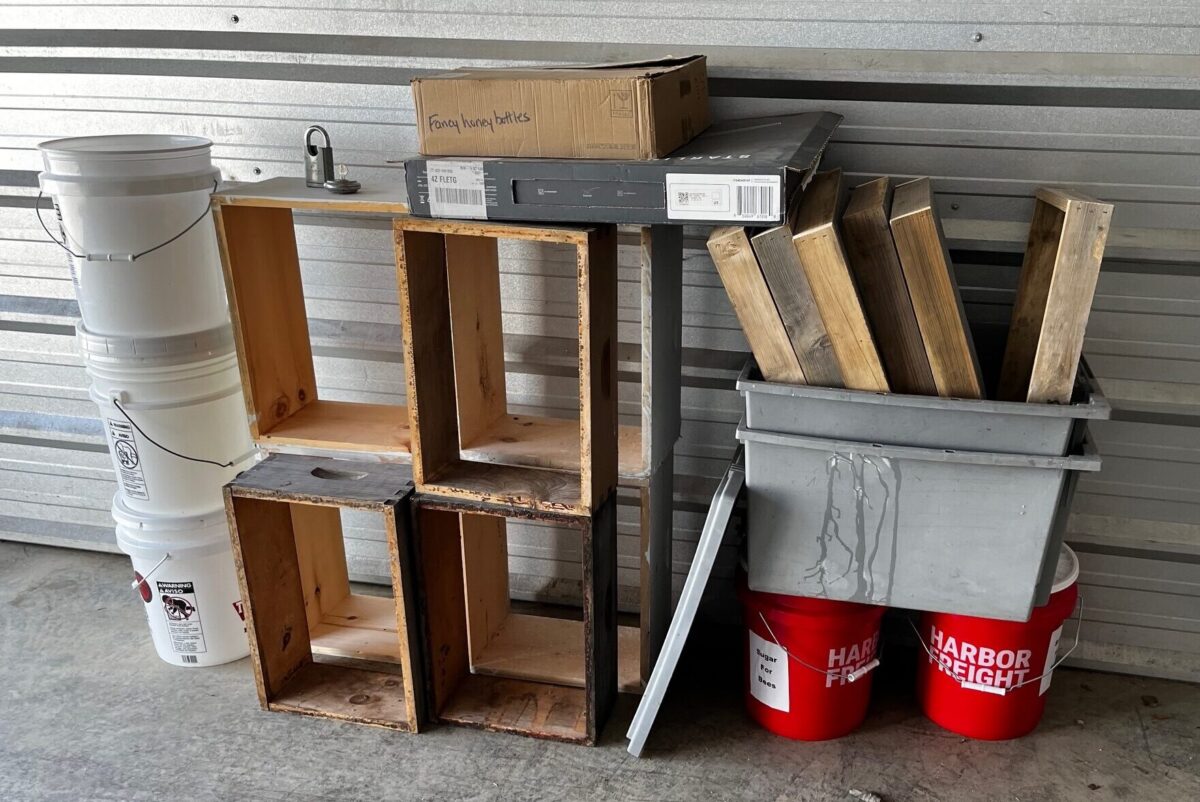
I am filling my storage unit up, one pickup truck load at a time. The first load was beekeeping equipment. Since we are only harvesting honey four or five months a year, there’s quite a bit of excess equipment sitting around the rest of the year, so some seasonal storage is nice to have. This includes the honey harvesting equipment, which I use twice a year but takes up floor space all year. I have gated buckets, decapper, and a wax bin, and related equipment. Plus, my wife told me I can’t buy my own electric honey extractor until I find somewhere to keep it. I’d say this qualifies!
My garage is currently home to five stacks of honey supers with drawn come (made from beeswax) in them. I don’t want to put wax in a storage unit that has no HVAC and probably gets quite hot in the summer. Because the supers will be on the hives starting in May and off by late August, I will avoid the high-heat months and can store them there all winter. And by storing them in what is the equivalent of someone else’s garage, I can use all the mothballs I want (to control wax moths) and not wince when I walk into the garage and am overwhelmed by mothball smell.
I’ve also moved things we don’t use but want to hang onto, like that old box of tax records, the ice cream maker we use an average of once every three years, and the contractor’s box that came off my last truck and I always thought I would do something with. Instead of turning it into a gun vault buried somewhere up the mountain, it’s in the storage unit—empty, in part because I have to find the key for it.
Prepper Storage
Because of that heat issue, I am not planning to store food in the unit, at least not in the summer. I have moved one of our three grain mills there. It’s our “emergency” mill. It’s not as nice as our Country Living Grain Mill—which I’ve owned since before Y2K and is the king of hand-crank mills—and not as easy to use as our electric mill. Low-hanging fruit also includes the #10 canner, in part because I have no empty #10 cans. I bought it used years ago, and my prepper friends and I canned all sorts of food with it in the early 2010s.
I also dropped our 55-gallon plastic drum off there. And the box of 100 cardboard USPSA targets is stored there. I took out ten, which should last me a few weeks. My progressive reloader, which I haven’t unpacked since we moved, also went into storage. Like the mill and the barrel, it might come in handy one day.
I have considered buying several of those thick mover’s blankets from Harbor Freight and creating an insulated spot for food storage. I figure a few layers of corrugated cardboard boxes would be good insulation on top. Throw the blankets over and let them hang down. That should help, with our cool nights helping dissipate the heat. But heat is the enemy of long-term food storage, so I will not risk it unless things look quite dire and we do a big stock-up. I may, however, put a thermometer in there so I can monitor the temperature.
Guns and Ammo
The contract says no flammable liquids or explosives. I’m not sure if that would include loaded ammunition. Of course, high heat is not great for ammo either. I may store a small amount, just enough to make an emergency reload for a few guns.
Speaking of ammunition, prices are slowly rising. Ammo I purchased for $12.95 a box and later for $13.95 a box is now $14.95 a box. I expect that will keep climbing, especially as the war continues. I have advised you to stock up. It may be years—if ever—before we see prices this low again. Remember this in six months when you buy a box of your favorite hunting rounds and are shocked at the cost.
I am unlikely to store a gun in the storage unit because it is not a secure location. I’m using a good lock, but it’s still a padlock on a metal building that anyone with a battery-powered grinder could cut open. In fact, if they rented a unit, they could go in at night and cut from their unit into the next in all three directions. I’m not sure they would find much valuable, but I guess that depends on how desperate or resourceful they are. If people are willing to have their kids climb inside a Goodwill donation box or steal from the thrift shop, they’ll stoop to anything.
More Coming
There’s plenty of room left inside—at least until after the next honey harvest. I’ll definitely store my empty honey jars there, and if necessary, we could store cases of spare quart and pint canning jars. The heat won’t bother them, but the question is, will we be able to get things like the canning jars home when we need them? It just depends on what the crisis is and how fast we act.
I can look at this as having redundancy in an offsite location, or I can look at as not having items handy. I’m trying to skirt that line so that what I do has more advantages than disadvantages.