Monday night was beautiful. The moon was a hand span above the mountains; bright, but a few days past full. The stars littered the sky, a net of silver pinpoints on a dark canvas, shining with a random mix of brightness. I was able to turn off my headlamp while the dog and I walked our normal late-night patrol. The landscape was deep shadows on a moon-swept background, and the soundtrack was provided by an orchestra of a thousand tree frogs searching for a mate. They were louder than the stream as it burbled across the front of our property. The owls, not to be left out, hooted at each other from one side of the valley to the next, causing the dog to tilt her head and listen closely to make sure they were not coyotes.
While I saw a pair of turkeys in the neighbor’s field earlier that day, we ran into no raccoons, possums, bobcats, rabbits, coyotes, foxes, or other mammals. I consider this proof our patrols work. We did see a couple of salamanders who share the dog’s watering hole and half a dozen woolly bully caterpillars that seem intent on crawling across our excuse for a lawn. They predict a cold winter.
This nighttime view of our rural world most people never experience. My wife, for one, is still intimidated by the great outdoors when it is dark. She could ignore the skunk that frequented the dumpster in the apartment complex she lived in while we dated, but she doesn’t want to see a pair of shiny yellow, green, or orange eyes looking back at her at 11:30 at night. I have to admit, the first time I saw it, it spooked me, until realized it was a raccoon.
Using the Dark for Cover
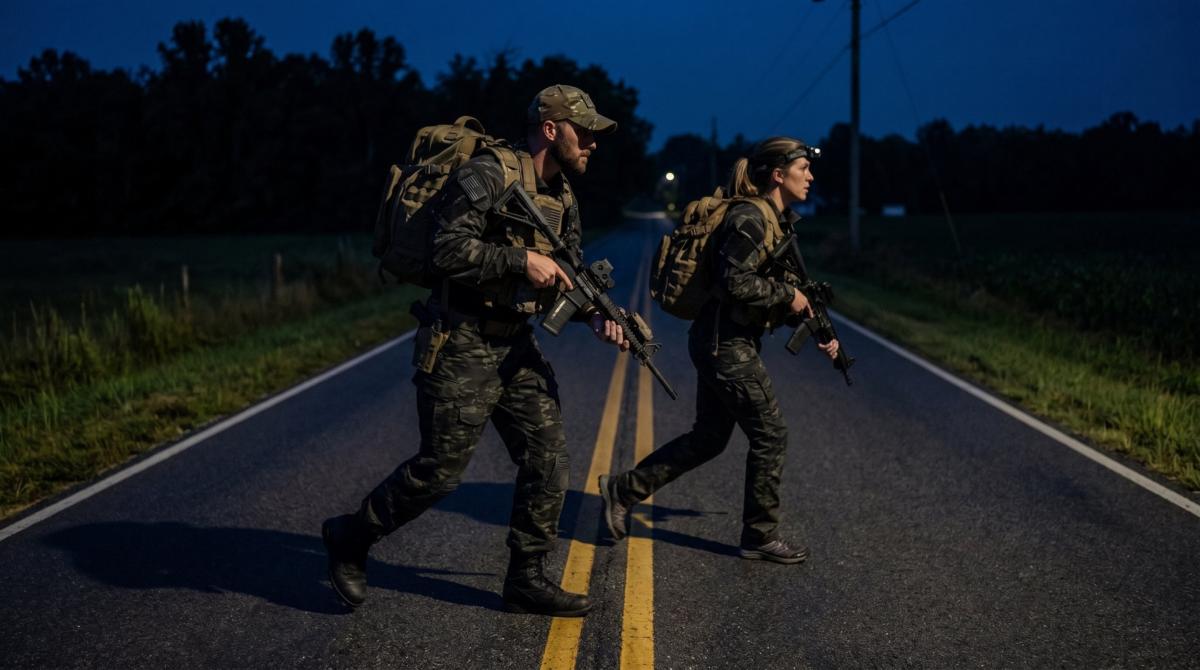
It is one thing to think about bugging out on foot and using the dark to conceal your passage; it is another to have the skills to do it and the experience of having done it. I’m not going to pretend my nightly dog walks are going to help me own the night, but I dare say it’s better than nothing. Here are a few things you should expect and a few things to practice if you ever plan to move under the cover of darkness hoping to avoid danger.
- Covering distance at night sucks. If you are doing it to avoid confrontation and stay hidden, expect your trip to take at least two or three times longer than it would if you were walking there on a sunny afternoon with no threats. You don’t want to step into a hole or slide off a rock you didn’t see and sprain your ankle. Neither do you want to bang your head into a low-hanging tree branch or walk into a thick blackberry bramble and get scratched. Hazards that are easy to avoid in daylight are more challenging at night. You will lack depth perception, and you will have to learn to look out the sides of your eyes rather than the center, which is optimized for daylight use.
- You are at risk. Yes, traveling at night can hide you, but it can also hide threats you might visually detect during the day. Your situational awareness suffers in the dark, and sound may even travel further. In a post-SHTF bugout from your development, there might be advantages to leaving the house undetected at 2 a.m. and covering enough ground to get away before you are spotted. But once you clear the area, you may need to walk the rest of the way during the day, reverting to night moves to cross chokepoints like bridges.
- Night vision technology is becoming ubiquitous. It’s not just in expensive night observation devices (NODs) or gun optics, but everywhere from cheap security cameras to drones and AI devices. You may not be as hidden as you think, and an adversary with NODs will put you at a severe disadvantage as you walk into their ambush.
- Navigation is more difficult. During the day, I can shoot an azimuth between three mountain tops or other landmarks, look at my map and know right where I am. I can then pick another geological formation and aim for it, knowing that I am going in the correct direction as long as it is in front of me. At night, those landmarks fail, even if you have night vision. Unless the moon is extremely bright, the only practical navigation you can do is to frequently consult your compass or follow a river, a stream, or a road. (These “natural points of drift” are common paths of least resistance and may be dangerous because a river or road are among the first places a hostile force will create an ambush or want to charge you a “toll” to pass.)
- Light discipline is critical. If you are using darkness as a cover, your eyes will gradually adapt to the darkness as the sun sets. One flash of light—say from a cell phone screen or a flashlight—will ruin it. It will also announce your presence. Believe me when I tell you, up the mountain in the dark, I can see an ATV headlight well before I can hear it. If you want to look at that map in the dark, you either need a red light filter, or you need to lay a poncho on the ground, throw a wool blanket over it, crawl underneath it, and turn on your dimmest penlight. That will still harm your night vision, which takes 45 minutes to recover, but it will not hurt your companions or be visible to potential predators.
- So is noise discipline: Noise discipline is important in daylight, too, but it becomes more important when someone might hear you before they can see you. We’re talking tactical things like sloshing canteens to the clank of your rifle against another piece of metal on your kit and less tactical things like kids who just can’t stay silent.
Overcoming the Dark
I do not plan to bug out. I hope I won’t need to do too much after-dark patrolling on the mountain or nighttime roadblock manning down in the valley. My nighttime chores can be done in the dark, but it’s much easier to ensure all 15 chickens made it back into their coop with a beam of artificial light than it is in the absence of light. Even accompanying the dog down to the creek for a drink is safer if I can see where I am placing my feet. And those glowy eyes I mentioned earlier? They won’t glow unless they are reflecting light. That is why I am a big proponent of headlamps.
In Praise of Headlamps
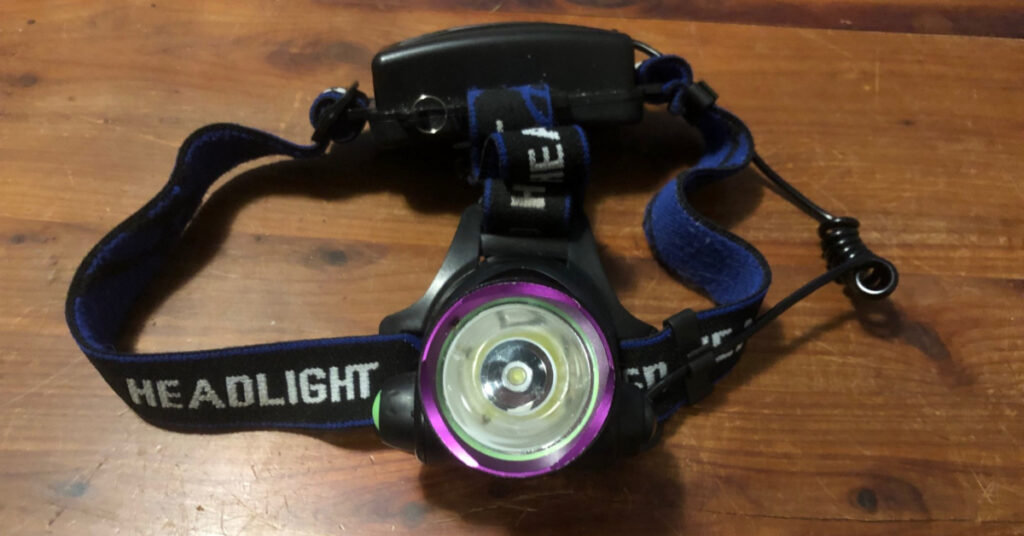
When you need to work in the dark rather than hide in the dark, a headlamp allows you to do so hands-free. That beam of light is always where you look because it is strapped to your head. My survival stash holds more than a dozen rechargeable headlamps of different brightness levels and a few inexpensive models that use AA or AAA batteries. The bright headlamps are for outdoor use, and the less-bright models are for indoor use.
If you wear a headlamp every day, as I do for night-time chores, it becomes second nature to reach up and turn it on or off, or cycle through the various brightness settings. You also adapt to the weight, which is far less than a pair of NODs.
Headlamps can be tremendously useful, and I have a set in every EDC bag I might grab. They are in my vehicles and hanging in the garage next to my muck boots. You should own a few pairs, too. Just be aware that when you are beaming 800 or 1,000 lumens around, you are not hiding. You may, in fact, be announcing your presence to everyone within half a mile.
Flashlights
I carry a tactical flashlight in my pocket every day. My wife has a small one in her purse. We both use them more than you might expect. Mine has five settings, and I keep it on the second lowest mode, knowing that I can turn it up bright, very bright, or Turbo with every click. But I don’t think I’ve found a need for Turbo.
The advantage of a flashlight over a headlamp is that its pocket clip makes it better suited for EDC and easier to point into nooks and crannies, like under the car seat or when you drop something and it rolls under a cabinet.
Tactical lights have come a long way in the past ten or twenty years, as has their ability to be recharged. Many current models are flat, so they don’t roll. Most can be charged with your phone charger or any other USB plug or socket. Several of my newer lights require high-discharge batteries because they draw so much power at their maximum brightness level, and LEDs just keep getting brighter and brighter.
Tactical flashlights are so good today that an $80 model is probably brighter and has a better run time than a $180 model was back in 2020. Buy one (or two), just be sure to buy a reputable brand and not a cheap piece of Chinesium that will never live up to its marketing claims.
Gun-Mounted Lights
Having a light on a gun you may need to defend yourself or your home is not a bad idea. And for people who claim it will give away your position, my response is, “so will your muzzle flash.”
Almost all my AR15s have gun-mounted lights, as do two of my shotguns. I own a TLR-1 that will fit any pistol with a rail, plus a pistol-laser, and a light and laser combo. None of them are mounted on my guns because I didn’t like the laser as an aiming point; I think red dots are more accurate for skilled shooters. I know some people swear by a pistol light, but I don’t; mostly because I don’t go anywhere at night, and when I do, I am wearing a headlamp. I let the headlamp illuminate the target and use the gun’s sights to aim at it.
On a rifle that is intended to shoot coyotes at night, to defend the homestead against marauders post SHTF, or for possible offensive purposes, a light is recommended. Think of it this way: You have to see your target to shoot it. More importantly, you have to identify your target to make sure you are not shooting a friend or family member. A bright white light capable of reaching 200 yards or more will help you do both.
Again, gun lights will ruin your night vision, draw attention to your location, and prevent you from hiding in the dark. But when you need one, you really need one.
Working and Living in the Dark
We all face the threat of the grid going down, whether for hours, days, weeks, or the 18-month figure I have heard bandied about quite a bit in recent times. If that happens, you will be far better off if you have experienced living in the dark before.
Yes, power outages have many disadvantages, from everything in your refrigerator and freezer slowly going bad to the inability to run your well pump. These can be overcome in multiple ways, including the use of generators that burn fuel and those that harness the sun, but none are perfect and all will likely require occasional use of a flashlight, headlamp, or lantern. For example, when we would run our generator to keep our food cold, we ran it two or three hours in the morning and another two or three hours in the evening. After we shut it off, we used headlamps and hurricane lanterns. (No candles, though; we have not yet had to resort to using candles.)
Get used to that now, while you still can throw up your hands in defeat, turn on the light switch, and go out and buy something better, brighter, or more suitable to your needs than what you are trying to live with. Experience is an excellent teacher. If you can’t learn from mine, get your own experience.
There may be times when stealth is called for, and the last thing you want to do is turn on a light that “highlights” your location. You need to practice this, too. Start with a night like I enjoyed Monday night and then repeat occasionally, because a warm summer night differs significantly from a cloudy, wet October night or a cold January night with two inches of crunchy snow on the ground.