
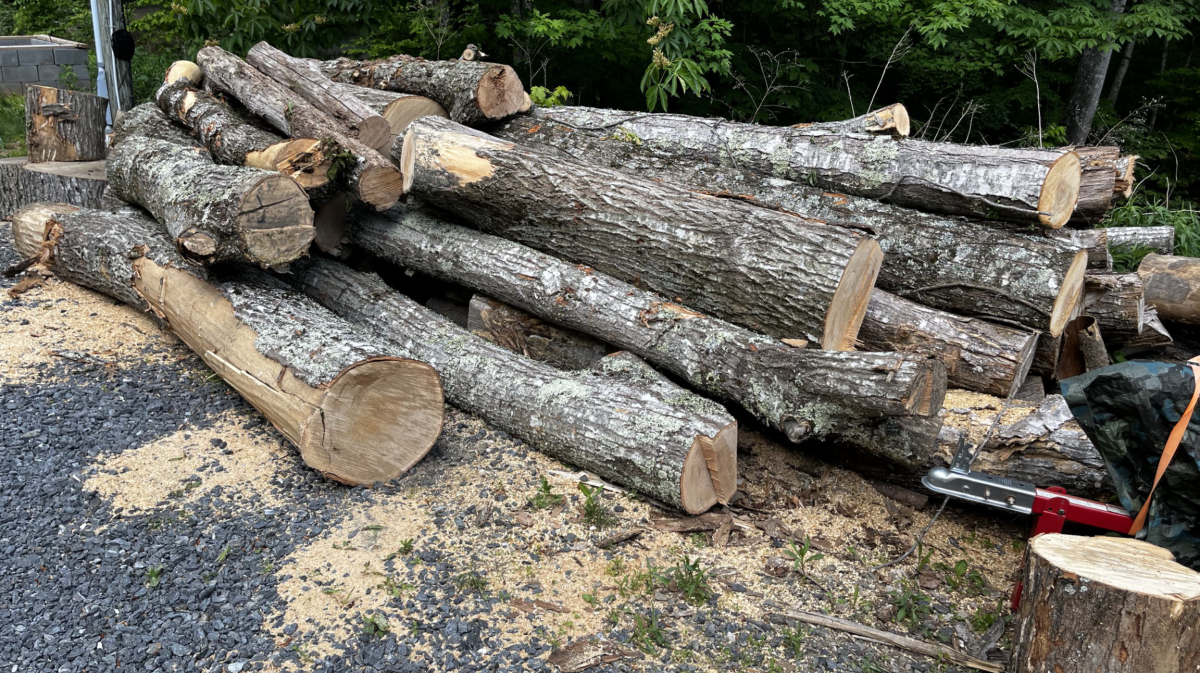
We had a crew of five professional tree trimmers in four trucks towing two trailers, a large chipper, and a backhoe out at the house the other day to take care of some trees that might otherwise fall and block the road or damage something else important. Of the five, three trees already had some dead parts, so it was just a matter of time before something gave. We considered it preventative maintenance.
The guys shredded the smaller limbs and the junk trees, but I kept the trunks from the oaks and what is known around here as a “hard maple,” but in other parts of the world is called a “sugar maple.” One big maple was a once-healthy tree that got worse and worse each year, until the top half was dead. We had it taken down.
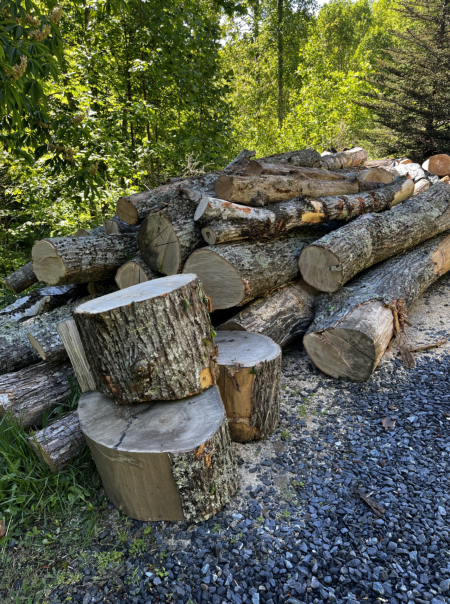
Suffice to say I now have more firewood that needs to be cut and split. How much? At least 2.5 cords, enough that I am may run out of room to stack it. Enough my wife made me promise not to get any more until I had finished this pile.
Like my to do list, the pile of firewood poles grows and recedes. I think she had been seeing the light as it dwindled in size, but now it is bigger than it has ever been. To me, that’s warmth all winter. To her, it’s cluttering up the landscape.
Knowing this was planned is why I bought the Stihl MS261 chainsaw.
Mountain Living
When we were looking for a retreat in the mountains, specifically one with a wood burner, my plan had always been to cut my own firewood. Turns out cutting it is the easy part. Harvesting it is difficult. Getting trees out of the woods can require heavy equipment, and my side-by-side is far from heavy. Yeah, the Polaris Ranger’s winch may pull a small or medium log out of the woods, but it won’t lift it or stack it.
My neighbor says he used to cut four-foot lengths and roll them down the mountain. I’m saving that approach as a SHTF fall back. Instead, I cut downed trees in place and drive down the mountain with rounds in the back of the side-by-side.
For the first few years we lived here, my “wood man” brought me cut and split wood and I stacked it, re-splitting it where necessary. Hurricane Helene changed all that by producing a surplus of downed trees. I’ve been cutting and burning wood from our land ever since, with the guy down the road (who has heavy equipment) bringing me a couple dump trucks full of logs he has cleared.
I learned early on not to accept tulip poplar logs. They may grow fast and make a tasty honey when the bees harvest nectar from their big blooms, but they burn like a match. When I put three or four tulip poplar logs in the stove, I have to add more 45 minutes later. Oh, they make heat, but they don’t make coals that will last the night. If we cooked on a wood cookstove and wanted to heat the griddle fast, tulip poplar would be just the thing. For keeping the house comfortable all day and night, they are lacking.
YouTube versus Real Life
I occasionally watch some guy cut firewood on YouTube. Most of them have nice machines to help them out. Even the ones without fancy firewood processors—which are mechanical marvels that cost more than my pickup truck—have splitters that put my basic Lowe’s model to shame.
But I’m not trying to make and sell 100 cords of firewood. I’m just trying to split five or six cords a year for us to burn. And if I take half the year to do that, well, I’m officially retired, so I got the time. It breaks up an afternoon that might be otherwise spent at my desk.
The Big Myth
Speaking of retirement, I always wondered how my dad claimed to always be busy when he first retired. Now that I’m retired, I find I’m always busy. Not that the weather has warmed up, there have been weeks where I’ve been too busy to read a book. My time watching YouTube is less than half of what it is in the winter, and because that’s after dinner, I often nap through it. (Naps are another advantage of being retried. Retired guys are expected to nap. I think it’s in the manual.)
Maybe when I am 78 or 83 I’ll slow down, but right now I am challenging the myth that retirement is when you take it easy. I did so for the first six or nine months, kind of decompressing from working for 35 years, but that was partly because of the COVID lockdown. Once things reopened, I got pretty busy. I have two volunteer “jobs” and one of them includes serving on the nonprofit’s board for the third year. At the same time, my bee yard is growing, and I’m working on three or four other projects and side jobs, only one of which is this blog.
Retirement Freedom
For those of you who plan to keep working at age 60 or 65 because you don’t know what you would do when you retire? Chances are you will find something. If you love the work or need the money, then by all means, keep working. But volunteers can say “no” much easier than employees can, and that can be freeing. You need me to help assemble picnic tables and playground equipment on a work day? Sure, I’m good with tools, and it sounds like fun. You want me to run the weed eater? Nope, I don’t like doing that at home, I sue as heck am not going to volunteer to do it.
What are they going to do? Fire me? I work for free!
If you retire and just sit around, that either shows a lack of imagination or I have to assume it must be what you want to do. I’ve got nothing against fishing or traveling, but there are plenty of good causes out there you can work on or for. I looked at volunteering related to hunger and at the animal shelter, and I chose instead to volunteer helping children. And while I cannot give thousands of dollars, I can give my time. At least, until my calendar starts filling up.
Things slow down in the winter; even volunteering. I know, it’s not summer quite yet, but part of me is looking forward to winter. But I gotta cut some wood first so we don’t freeze.


I will be getting a wood burning stove soon too. Can’t afford to heat with propane anymore after the harsh winter we had. Therefore I too will be cutting and stacking. May I ask what the cost was for you to have those timber trucks do that work for you?
We spent $3,000, and we’d gotten another quote for $3,800. It took the crew a full day. One of the oaks was almost four feet at the base, and two of its five primary trunks were dead. They had to climb it and cut it down in sections. I expect this was the expensive part of the job. It certainly took the longest and required the most man power.
In this case, the firewood was a bonus, not the objective. Keeping the firewood saved us money and saved them work because they didn’t have to haul it away and dispose of it, but we could never afford to hire tree removal guys to cut trees just for that purpose.
Thank you! I’ve got some work to do.
Comments are closed.